It was inevitable.

As an obsessive family historian and researcher, I knew someday I would have to seriously approach the question of what happened to my Polish ancestors who stayed in the homeland.
For over a decade, I’ve been restoring the severed Slavic branch of my family tree: Grandpa Hill’s family. We considered them our black-sheep. Some of my siblings thought it best to honor our grandmother’s stated desire to never speak of them, but I resisted. I couldn’t help it. When I looked in the mirror, I could see them looking back at me. I needed to know why we became estranged. They must have done something truly awful. But what awfulness could justify keeping children from knowing their grandfather’s story? We learn from our parents’ and grandparents’ mistakes, after all. Their hard-earned lessons are our inheritance. Repressing past stories silences important lessons.
For years, I thought my Anglo name was randomly chosen. I was in my fifties when I finally learned that my surname – Hill – is a translation of the “gora” in Gorzynski. Anyone in the 1920’s rustbelt Polish-American community would have recognized the code. My father and his mother chose not to pass it on to me when I was born in a Cleveland suburb, in 1958. Family Search and Ancestry led me to my correct surname, and my great-grandparents’ story. I’ve since traced their American journey backwards to their arrival at Castle Garden. Then, with the help of Iwona Dakiniewicz, a genealogist I met through the Polish Genealogy Society of America, I located all my family’s offshoots in Poland. Where once I barely knew grandparents, now I know at least three generations.
My father’s pedigree represents three different Polish cultural regions. Dad’s paternal grandfather was a Górzyński who was baptized in Górzno in Brodnica County, Kuyavian Pomeranian Voivodeship. Great-grandpa’s father and grandfather were baptized in nearby Bryńsk. Górzno public records document the 1859 birth of my great-grandmother, Franciszka Gólembiewska, in nearby Ostrowy. Her parents were married in Górzno, too. Her mother’s family, the Pruszaks, appears to go back several generations in this area. So far, I can’t say that for her father. Perhaps he was itinerant, as my great-great grandfather Górzyński was.
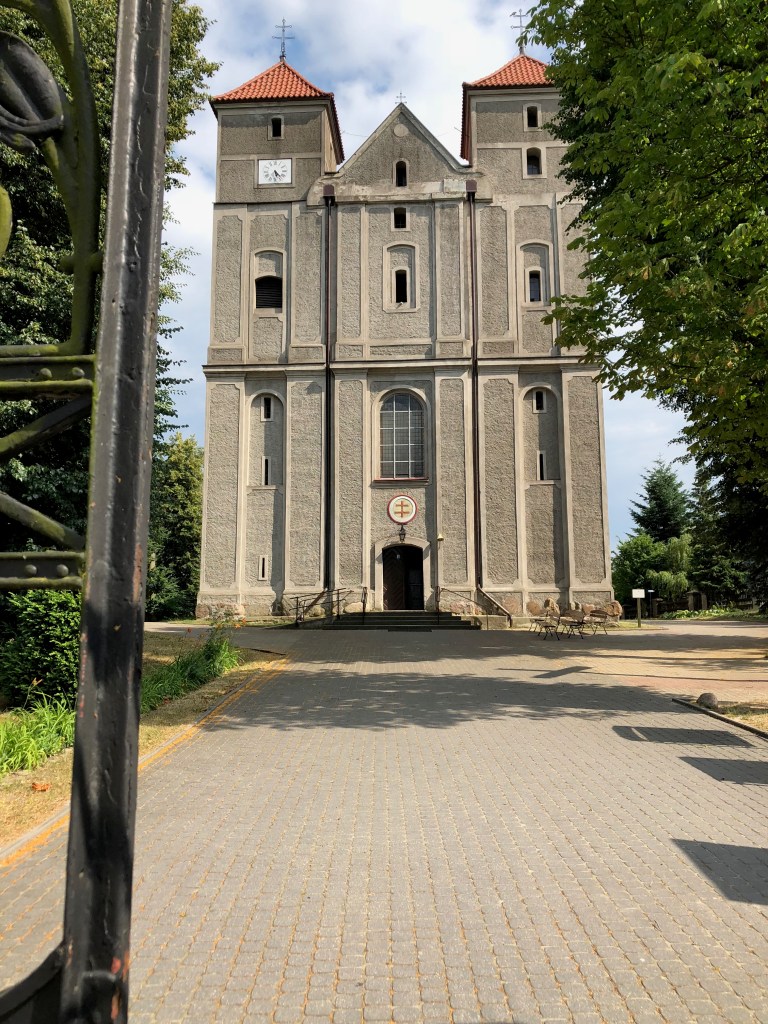
Elevation of the Holy Cross Church, Górzno, Poland. Photo taken by me June 19, 2018.
My grandmother’s father came from the Suwałki Region. He immigrated in 1881. Grandma’s mother was the first American-born child of immigrants from Pomerania. I’ve yet to visit these areas, but my husband and I were able visit the Górzyński homeland in 2018. With Iwona’s help, we saw some of what’s left in the villages of Bryńsk, Czarny Bryńsk, and Ostrowy. The lands around them are a landscape park now.

A view from our cabin at Hotel Dworek Wapionka, Górzno, Poland. My photo, taken June 19, 2018.

Taken at Pałac Myślęta Hotel, My photo, taken June 18, 2018. (This is not in the Górzno-Lidzbark Landscape Park; it’s forty minutes away from there, in Uzdowo.)
I fell in love with the landscapes of my homeland. To honor my ancestors’ lost memory, I wrote a novel in which I imagined rural Poland, one hundred and fifty years ago. This was a time when Poland didn’t exist, having been partitioned during the 1790s by its neighbors, Prussia, Russia and Austria. In West Prussia, where my family lived, Polish language, history and culture were prohibited. What was the breaking point that caused them to finally decide to leave this beautiful homeland? The Górzyński migration took them first to the Susquehanna Coal Company mines of Nanticoke, Pennsylvania. After ten years there, they moved to Buffalo, New York; a decade later, they resettled in Cleveland. My great-grandfather died in a house he co-owned with his sons. A nice ending to a tumultuous journey. Their story really isn’t remarkable, though; it’s the story of thousands of Poles who migrated to industrial America. Proud, hard workers, they didn’t always assimilate well. In fact, some planned on returning home. Some did. Americans, for the most part, weren’t kind to Poles. In 1901, when a “Polack” shot President McKinley at the Pan American Exhibition, anyone Slavic became even more marginalized. That infamous event ends the book. I’ve been marketing it under to titles: The Double-Souled Son and The Polish Assassin. I’m hoping a publisher or agent will help me decide which is better.
I’m three generations away from the Górzyński family’s migration – enough time to forget any Polish patriotism my family ever felt. I have no known relatives in Poland, though Polish records indicate some of them stayed. Did they survive? They were rural folk. In each of my ancestral home regions, villages were destroyed, if not by the Germans, by the Russians. What I’ve learned about my family’s villages keeps me up nights. One early morning, while sipping warm milk and honey, I remembered a similar autumn night, forty years ago. I was drinking tea with my grandmother, and I asked her if we still had family in Poland. Slapping her hands over her ears, as if I’d screamed at her, she shook her head. “It’s too horrible to tell.” After that, she clammed up.
I had a blissful childhood, thanks to her. I remained naive about the world’s evils well into adulthood, thanks to her. I don’t blame her for her choices, but I’m glad I now know what she kept from us. Because it’s happening again. The current Russo-Ukraine war harkens back to what happened in Poland, not so long ago. If we think of ourselves as our families, ancestors and all, we’ve all been forced to migrate before, and given our current climate crisis, it’s likely to happen again.
This is the first in a series of photo essays about the events in my Eastern European home regions after my great-grandparents left. I like to engage in a lot of other art forms while I’m working on a novel. Watercolors were significant to my process writing The Double Souled Son. These blog entries are process writings for a new novel. Tentatively titled American Limbo, the next Górzyński novel imagines my Polish-American grandparents’ coming of age in jazz age and depression-era Cleveland, Ohio. Based on what little my grandmother told me, the news from abroad during those years contributed to her decision to opt for total assimilation.
Each entry will briefly describe the family that left that given area, when they left, and what happened in those villages after they left. To sweeten the bitterness of forthcoming content, I’ll stick to facts alone, while including photos and paintings of my ancestral landscapes as they are today. I couldn’t imagine a more beautiful place.

A field in Czarny Bryńsk, Poland. Taken by me, June 18, 2018.
 Mary Louise Hill