
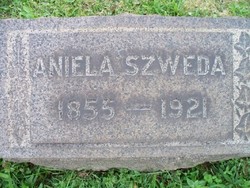
Jakup and Aniela Szweda are my Grandma Hill’s grandparents. They were the first of my Polish ancestors to arrive in New York harbor, on April 18, 1870, aboard a ship called the D. H. Watjen. I’m not sure how long it took them to get to Berea, Ohio, where these graves are located in St. Adelbert’s Cemetery. When we asked why our family settled in Berea, my father used to say that “Berea” meant “This is where the wagon wheel fell off.” I thought he was kidding. Seven years ago, I was contacted by an Ancestry DNA match – I’ll call her L – who knew a lot about this branch of the family. L told me that the Szwedas were part of a larger group that ended up in Wisconsin. (The name Szweda shows up several times in a list of Kashubians who settled in Canada, Minnesota and Wisconsin.) Only a few stayed in Ohio. Why? Perhaps my father wasn’t kidding, and Berea was where the wheel fell off. In the early 1870’s this rural community fifteen miles southwest of Cleveland offered a lot to immigrants looking for work and a new home. According to the 1911 installment on the United States Immigration Commission’s Immigrants in Industries part 24 Recent Immigrants in Agriculture (available in Google Books), “there is a large Polish population, both in the town of Berea and on small farms in the immediate vicinity, as a greater part of the employees in the stone quarry . . . are of that race. . . A large number of the Poles either own small farms of from 1 to 10 acres, with a house, and work in the quarries, or rent small tracts of improved land.” The report concludes “Because of the opportunities for outside employment and because most of the {land} purchasers have bought only small tracts, for which they could soon pay, the immigrants at Berea have suffered few of the pioneer hardships frequently experienced by immigrants in purely rural locations.” So, my grandmother’s migrant ancestors’ story had a happy ending, if they could avoid getting crushed in the sandstone mines.
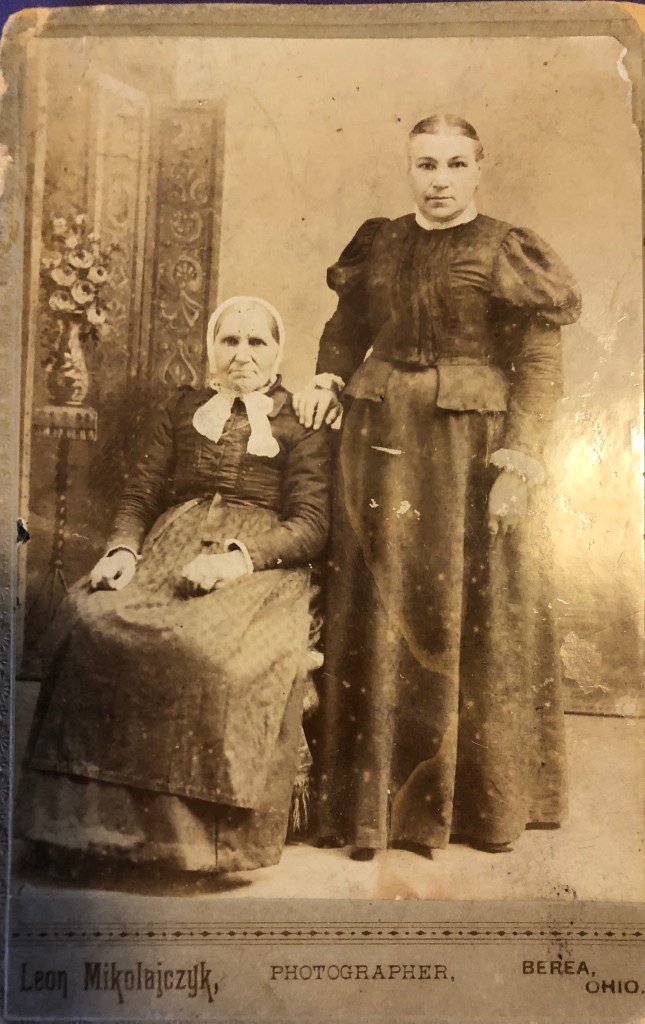
The standing woman below is Aniela, with her mother, Mary Januszik Skorcz, who also rests in the Berea cemetery.
“L” told me to check the Poznan Project database for their home in Poland. And sure enough, I found Jakup (Jacobus) and Angela 1865 marriage in the Catholic Parish in Sadki.

Through the Poznan Project, I could confirm the origin of several other Berea residents, including many of Jakub and Aniela’s siblings and cousins. If not from Sadki, they came from nearby villages. Did every resident of this corner of Poland migrate to Wisconsin or Ohio or where ever in America their particular cart lost its wheel? I don’t know. I imagine a stubborn few remained. The elders and their caregivers. Hopefully, they had all died off or moved away by 1939.
Thirty-eight kilometers west of Bydgoszcz in northern Poland, Sadki currently has 2,000 inhabitants. Wikipedia tells me this region has been part of Poland since the tenth century, when it was a royal village. Prussia occupied this area throughout the nineteenth century and into the twentieth. The Versailles Treaty returned it to Poland in 1919, but that only lasted until September of 1939. According to Wikipedia, “During the German occupation of Poland (World War II), the local forest was the site of executions of 86 Poles from Sadki and other nearby villages, perpetrated by the S.S. and Selbstschutz in October and November of 1939 as part of the Intelligentzaktion.”
May they rest in peace.
✟

Other than this Wikipedia image of St. Adalbert church there, I’ve found very few photos of Sadki.
✟
Notably, the church built in the 1870’s by the new Polish residents of Berea, Ohio was also called St. Adalbert’s. This postcard image from the church’s centennial anniversary book may have been sent to relatives back in the Old Country.

As with all of the churches built by Polish immigrants who settled in the United States, Berea’s St. Adalbert’s interior was lavish, as can be seen below. (The annotation says this is the interior of the “first” St. Adalbert Church. When, in the early 1930’s, it was determined that the steeple and the foundation of the original building needed extensive, expensive repairs, the Polish community in Berea opted to build a new church instead.)
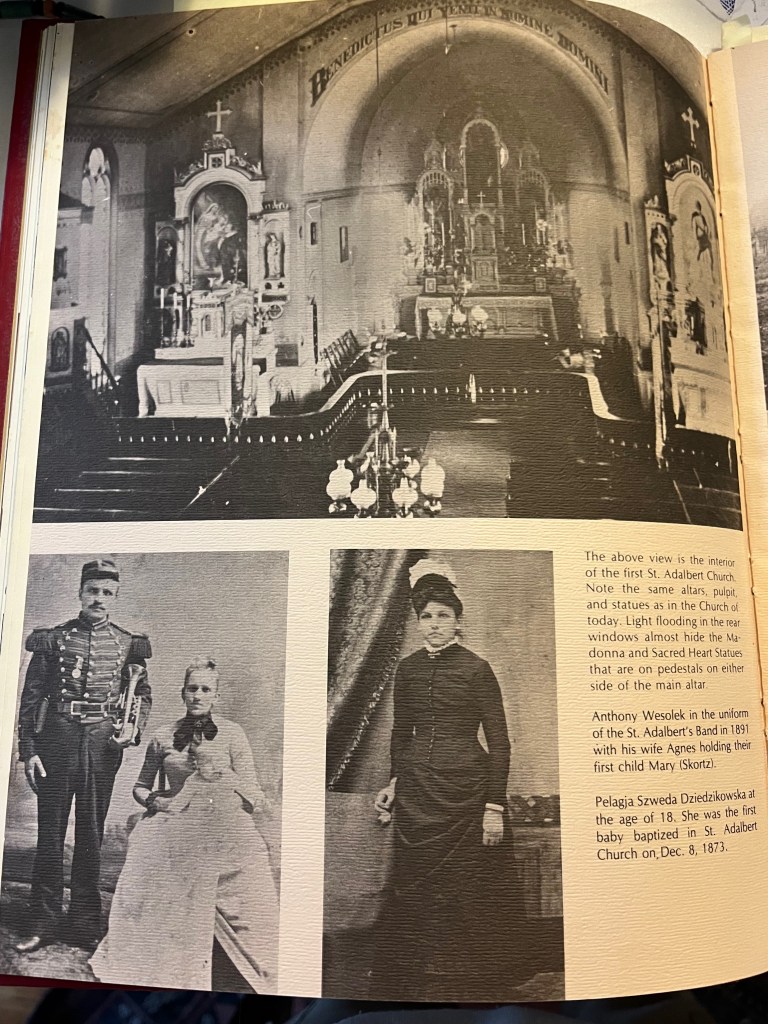
As the last annotation on the right says, Berea’s St. Adalbert’s first baptism was celebrated on December 8, 1873. The child was the first American-born child of Aniela and Jakub Szweda. That girl, Pelagja, married a Polish immigrant named Jan Dziedzikowski and had seven children. My grandmother, who was baptised Jadwiga Dziedzikowska, was their eldest.
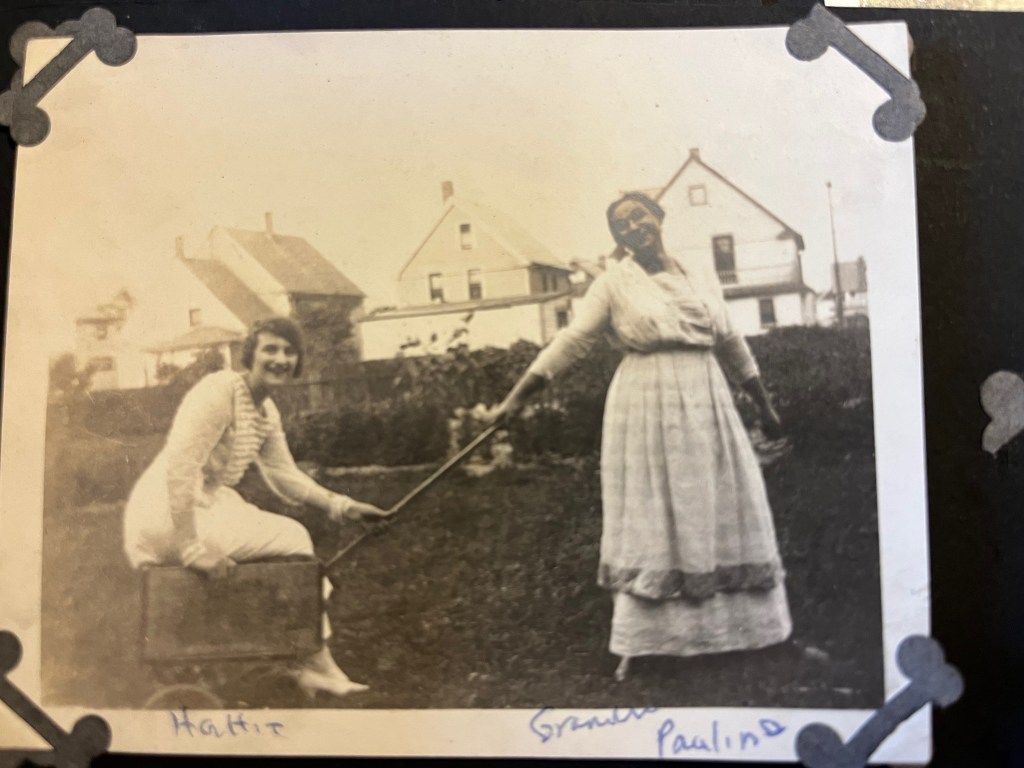
Pelagia (later known as Pauline) playing with her eldest child, my grandmother, Jadwiga (Hattie). Approximately 1917.
 Mary Louise Hill