Thanks to Iwona Dakiniewicz’s 2017-2018 research in Poland and my own subsequent research on the Polish database geneteka.com, I can say my paternal grandfather Joe Górzyński’s family lived in and around the village of Bryńsk in Działdowo County, Warmia Masuria from approximately 1790 until 1910 or so. Maybe longer. His parents lived in two of Bryńsk’s colonies – Czarny Bryńsk and Ostrowy Bryńsk – before they immigrated to the United States in 1881. Were their families originally from this area? Maybe. The name Górzyński may be derived from the nearby town of Gorzńo. But they may have migrated here, by choice or force, from another part of Poland. A distant Ancestry DNA match told me that his Górzyńskis were from an area closer to Warsaw, on the Vistula River. The two families – likely cousins – immigrated to the Americas at roughly the same time. Our DNA tells us we have a common ancestor who lived sometime during the 18th century.
Another American with links to Bryńsk, Kent Kolberstein, has a blog called Visit to Bryńsk that documents his visit to Bryńsk. His blog provides this Google translation of a description of Bryńsk’s history:
“Outline of the history of the village of Brynsk”
“First recorded in the sources, our Brynska name was “Brennitia” and comes from the year 1229. In 1410 the Teutonic Order used the name “Borausee”. Brynska areas were settled after the partition of Poland by arriving German colonists to Lidzbarka and its surroundings. The first houses were built along the channel of the river Brynicy. In time, expansive sustainable forestry led to the formation of large clearings, no locals whom they settled workers. Conducted at the beginning of the nineteenth century colonization of Prussia led to the creation of five large settlements of a common member Brynska ie. Brynska Krolewski (Royal), Brynska Szlachecki (knighthood), Brynska Kolonia (Colonie), Brynska Czarny (Black) and Brynska Fialka (no polish translation but it means “violet” in Russian). No area of sediment rapidly, operated brickyards, distillers, mill with a windmill and sawmills and inns. Brynska Szlachecki (knighthood)was at that time an important center industrial-commercial. Today in the area are preserved foundations of the tavern, a brickyard, and a kiln lime and tar. Currently, the village Brynski captivate the beauty and its rich history.”
Born in Bryńsk, my 2X great grandfather was baptised Johann Górzyński at the Catholic church in Górzno. The eighth child of Franciszek and Jadwiga (Renska)’s eleven, and the sixth son, I’d wager Johann couldn’t count on inheriting much of the family fortune. He became an itinerant carpenter. In 1854, he married his first wife, my great great-grandmother Julianna Falkowska. They had two boys, Jan and Marian (my great-grandfather), before Julianna died. A widower at 29, Johann remarried Ewa Lampert and returned to his traveling profession, producing thirteen more children in various villages throughout Masuria while, apparently, his two eldest sons remained in Bryńsk and Czarny Bryńsk. Johann died, around 1891, possibly in Mroczno. In 1895, Ewa and her children moved to Chicago. My great-grandfather’s half siblings had many children, some of whom are also trying to rediscover the Górzyński story. On first encountering the current generations of Johann and Ewa’s kin, I felt a bit like an interloper. Most of them knew their shared ancestors were a great-great grandma named Ewa Górzyński and her husband Johann aka Jan. They didn’t know Ewa was a second wife, and Johann had two elder children from another wife. Our DNA helped verify this. I’m especially grateful to my Górzyński third cousins Joanne and Paul, who corresponded with me about our DNA relationship. Together, we’re mapping out the story of the Górzyńskis in America.
My great-grandmother was Franciszka Gołembiewska, born up the hill from Czarny Bryńsk, in Ostrowy (also known as Ostrowy-Bryńsk). She was the eldest daughter of Thomas Gołembiewski and Anna Prusak. In her initial research in 2017, Iwona found several significant Gołembiewski records, including five of Franciszka’s sibling’s births and marriages, with husbands’ birth places, parents’ names and significant dates.
The fates of the Górzyński and Gołembiewski families summarize several of the choices made by Poles living under occupation in the late 19th and early 20th centuries.
The Wikipedia article “History of Poles in the United States” says that” Between 1870 and 1914, more than 3.6 million people departed from Polish territories (of whom 2.6 million arrived in the U.S.)” According to my Ancestry and 23&Me DNA matches, several Górzyńskis, Gołembiewskis, Prusaks, and Falkowskis ended up in Nanticoke, Pennsylvania; Buffalo and Rochester, New York; Chicago, Cleveland, Wisconsin, New Orleans, and Los Angeles. I have a few 4th cousins in England and Canada.
While the Górzyńskis scattered throughout the English speaking world, only two of the Gołembiewskis followed them. Others remained in Europe. One great-aunt, Josephine, married Franz Amenda in 1890. Recently, I discovered another tree on Ancestry that named Josephine Golembiewska and Franz Amenda as great-grandparents. This tree featured a photo of their daughter, Honorata. This name alone captured my attention: my grandfather’s eldest sister was an Honorata, too. And I thought I detected a resemblance between Honorata Amenda and my great-grandmother. I reached out to the researcher, and after a few exchanges, we both agreed we’re third cousins. The Amendas moved to Essen, Germany, probably before the first world war.
A few of the Gołembiewskis stayed in Poland. 2X great grandpa Thomas died in Ostrowy in 1895. My great aunt Julianna Gołembiewska married Johan Bartnizki in Bryńsk on November 22, 1903. A year later, her mother (my 2X great grandmother) Anna Prusak, died in Ostrowy. Julianna’s husband Johan died of old age or heart attack in 1944 in Dzialdowo. She died three years later, also in Dzialdowo.
The city of Dzialdowo is thirty three kilometers from Bryńsk. Its Germans name is Soldau. Early in World War II, the Nazis built a concentration camp there.
Flashback: It’s 2018, I’m standing knee deep in Lake Piaceszno, thirty kilometers west of Dzialdowo. A pristine lake with a stunning beach, it once provided the setting for a Prussian hotel. An odd place to be born. But according to my great-grandfather Marian’s baptismal record, he took his first breath by that lake. So in 2018, I ignored Iwona’s warning that there’s nothing much in Piaceszno and insisted it be one of the stops on our ancestral tour.
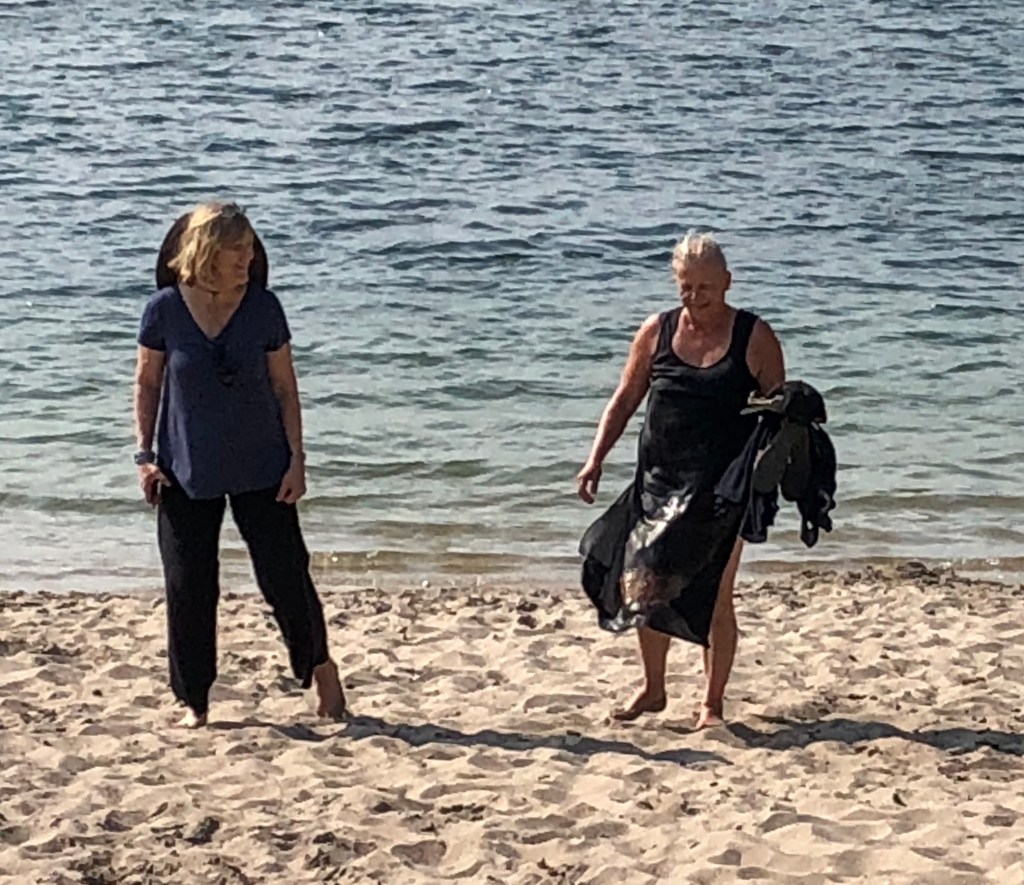
It was a sunny late spring day. We’d been driving around for hours. We pulled into a parking lot and looked around. Across the road from Lake Piaceszno were fields; behind the lake, forest. Mid-afternoon sun glinted on the rippling water. It was hot, and we’d been driving for a few hours. Without a second thought, Iwona dove in, totally clad. I wanted to join her, but, conscientious middle-aged American traveler that I am, I was wearing pants with a money belt underneath them. All I could do was roll up my pants’ legs and wade in. After a brisk little swim, Iwona joined me in the shallows, and we walked together to the beach.
“I couldn’t control myself,” she said. “This lake is perfect.” I agreed. I was smitten by the beauty of the land the Górzyńskis had left behind. As if reading my mind, Iwona said: “You know, your family didn’t want to leave here. They had no choice but to go. You have no one left here.”
It took a few years for me to understand what she was telling me.
This past summer, I read about some mass graves discovered near Działdowo. 17.5 tons of human ash were found. Officials estimated that least 8,000 were interred there. The BBC says “The bodies are thought to have been dug up and burned in a Nazi operation to hide traces of their murders. The Nazis murdered Jews, political opponents and members of the Polish elite at Soldau.”
An early report said these ashes included the remains of residents of the surrounding villages. I recently found additional evidence to confirm that, on a Facebook page I follow called Przystanek Górzno (roughly translated “Bus stop Górzno.”) On September 1, 2023, their commemoration of the Nazi invasion of Poland was the text of a monument erected in the middle of the Bryńsk square. Though FB’s translation was far from perfect, the meaning was clear. It seared into my heart. It described September 1, 1939 as a pleasant late summer day. No one in Bryńsk knew what was happening in other parts of Poland. A German soldier or two appeared, for what seemed a routine inspection. No one suspected. But the next day, German troops appeared and rounded everyone up, led them into the woods, and executed them. A few escaped and hid in the basement of an old schoolhouse.
Yet, great-aunt Julianna and her husband survived the war. They were both 70 years old when they died, apparently of natural causes, in the city of Soldau. Johann’s profession on his 1944 death certificate was listed as “laborer.”
✟
Today, Czarny Bryńsk houses the headquarters of the Gorzńo-Lidbark Landscape Park. A few houses. Farms. Lots of fields. Woods. Rivers. Lakes. Driving there, the roads weren’t good. Iwona feared for her tires. Finally, we came upon a sign, and I demanded that we stop. Regretably, I didn’t take a photo of the sign. This image was posted on August 18, 2023 at Przystanek Gorzńo:

“That building,” Iwona said, pointing to the wooden cottage. “Dates from the time your family was here.”
I examined it as closely as I could.

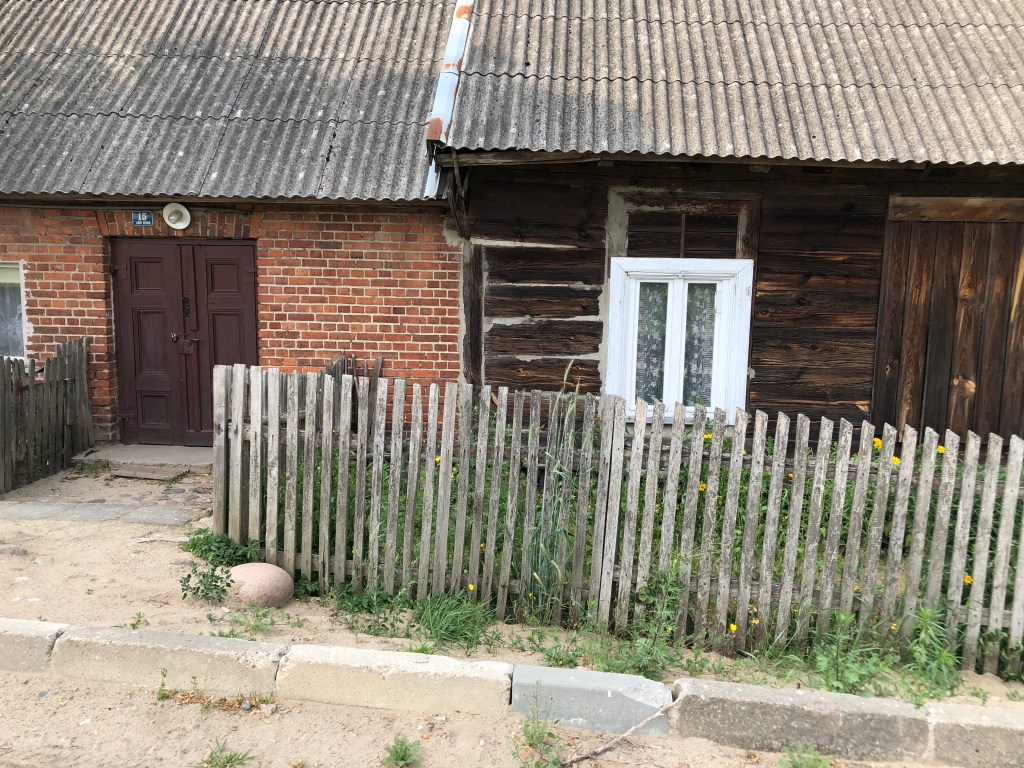
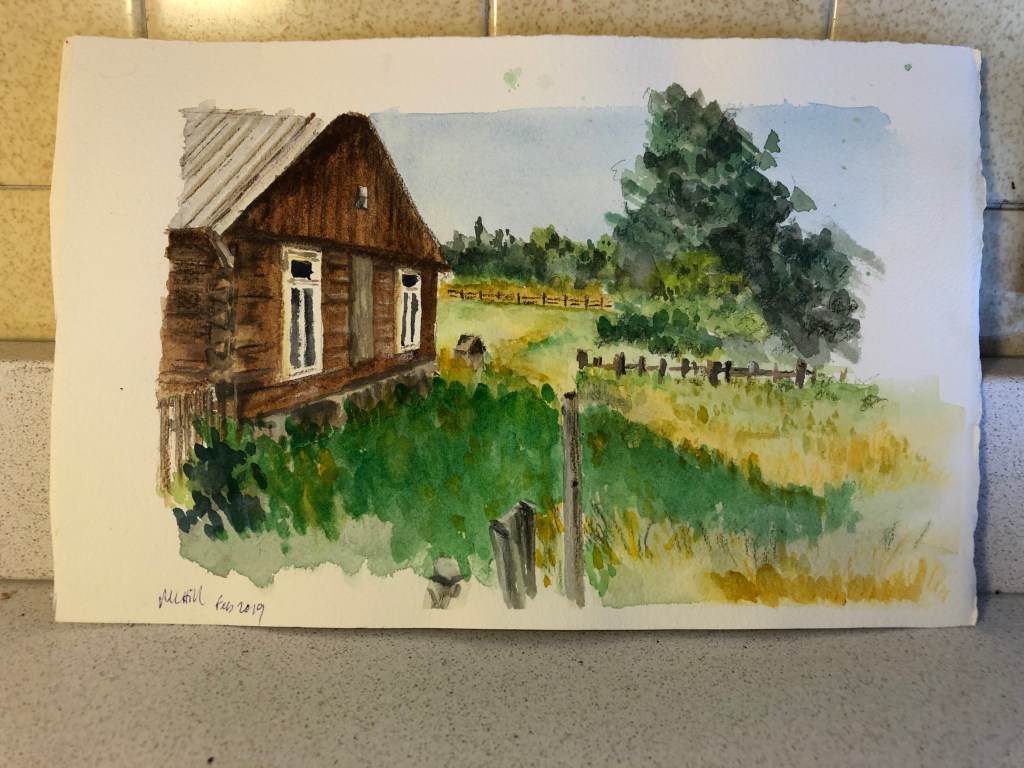
On that trip, we also visited Krakow, Warsaw, Toruń, and Gdańsk, as well as my husband’s grandfather’s birthplace of Turza Wielka. (Only twenty-six kilometers from Piascezno.) Once back home, I obsessed over these photos, especially those of that old wood cottage in Czarny Bryńsk. My Górzyńkis were carpenters, after all. Perhaps they helped build this relic. Finally, I painted a watercolor of it.
On the Gorzńo Facebook page, this house gets featured often. It’s obviously a landmark for those who know the area. People tell stories about, the most common being that it was a schoolhouse, a long time ago. Does it have a basement? I don’t know.
✟
 Mary Louise Hill