Thanksgiving Reflection #1: Mom’s Stuffing – a recipe.

My first room in Syracuse, 1985.

I’m experiencing my “year of firsts” after the death my mother. Mom passed away on December 25, 2020. That’s right: Christmas Day. I could write a whole article on the Curse of the See-Sawing Meaning of Christmas Day in my family. I won’t. You might be able to figure it out if I tell you that this year, my 27 year-old nephew Danny (who was born on Christmas Day) and his girlfriend are expecting a daughter, due on Christmas Day, the first anniversary of Mom’s death.

But back to my year of firsts. Thanksgiving. I was dreading this Thanksgiving. Preparing a 20 pound turkey for a large group was sure to bring back many memories, some painful. As it turned out, Phil and I participated in a Thanksgiving Eve COVID-friendly food exchange with Phil’s son and daughter-in-law, her mother, and her aunt. We exchanged our favorite side-dishes. Each attendee received a few cups of Mom’s stuffing. I baked theirs as a casserole. I baked our stuffing portion Thanksgiving day, under a five pound turkey breast. Phil and I ate alone, with the cats. Our solitude eased the pain. As did the stuffing. Making only the stuffing, I found myself engaged in a ritual that honored the time I spent with my mother on Thanksgiving. Today, I realize how grateful I am for stuffing.

I was the eldest child living at home on August 10, 1978 when my father suffered a near-fatal heart attack in our living room. Mom resuscitated him with CPR. He never recuperated. Dad died December 29 of that year. He was 51. Mom was 50. She and I were always close, but those years, we grew closer. A student at Cleveland State University with two jobs, I did my best to help her negotiate her own grief and the grief of my three younger siblings. (We had another elder sibling who was grieving alone at another university.) While many resorted to excessive drink, I did not. I became anorexic, but that’s another story. Mom leaned very heavily on me during those years; I helped with housework, cooking. If she had no income or fell short, I paid bills for her.

I’m not sure any of us were fully mended in 1985, when I left for Syracuse University’s Creative Writing Program. Mom was remarried to a patient man named Bill, which added six more daughters to her clan. Mom escorted me to Syracuse twice: first to help me find a room in the house of a young, female lawyer. Second: to help me move. Her oldest and best friend, my Aunt Jean, came along. Jean presented me with a soup pot as my going-away gift. “You’ll always be fine if you have a pot to make soup in,” Jean declared. She was right. I still have it. After I was secured in my new home, we all went down to my mother’s father’s family farm in Stowell, Pennsylvania. We stayed with mom’s aunt and uncle for a few days before Mom and Jean headed for Cleveland, and I returned to Syracuse. My mother cried. Probably because I did not. I was eager and ready to go.

I never moved back to Cleveland. Except for the four years during which I lived in Ankara, I spent every Thanksgiving that I could with my mother. The Thanksgiving routine became part of me: unless I-90 was snowbound – and if it was, Mom insisted I stay in Syracuse, or Buffalo, or where ever I might live at the time – I would drive on Wednesday. The years passed and my Cleveland-based siblings’ lives became more demanding, so I was often the only person with Mom the night before Thanksgiving. I always brought a bottle of wine. I am grateful to both of my husbands, first Bill and now Phil, for agreeably joining me on these visits. Both enjoyed Mom – Katie, to them. She was very good company. On Thanksgiving Eve, she and I sipped wine together while we broke the dried stuffing bread into the roaster. (How much? Oh, about two loaves’ worth.) Also the night before, we sauteed an onion with a few sticks of celery and some garlic, cleaned out the bird, boiled the giblets. Retained the broth for the stuffing, strained the giblets, and cut them up for the cat. We laughed a lot. Those were sweet evenings. The following mornings were pleasant too, when we rose together, made bacon and eggs for whomever was there to eat them, then readied the bird for the oven.

As she aged, Mom could not stand for long because she had spinal stenosis. So, she sat at the kitchen table with a loaf of good bread, fruit preserves, a slab of butter, and a cup of coffee. Each year, she spent more time sitting at the table. She monitored my actions. By the time her dementia was noticeable, I knew the basics, but I always had to check with her for the finer details. No matter if she was hallucinating a man pushing a lawnmower across the neighbor’s roof, or a knight chasing a giant golden chicken around the backyard, she could always tell me how to make stuffing.

As I gathered the materials for my stuffing this year, I felt blank. I found myself googling how to make sausage stuffing. I found a recipe that looked a bit like Mom’s and suddenly realized. I didn’t need a recipe. My Mom’s recipe was my inheritance.

Phil brought ciabatta bread from the co-op. As I sliced it and lay it flat on cookie sheets, I knew my Mom was with me, and she was a little aggravated that I was going to make the stuffing and not put at least some of it into a bird. It’s going to be very bland. You’ll have to work hard for the flavor. I had chicken broth I’d made from the remains of a whole chicken a few nights before. That will help. Still, it’s not enough.

Mom was disappointed too, to see the sausage from the co-op was precooked. We sipped some wine, stripped off the sausage’s thin casing, cut it into pieces, and sauteed it enough in a little olive oil to make a juice. Removed the sausages, then sauteed a large sweet onion in its drippings with some garlic and celery. Always olive oil. A little butter would help! I couldn’t argue.

The next day, continuing the ritual, those memories of mom continued whispering in my ear: Wash your hands, and keep washing them as you work. You always make a mess of things! I washed. Between each stage, I washed again, rinsed well.

With my hands, I mixed the bread crumbs with the sauteed onion, garlic and celery. Added the cooked sausage. Cracked one egg into it. Only one! (She always reprimanded me, when I reached for the second.) My fingers worked it into the mix.

Then I poured a cup of the warmed giblet water into it. You never know how much you’ll need, so have at least two cups more ready. It doesn’t matter if some of it is cold. I added the rest slowly, until I had no more crunchy pieces of bread. I smooshed, started to mush. Don’t let it get too mushy! she scolded.

In those latter years, when Mom needed a walker, then a wheelchair, I always realized, too late, that I had forgotten to set my seasonings out. She’d be sitting at the table, coffee in hand, unable to help. My gooey hands left bready goo all over the cupboard door, the poultry seasoning container, and the salt and pepper shaker when I went to get them. Mom would shake her head and mutter, Mary Lou! This year I had my poultry seasoning, salt and pepper ready before I did anything else. Once the stuffing was ready for the seasoning, I started adding, first a tablespoon of each. Then a bit more poultry season. How much? So much relies on taste! Mixed it in with my hands, then we both tasted it. Mom knew the adjustment every time. More poultry season and salt! Taste again. Mom had the final word. Our last few years making stuffing together, I had to bring the roaster full of stuffing over to her for her approval. Her quivering, arthritic fingers would pick some out, raise it to her lips. She’d nibble. “That’s good Babe,” she’d say. “I think you got it.” Then she giggled that silly laugh of hers, and urged me to sit down and drink coffee with her.

I reminded her we still had to stuff the bird and get it in the oven. 375 degrees, I believe. She let me handle the bird. She really didn’t like touching raw poultry. She didn’t like the taste of turkey, either. So it was my job to make sure our bird was clean and buttered inside and out, before I started stuffing. I stuffed both ends and bound them carefully. Secured the openings. I always used a cooking bag. Mom held it open while I slid the stuffed bird in. That was a feat, believe me: we rarely had a bird less than twenty pounds.

It was usually around that stage that we always realized we needed the roaster – which still had plenty of extra stuffing in it – to cook the bird. The extra stuffing went into casserole dishes, dotted with butter. One of us cleaned the roaster. The turkey went in. The extra stuffing joined it, for the last 45 minutes.

Around then my siblings would begin to appear, Mike with his pies, Chris with salads, rolls and home-made blue cheese dressing, Nancy with the potatoes. Vegetarian for Dan. Even after Mom’s second husband died, his daughters brought their families. Partners, spouses, children. Dogs. Grandchildren. A busy house. That was when my mother was happiest.

My stuffing this year was extra special, even though none of it saw the insides of a turkey. As I was preparing my materials, I realized I had no poultry seasoning. None. Mom scowled in my head. “Don’t you dare go to the store,” she said. “You can make it.” I had never made poultry seasoning before. I googled it. The recipe I found had nutmeg in it. Sounded interesting. I used the proportions of rosemary, thyme, pepper, celery and onion powder, and salt that it called for. And sage.

It didn’t seem like enough sage. It isn’t, Mom whispered. Use more. I’ll tell you when to stop.

I listened. She told me.

It was perfect.

Mom and I, outside her front door, circa 1990.

Doubly Cursed: Process Paintings

I’m working on what I hope will be final drafts of my novel. The book is called Doubly Cursed. I’m working on a concise summary, since I’m preparing to pitch it at the end of next week. Once I’ve concocted one, I’ll include it.

The first half of the book is set in late 19th Century Poland. The area I’m focusing on was in West Prussia then. The village is Czarny Bryńsk, which is the last place my Górzyński ancestors lived before they immigrated.

The main characters? The Górzyńskis, of course. Absolutely fictionalized. Mythologized, even.

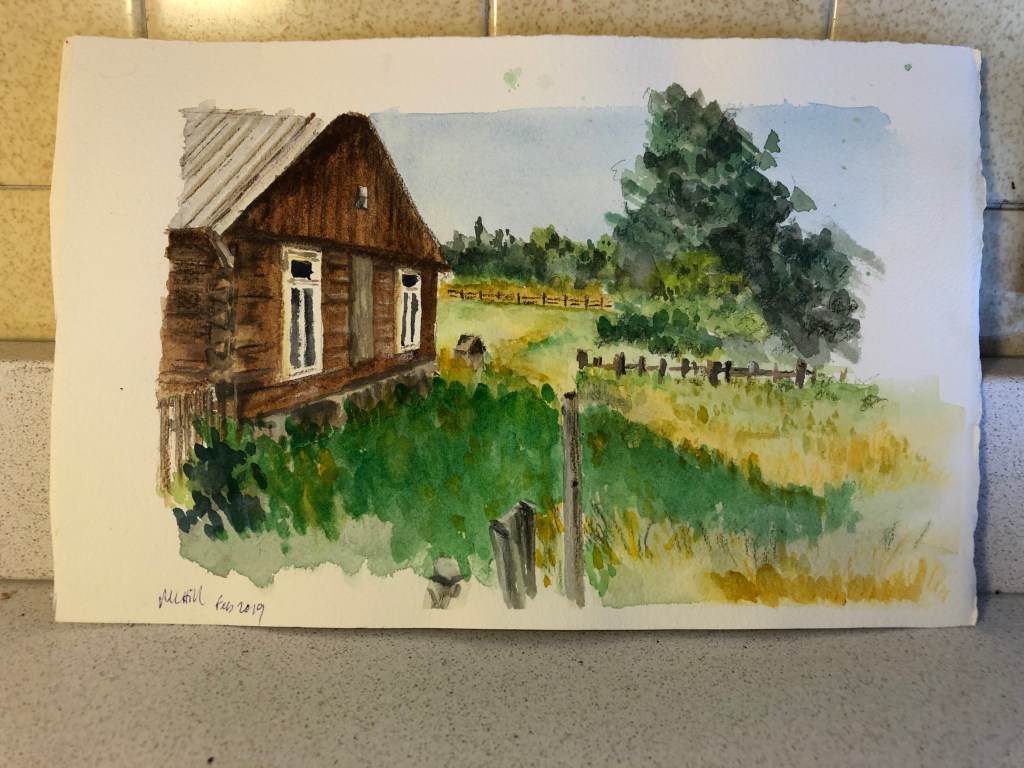
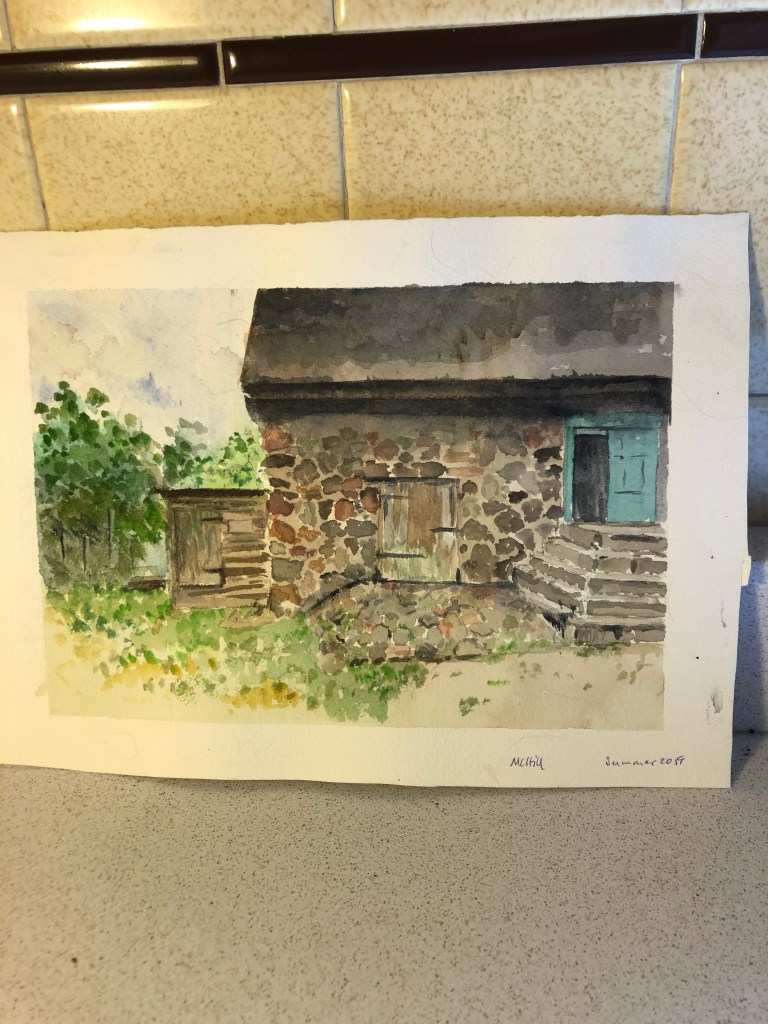
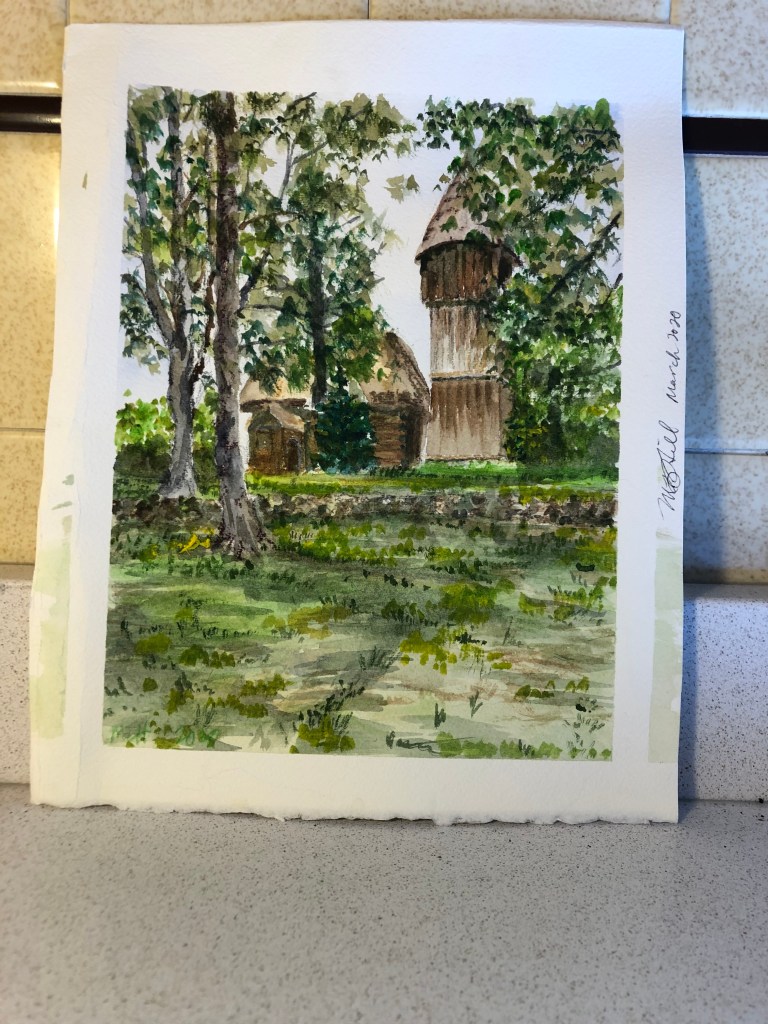
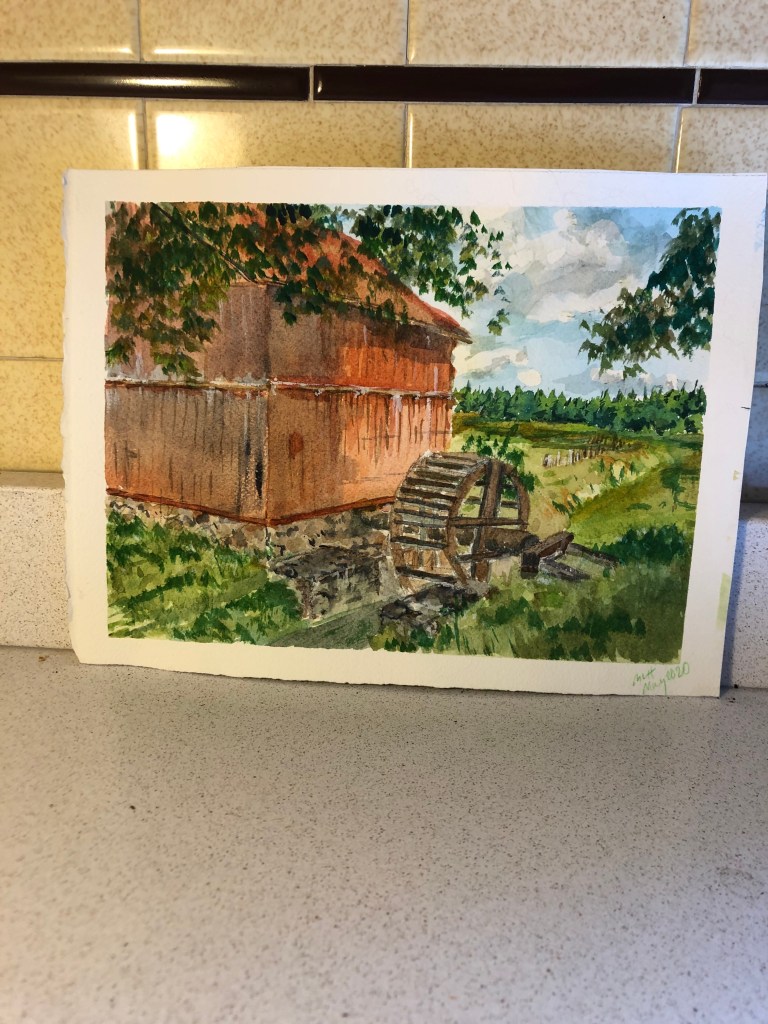
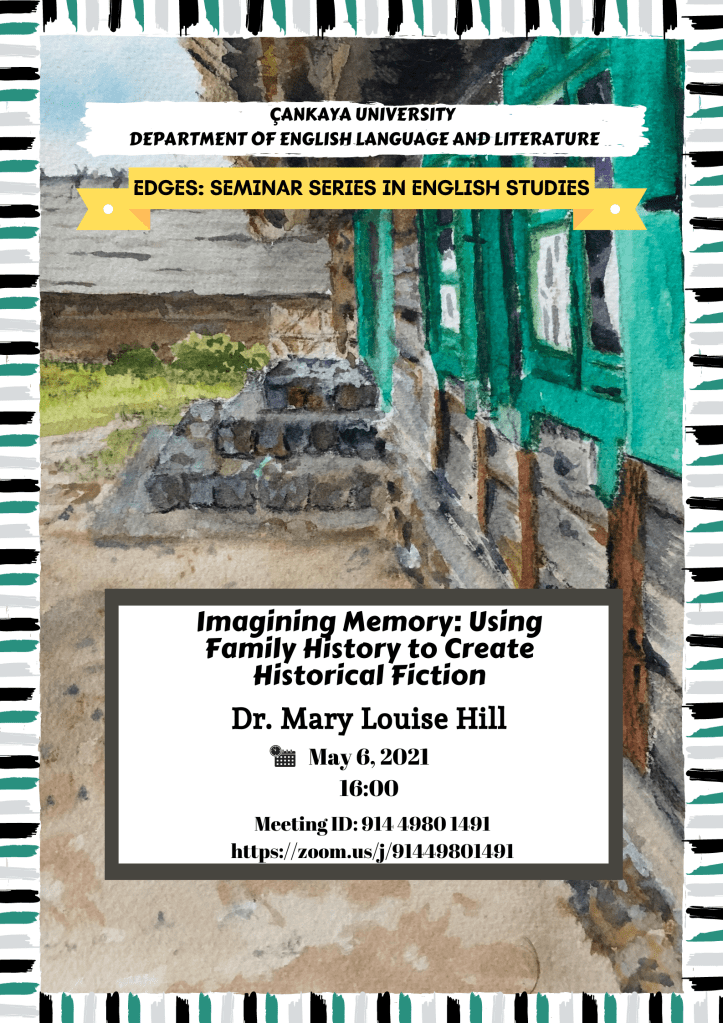
The Górzyńskis were woodsmen, and carpenters. In order to access an intimate know of woodworking and building in Poland, I did paintings. All of these paintings are based on photos that I took during my 2018 visit to Poland. One is based on a building still standing in Czarny Bryńsk. The others are buildings from the region and the period, now located at the Museum of Folk Architecture, Olsztynek, Warmia and Masuria, Poland, Europe.

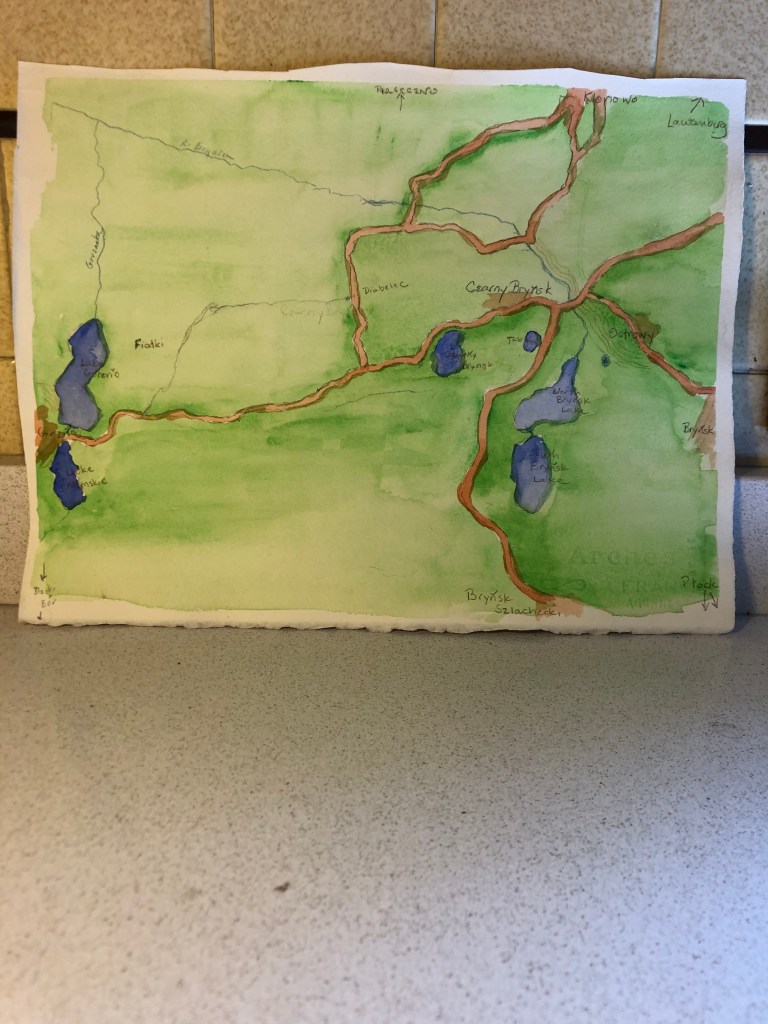
In order to imagine locations, I painted a map. I need to redo this. I have a different picture of the landscape now, and the relationships between the villages. I’m simplifying an important village relationship in this painting above. Czarny Bryńsk means “Black Bryńsk.” I’m only calculating the relationship it had to Bryńsk (mid low right quadrant), but I now guess that Bryńsk and not Górzno was the usual market town for someone in Black Bryńsk.) I had to rewrite some stuff when I figured that out.
Czarny Bryńsk house, from the time period of the book. The last time I checked, it was an Air B&B. Czarny Bryńsk has very few residents now. It houses the offices of the Górznienńsko-Lidzbarski Park Krajobrazowy. (Gorzno-Lidzbark Landscape Park.). It is surrounded by amazing parkland.
Interior Shot. Early painting.
Through The Window. My first attempt at a Polish landscape,

Long Front.
Out Buildings
Stone House
Village Church.
Fenced in Village Grounds
Polish Mill

To say . . .

To say . . .

To say I miss you

        is not enough.

To say I’m lonely

        even when I’m not alone

         comes nowhere near

the way I feel. To say

         this room is not big enough

          to hold my pain

misrepresents space and containment.

There is more life to live,  I know that:

                  Life in another hue, without you, is vast and empty.

                  Like a desert,

                  It demands that I must be

Very attentive

To

Signs of

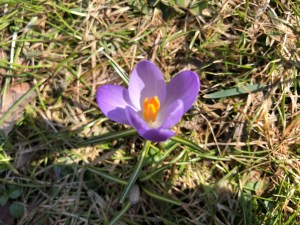
Blossoming.

(Written two months after losing my 92 year old mother, who I could not be with at the end, because of COVID)

by: Mary Louise Hill (3/10/2021) photo by Phil Nicolai, taken the morning of 3/10/2021 in Buffalo, NY                                               

Seismic

There are so many deaths going on now. Fast,

and furious. Great people are leaving us.

Seminal people are leaving us.

We are at a cusp,

and we’re being challenged to learn from this.

With every parting,

we’re being challenged to be accountable.

2/6/2021

To all my fellow academics and students in Buffalo, New York

I’ve been a full-time academic in Buffalo, New York since 2005.  That’s when I joined Medaille College in a tenure-track position in English. The first 10 years of my academic life here, I went to Kleinhans Music Hall maybe three or four times a year. Maybe only once.  Always at least once.  The most important trip to Kleinhans, when you’re an academic in Buffalo, New York, is the one that comes around this time of the year: the graduation ceremonies.

Five years or six years ago, I moved into the Kleinhans neighborhood, so now a walk around Symphony Circle is a daily occurrence.  I go to concerts and events here more often now. When I’m working, I drive by this place at least twice every day. Still, that graduation day remains a unique and special experience of Kleinhans.

When I was out on my COVID constitutional today, part of my route went by Kleinhans. When I got to that block of Porter Avenue, I had a flashback to all those graduations. The nagging excitement, and the aggravation of it all.  It’s a rule: graduations in Buffalo must always be on the first beautiful Saturday of the year when I had absolutely no grading or class planning to do, and here I would be, having to spend the entire day watching students go absolutely insane.  So, I would always wait until the last minute, even though that meant the parking and traffic was abysmal.  Goddamn those narrow streets! Who planned these roads?  What’s the big deal with this traffic circle?  All of that aggravation, plus the tedium of it all.  I mean seriously: it’s a beautiful thing for the students, but faculty are generally an ornament.  We play games on our phones, read magazines inside our programs, take votes on which of our students is wearing the best shoes, count the number of Honors students, listen to the mistaken pronunciation of students’ names, anticipate the announcement of which faculty member would receive the coveted Brian Shero Award.  I won it once.  That was the year I actually didn’t make it to the graduation. I was in Spain.  The president of the College made an excuse for me: “she’s doing research abroad.”

Oh, there’s refreshments.  Groups of faculty always go to Allen Street during the two hour break between the Graduate Student ceremony and the Undergraduate Ceremony.  Most of us are pleasantly buzzed by the time of the insanity of that second event.  And the cookies afterwards.

Yeah, it’s just cookies, but traditionally, this has been my time to shake my students’ hands, give hugs, or just nods across the room, to say “congratulations” and wish a beautiful life.  It’s always so anticlimactic. Still, I’m always so grateful to have been there, for that event, not to mention for those four years of each students’ lives.  During those four years, I often witness the transformation from kid to adult.  It’s an awesome responsibility and an honor to be a college professor.  Especially at a small urban college, where my students are so diverse.  So many are first generation college students.  Just making it to Kleinhans probably seemed an impossibility for most of them when they first started. So when they saunter across that stage, and their parents are screaming, and they stop in the middle and do a jig, well, I applaud them.  Or when they rush across in sensible flats, shyly shake a couple hands, then hurry down the steps.  I applaud them.  Or when they’re wearing their best Sunday clothes, walking tall, feeling proud.  I applaud them. It’s an amazing sight to behold.

So today I was walking by Kleinhans.  And when I had this flashback. I started filming what I saw as I walked.  Today is so typical of the day I’d be required to be at Kleinhans.  But it’s pretty deserted.  You’ll notice there’s a group of kids meeting in the parking lot, in a perfectly spaced, socially distant circle.  They’ve been there every day this past week.  The other day, I saw a young woman, standing all alone in front of the building, dressed in her graduation gown. It blew in the wind as she took a selfie in front of Kleinhans.  I applauded from the sidewalk, but she didn’t see me.  She got in her car and drove away.

You’ll notice too that that Tai Chi place is for sale. And that community garden that is supposed to be Shakespeare’s Garden is awaiting someone to obsess over making sure all its blooms are Elizabethan.  It was beautiful a couple years ago.  Last year, not so much so.

I dedicate this to all of my colleagues, and to all of the students whose lives have been part of mine, in one way or another.

Mask

“I thought it would be a good opportunity for me to be here, to be able to speak to these researchers, these incredible health care personnel, and look them in the eye and say thank you.”  (Mike Pence, on why he didn’t wear a mask to the Mao Clinic.)

That’s me, walking down Summer

Street, headed for Richmond

Street, dressed for a pandemic,

only my eyes to see and be seen:

61 year old white woman eyes.

It’s one of those almost-Spring days, trees

Daring to blossom, sky clear blue,

Bright, but chilly enough to warrant

This coat, this hood, these gloves. The streets

Empty and wide, I feel like an explorer in a new land,

Pandemic land, where viruses can lurk anywhere,

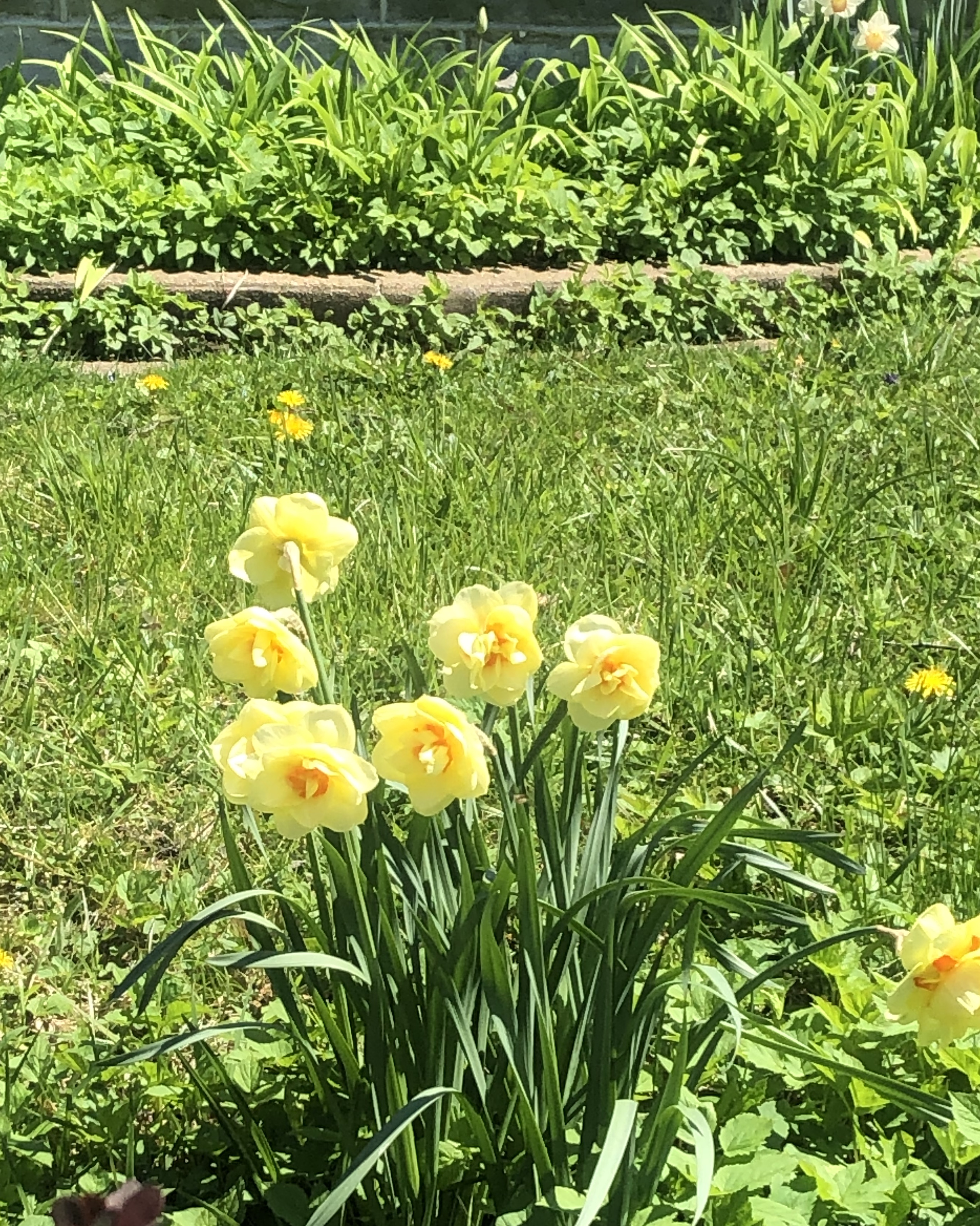
even on daffodil petals.

Barely a block to go and I see

him, having just turned or crossed;

nevertheless, he’s bearing down

on me.  Hands deep in pockets, mask

high, just inches from his hood.

Only eyes to see and be seen:

30 – 40 year old black man eyes.

I recognize a fearful voice, mumbling

in the back of my head:

It’s time to cross, it says, though to cross

the road will take me out

of my way.  I resist it.  I maintain my course.

He’s about my height.  Not quite

as spare.  His mask is black, and

mine is white. As we approach each other

I recognize fear. Fear in his eyes.  Fear of

me. Fear of all the things he thinks I see

when I see a man who looks like him.

Fear of all the things he knows

a woman who looks like me has the power to do.


The things he fears frighten me, too; they repulse me.  I want to smile and say hello.


I summon up a smile, will it into my eyes

and face him, for those seconds it takes me

to pass him.  All I can see is his anxiety,

diminishing.  His eyes grow calm,

his shoulders slack, we share

a nod of gratitude, even

companionship, and then

we both continue on our way.


daffodils

Clem

On this day, December 12, 43 years ago, my great Uncle Clem died.  I’m terrifically grateful to my Uncle Clem.

Clem, who died with the surname Doskey, was my paternal grandmother’s brother.  A sweet man, by all accounts.  He was three years younger than her, born 27 November 1896.   My grandmother always spoke of him adoringly.  I had the impression they were very close as children, and it would appear that closeness continued into their young adulthood.

My grandmother, who I knew as Harriet Hill, married Joe Hill in October of 1917. Some time after that, her beloved brother Clem met Joe’s sister Helen, and in 1922, they married.  Harriet and Joe had one son – my father.  Clem and Helen had a daughter, named Delma.  Delma was about as close to a sister as my father would ever have.

This story is a simple one to tell, for sure.  Or so it would seem.  Actually, this simple tale masks a far more complex set of relationships and lost names.

Clem was baptized Clement Dziedzikowski.  My grandmother had an equally Polish name at birth: Jadwiga Dziedzikowska.  They were two of the seven children of Jan Dziedzikowsi and Pelagia Szweda.  Berea, Ohio Census records show Jan and his family changing their names en masse, around 1900.  At that time, he simplified the last name to Doski.

This information was relatively easy for me to figure out.  Although she never told me any of this while she was alive, my grandmother left me the centennial yearbook for the church the family attended.  Both she and her sister Charlotte appear in a choir picture from the early 1900’s, and the picture is labeled with their real names.  Charlotte, notably, was originally Leokadia.

The bigger puzzle was my grandfather.  I always knew that our surname – Hill – was bogus. My mother had told me so, and she showed me a name – Golembiewski – that she had seen in an obituary once.  “The person who died was your father’s aunt on his father’s side.  So this must be your real name.”  For years, I accepted that as my true name.

Sometime during my 20’s, I wrote to St. Augustine’s Church in Cleveland, where my mother told me my grandparents married.  I asked for their marriage records.  I gave their marriage date, and the names Harriet Doskey and Joe Golembiewski.  The church wrote back to me saying that they had no one by that name getting married on that date, but they did have a Hatti Doski and Joseph Gurzinski.  I set this aside – I was in graduate school and, well, this was not the right name.

It wasn’t until about three decades later that I was introduced to Family Search and Ancestry, and I began poking around looking for my mysterious Polish ancestors.  The name Golembiewski yielded nothing.

Doski, and later Doskey, was more fruitful.  And this is where we get to my gratitude to Uncle Clem, and his wife Helen.  While my grandparents seemed set on erasing their true identity, Clem and Helen were not so inclined.  I found their marriage record. It was for Clement Dziedzikowski.  And Helen’s name – well, for the second time in my life, I encountered the name Gorzynski/Gurzenski.  Helen’s maiden name.

Within that same evening of research, I found Helen’s death certificate, and sure enough – her daughter gave Helen’s maiden name as Gorzynski.

I’d had it all along – my true family name.  But thanks to Clem and Helen, the evidence was secure.  Once I had that name, my quest to rectify our family name was nearly complete.

I would like to say Clem and Helen lived happily ever after, but that doesn’t seem to have been the case.  The were buried in different cemeteries, Helen with the Gorzynskis and Clem with the Doskeys.  They supposedly lived with their daughter when they got older, and my mother reports they didn’t seem all that happy.