Mending Estrangement: Rebuilding the Missing Branch of My Family Tree

Of all the inheritances one might lose, family histories are the most valuable. Money, jewelry, and furniture take second place to the stories our ancestors hoped would get passed down from one generation to the next.

*

My mom’s Lewy Body Dementia was in full blossom when we moved her to memory care in 2019, right before COVID cast us all into isolation. The facility was only blocks away from the home Mom and her second husband bought in 1982. Every inch of that house and garden was designed and decorated by her. Only a few of her precious items moved with her to the room where she died. Everything else was up for grabs.

Like many mothers, mine had a highly refined sixth sense. She could read your mind. She saw through her children’s deceptions so easily. At an early age, I decided my best strategy was to always tell the truth. It wasn’t surprising, then, that Mom knew the day her house sold, though no one told her. She was inconsolable on the day its contents were “secretly” liquidated. Each of her five children collected what we could pack into our cars before all the rest was taken away in a truck to parts unknown. Mom’s beloved octagon table, her selection of paintings and mirrors, her quilting fabrics, her piano, her organ, and her porch swing became anonymous finds in some second-hand store. That’s how family histories are lost, by the way. The keeper of the history dies or the last survivor of a generation gets sick during plague. Or there’s a fire. Or a war. Often, the next generation chooses to disengage from their immediate family. Memorabilia gets cast aside, its stories forgotten.

*

The current popularity of Ancestry.com, FamilySearch.org, and Henry Louis Gates Jr.’s Finding Your Roots signals a collective nostalgia for boxes left behind in some attic, somewhere, sometime during the 1990’s. Many of my fellow family historians have become pretty adept at fleshing out complex family histories. Some of us can trace American identity to the first wave of Western Europeans who broached this nation’s shores. I can do that on my maternal grandmother’s side, where I qualify to be a Daughter of the American Revolution six times over . . . and counting. On my father’s side, I trace my American identity to a migrant worker and his wife. Members of the Polish Peasant Diaspora, they were not welcome in America. We know the derogatory terms they encountered. Sometime during the 1970’s, mainstream America agreed not to use them anymore. DNA tells me my father was 100% Polish. His parents wouldn’t admit this while they were alive. I don’t blame them. They wanted to rise above the embarrassing stereotype attached to being Polish and pave the way for my generation to enjoy the American Dream. So our grandparents assimilated. Changed names. Changed locations. Some changed locations so many times, it’s as if they never stopped migrating. I’ve found death certificates for my relatives in cities all over the United States. Addresses confirm they never left the working class. They lived in company towns, industrial workers’ quarters, and densely populated ethnic urban neighborhoods. Many of them died young. Renal failure, cirrhosis, tuberculosis, and diabetes are among the most common causes of death.

Rebuilding a family tree becomes very difficult when ancestors relocated often, and were prone to changing their name. But not impossible. In my case, DNA results only confirmed suspicions. DNA doesn’t get you very far if you don’t have the proper surname. I have countless DNA matches on my father’s side that are only that: DNA matches. Their names are like Hill: Smith, Martin, Jessica, Rose. A generation or two back, an ancestor assumed an alias and began creating legal documents to support their revision of the family’s past. Little did they know that their grandchildren would have access to FamilySearch and Ancestry.com. There’s always a crack in the wall of documents created by ambitious migrants trying to rewrite their family’s history. For me, it was a pair of wedding documents.

*

My mother told me when I was eleven that my name wasn’t really Hill. She had written down a name she found in an obituary, but it was wrong. In my thirties, I became very tired of the blandness of “Hill.” I decided to find my true surname. I knew my father’s parents changed it. So, I wrote a letter to the pastor at the church where my grandmother told me she and grandpa wed, requesting a copy of his marriage registry on October 10, 1917. The pastor wrote back. He sent me this:

When they married, my grandparents were using variations on their Polish names. Twenty years later, I discovered on Family Search that”Doski” was first used by my grandmother’s family on the 1900 census. “Gozinski” is a misspelling. The proper spelling of my grandparents childhood surnames appeared on another wedding registry. The two witnesses to my grandparents’ nuptials were Grandpa’s sister Helen and Grandma’s brother, Clarence (aka Clemens) A few years later, Helen and Clem married.

*

On the day I walked into my mother’s vacant house to collect the things I wanted, I felt a bit like a stranger. She raised Mary Louise Hill (aka Mary Lou aka Louie aka Babe) in a void. I took after my father. Not knowing my father’s family, she didn’t recognize their traits in me. She didn’t know how to guide me.

I took mom’s sewing machine and a few pretty ribbons from collection. I took an antique mirror and some ceramic bowls from my maternal grandfather’s ancestral farm in Pennsylvania. And I took all of the old photo albums and memorabilia. Boxes of them, from all sides of the family. On visits home, I spent time sorting them out. I knew what was in those boxes, but I left them in Mom’s basement so other family members could have access to them. In the end, no one wanted them. I took them.

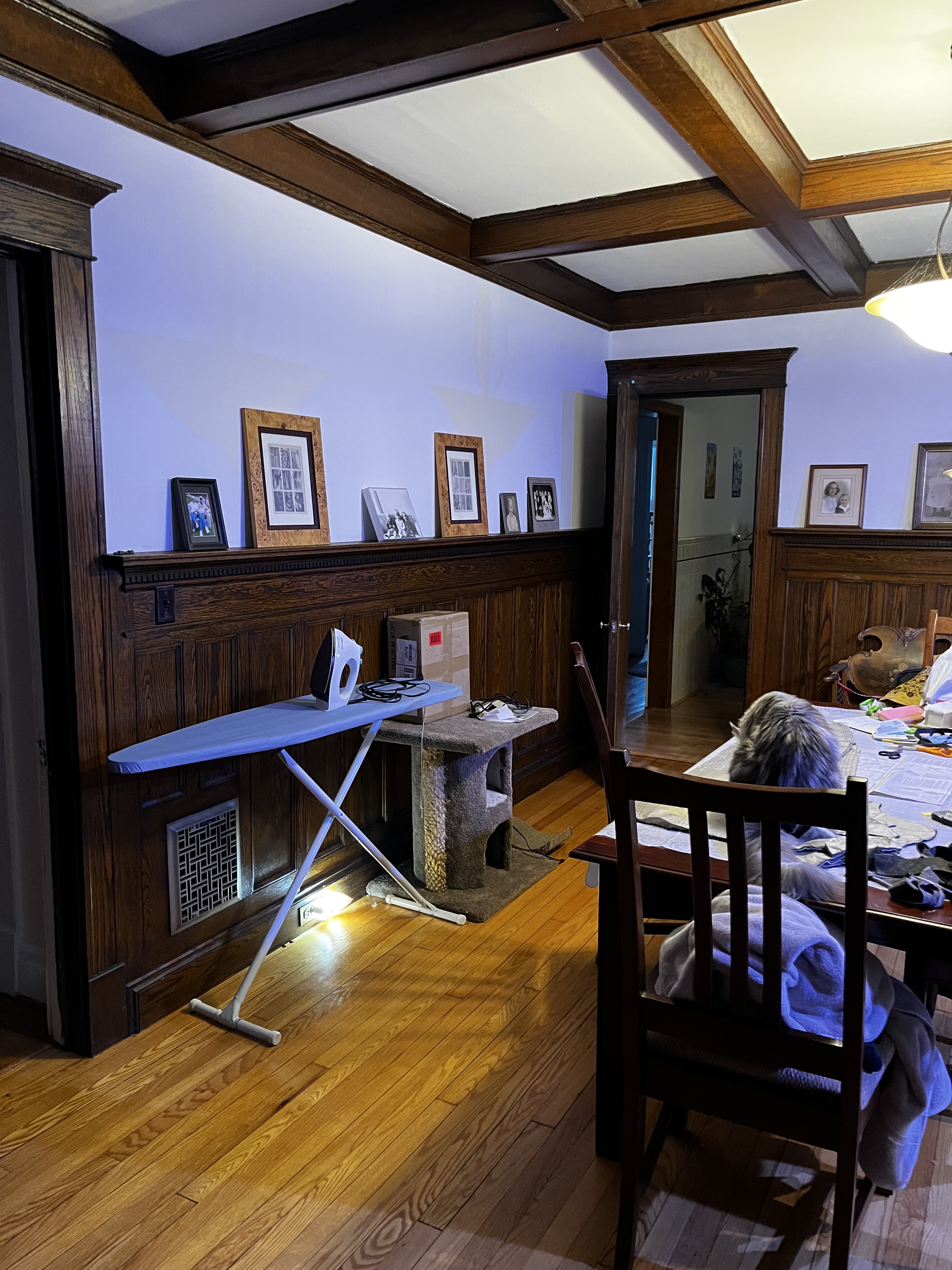
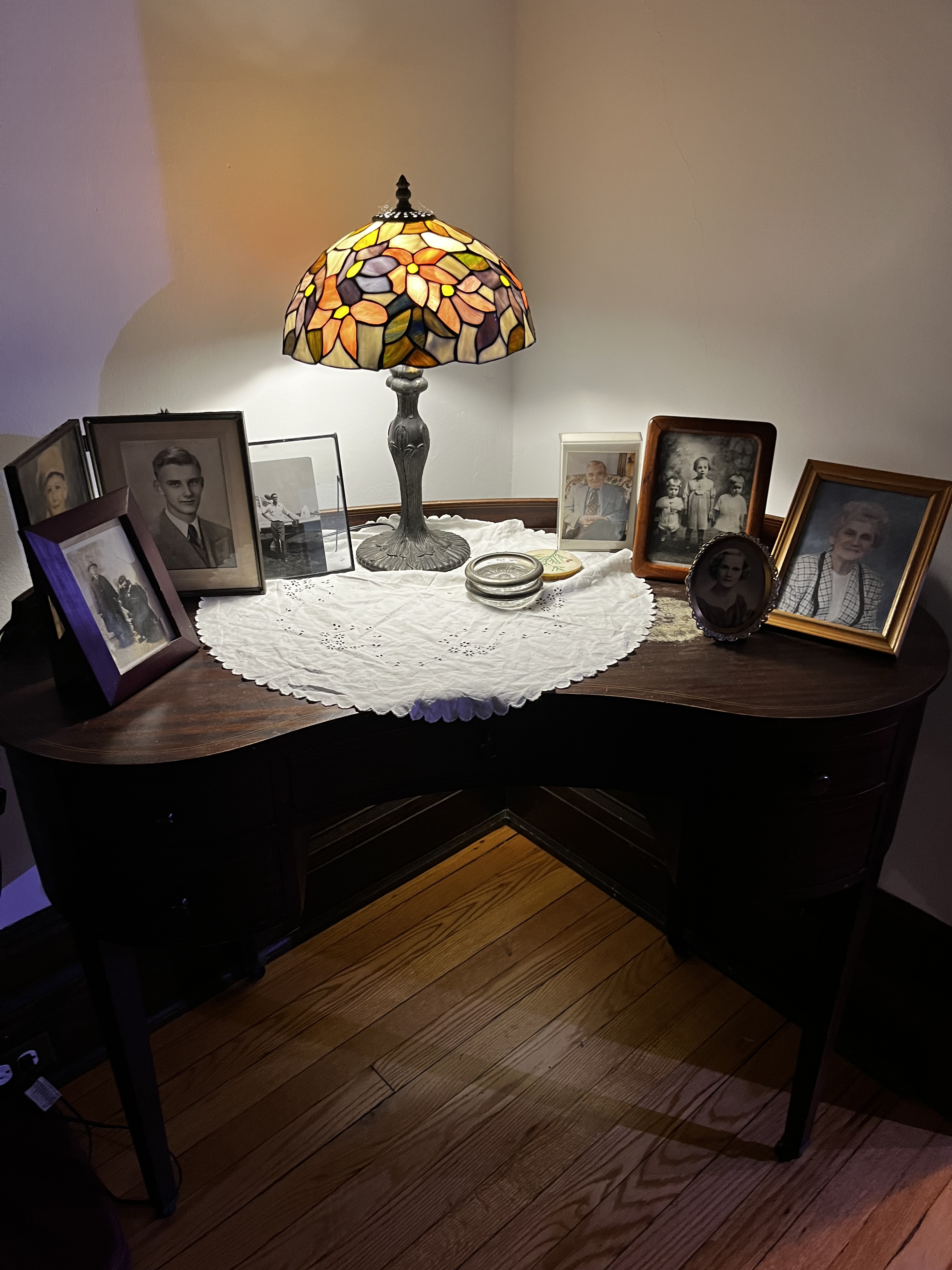
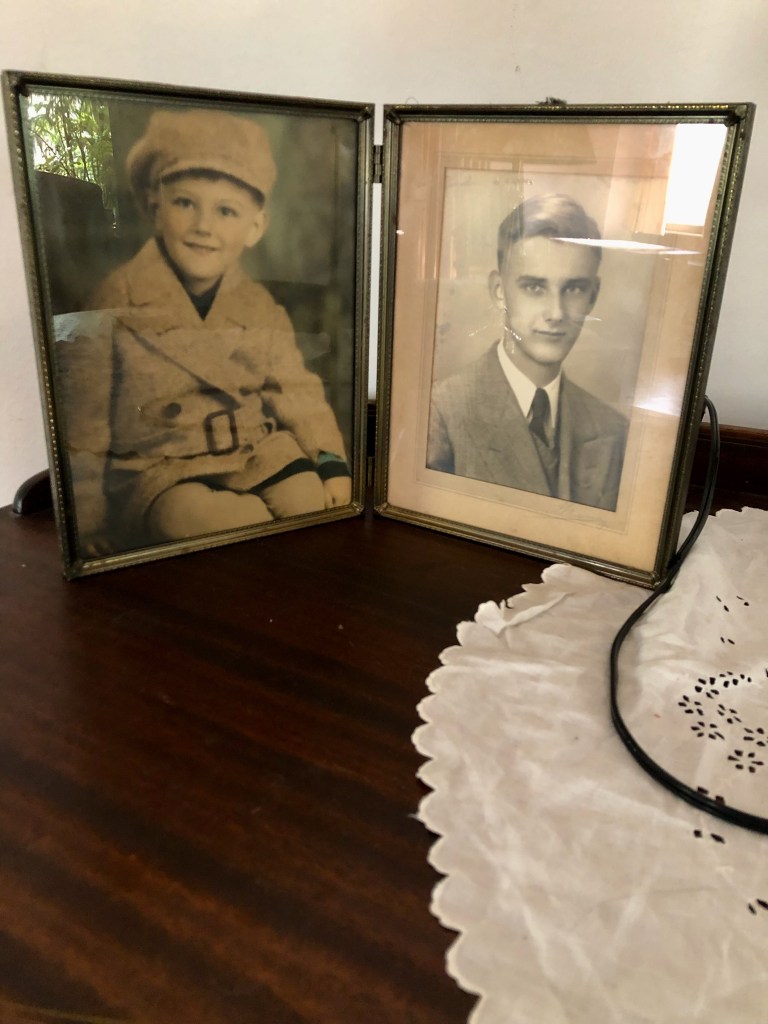
My mother took meticulous care of her own family’s photos, and they’re all marked well. (The display in the first photo above are hers.) Not so with my father’s family. It’s not that they didn’t take photos. Photography was one of Grandma Hill’s hobbies. She had multiple cameras, and she carried one of them almost everywhere she went. She took great care to organize her photos into albums. The problem is, she didn’t label anything. These were albums created for her own enjoyment.
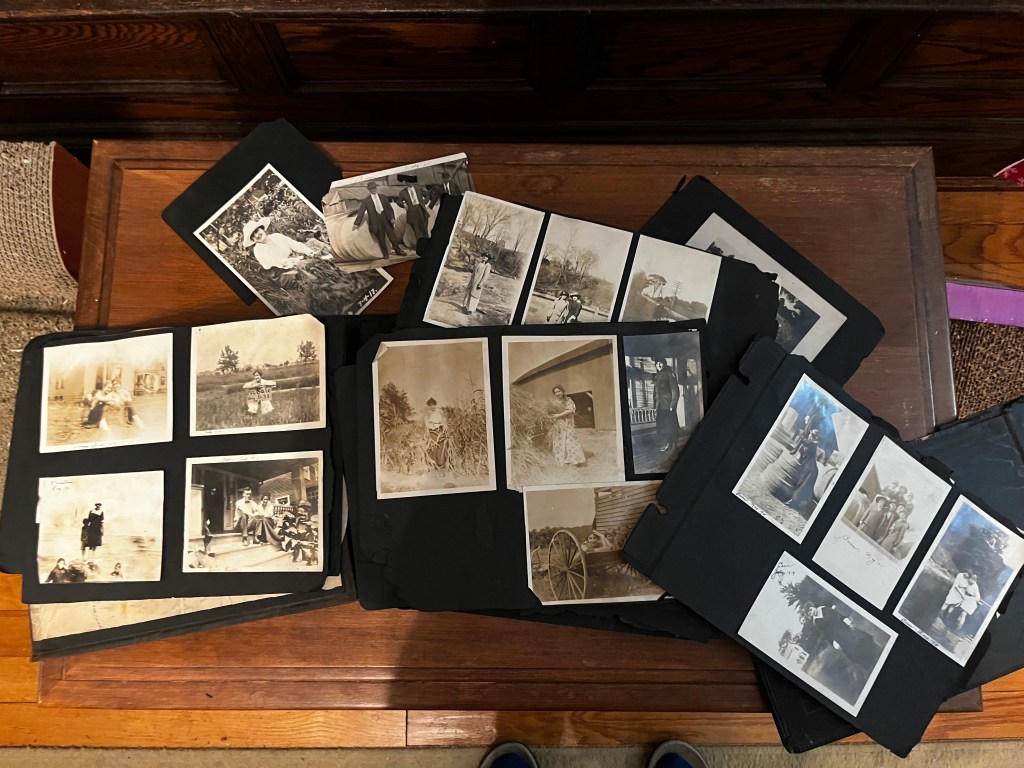
Over time, I’ve learned to identify many faces in my father’s family. The anchor photo is always my grandmother. Hattie. She had very distinctive facial features, so it wasn’t difficult to identify younger versions of her.

This is one of the rare instances where she put her name on a photo.

That nose and those eyes helped me identify photos from every stage in her life.
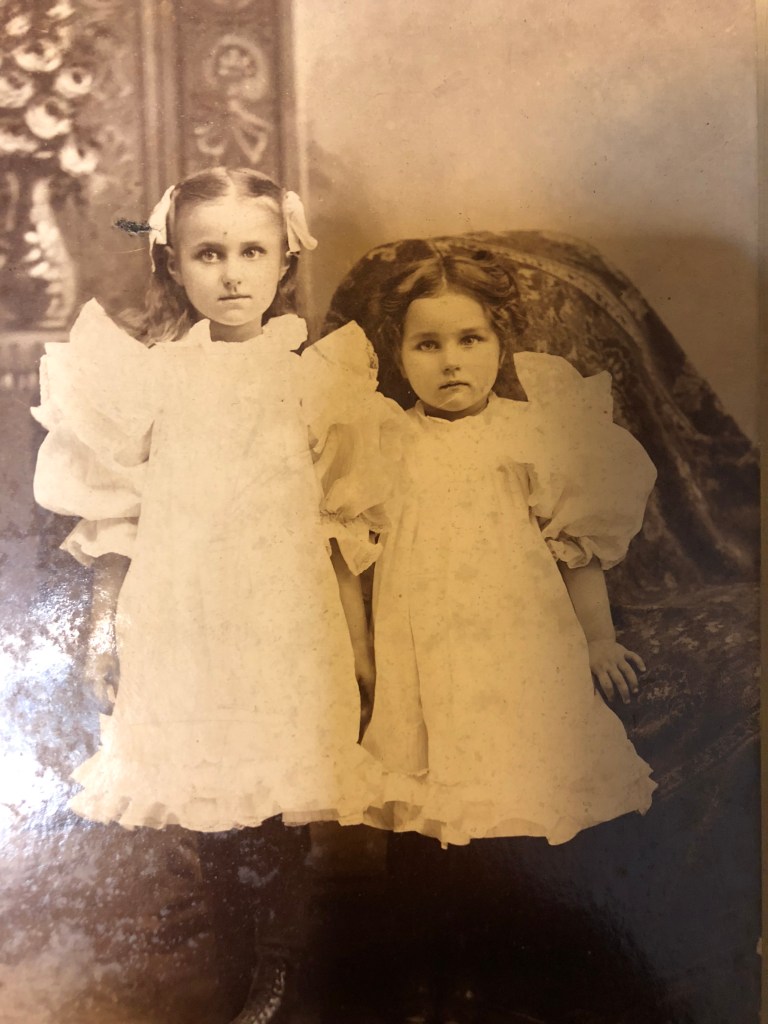
According to censuses and other public records for Berea, Ohio at the turn of the twentieth century, the woman I knew as Hattie Hill was called Jadwiga Dziedziekowski as a girl. A photo of her church’s choir in the centennial anniversary book confirmed that name and its spelling. This photo also informed me that my Aunt Charlotte was originally named Leokadia.
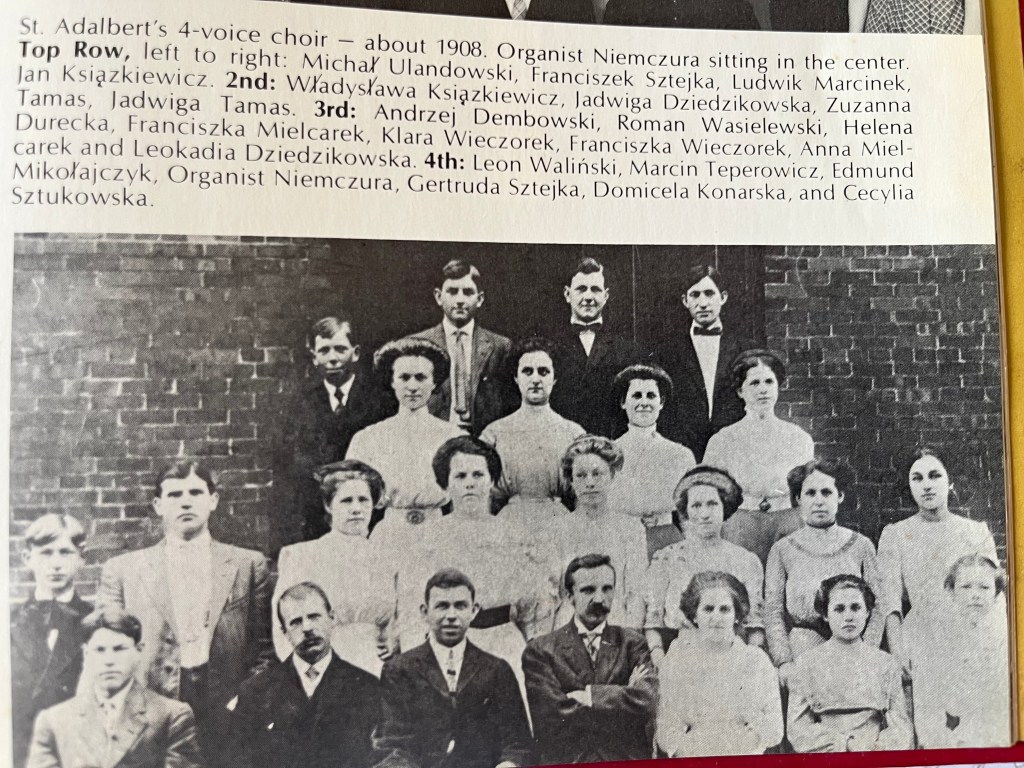
*

Migration – whether it’s from city to suburb, state to state, or country to country – is a sure fire way to become estranged from one’s past. Many families in Poland know they had relatives who left during their nineteenth century Partition. They have no idea where they ended up. I wrote a blog entry about the Dziedziekowskis several months ago which caught the attention of a Polish family historian with a mother who wanted to know what happened to her disappeared ancestors. The researcher recognized my tale as that of a long-lost relative. After exchanging photos, we decided we were distant cousins. When she finally admitted her father came from Poland, my grandmother told me I was the great-grandchild of Polish aristocrats. My new cousin informed me that was a lie: great-grandpa was from a hard working Christian peasant family called Dziedziach. His story had been passed down in her mother’s family: he and his brother Stanislaus had disappeared after their father died. When their mother remarried, they took off, never to be heard from again.

*

Though I lived in Buffalo and Mom lived in Cleveland, I visited her as often as I could. We were close. She often confided in me. One day, while she was still living at home, she asked me to get a particular sweater from one of the drawers. She was in the early stages of her dementia already, and nothing was where she thought it was. While looking for her sweater, I found this:

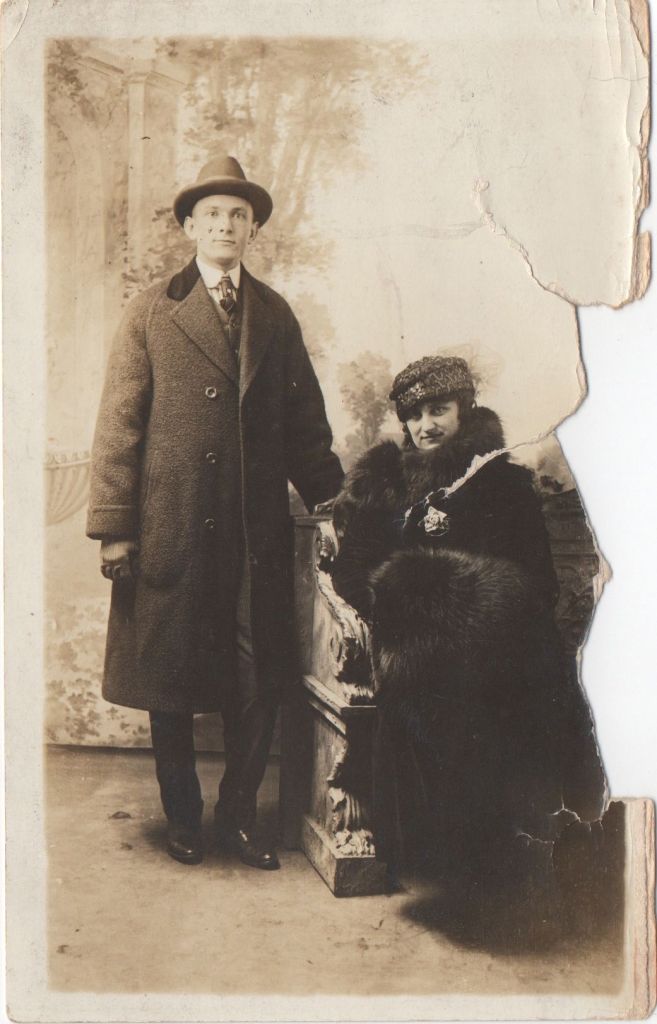
My mother was upset when I handed her both the sweater and this photo. She demanded I return the photo to where I found it. She knew it was the branch of the family I was most obsessed with. She’d written the name “Hill” on the back. And I could easily recognize my young grandfather. You see, even though I never met the man, I knew from photos that my grandfather had pretty distinctive features, too. Here’s a page from Grandma’s album that features she and Joe when they were courting. Grandma’s sweetheart is none other than the little boy leaning against his mother’s knee in the family photo.
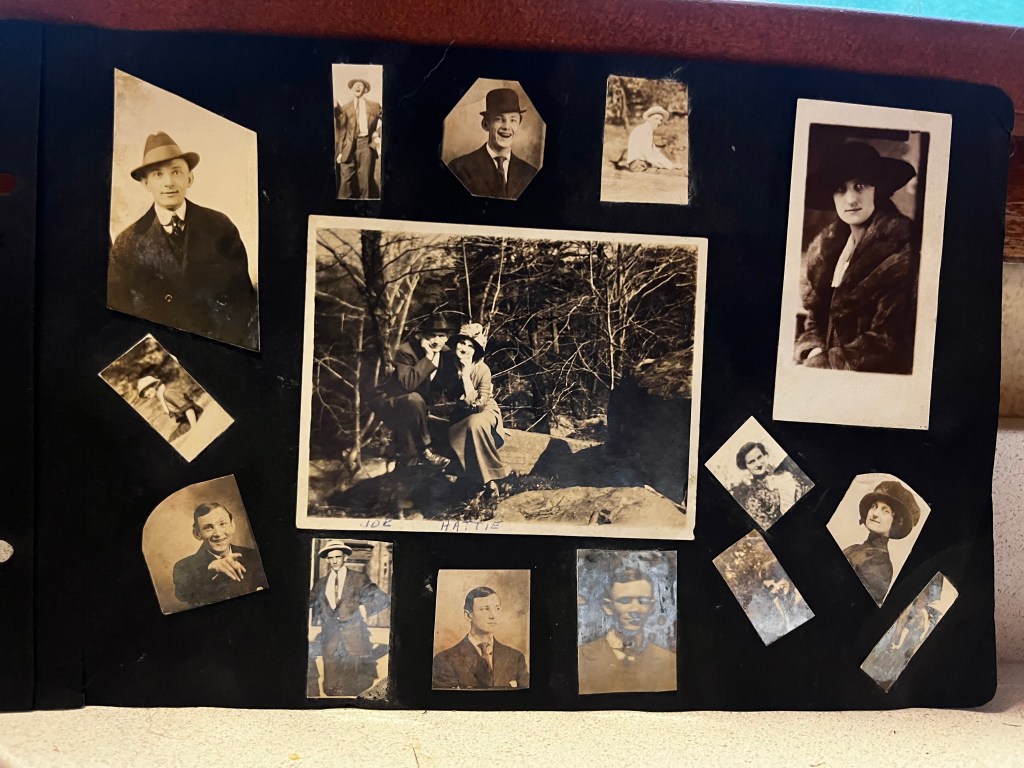
The Górzyński family photo tickles me. Grandpa Joe and his family laugh with me across time. My great-grandfather Marian – Oh my! I can imagine him winking. I estimate his photo was taken between 1895 and 1901, when no one smiled for photos. Anyone who did was considered a little inappropriate. On showing this to my seven-year-old nephew, he labeled it”the silly family.”
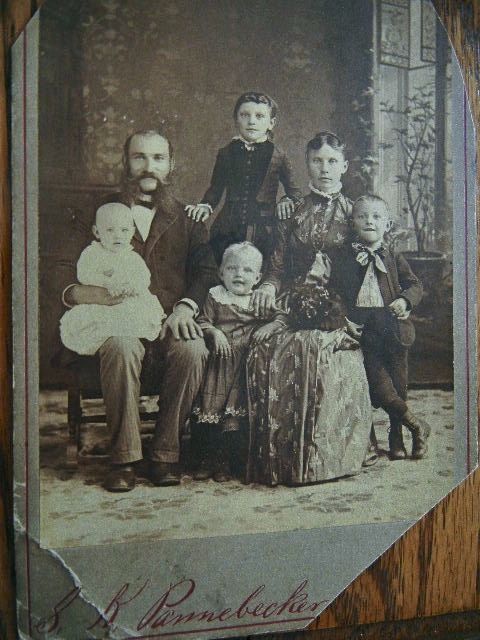
The silly family. The ancestors no one wanted to talk about. Were they silly? Were they embarrassing? Were they in the mafia? Or did they simply refuse to assimilate? My grandfather’s parents were migrants for a long time. They moved several times before they owned their own home. They always lived in the Polish enclave. Creating America’s Polonia was a process: villages reunited in working class areas near America’s mines, factories, and stockyards. At the turn of the twentieth century in Cleveland, Warszawa, the Polish neighborhood my family settled in, “was, in essence, a Polish town situated in the corporate limits of Cleveland” (Polish Americans and Their Communities in Cleveland, by John J. Grabowski, Judith Zielinski-Zak, Alice Boberg, and Ralph Wroblewski.) That community flourished as long as it could remain isolated. President McKinley’s assassination was the first of several events that forced the assimilation of Polonia into the urban Cleveland landscape.

Great-Grandpa Marian (often called Frank) died in 1914. Franciszka stayed in the Warszawa house her husband built for her until she died. That house – a double with a livable attic – is still standing. In 1920, the house was functioning as my great-grandparents had intended: Great-Grandma lived there with Walter and his family, and Joe and his family, plus Helen and John, both still single. After Walter died and his wife and daughters moved out, Helen married Clem, and their family moved in. My grandparents moved out when my father was born. Helen and Clem stayed on with great-grandma for a few more years before finding their own suburban home. During the 1930’s Grandchildren moved into the family home, but they didn’t last long. By 1939, when Franciszka died, she had tenants. The final census she appears on – 1930 – lists her as illiterate, her language, Polish. At the time of her death, her eldest living son – and possibly the child who was in line to inherit the house – was my grandfather. By then, Joe and Hattie lived in the suburbs. It appears Joe washed his hands of the family situation completely. Franciszka’s death certificate and the documents marking the sale of the house were signed by Grandpa’s youngest brother Eddie, who still lived nearby. It’s amazing this photo remained in our possession. Although mom kept us hidden from us, I credit her with keeping it. She valued family history, even when it was a little embarrassing.

Embarrassing by whose standards, though? My research suggests otherwise. To their family back in Poland, they were a success story. Until they lost touch. This photo was taken to send to someone. Chances are, copies of it went to Poland, where everyone knew the beginning of this family’s story.

Marian Gorzynski was orphaned at age three when his mother died and his father moved away and remarried. When Marian married, he lived in Czarny Bryńsk, Kuyavian-Pomeranian Voivoideship, Poland and had a respected trade: he was a wheelwright. Franciszka Golembiewska was the eldest daughter of an esteemed family in nearby Bryńsk-Ostrowy (shown on maps as Ostrowy), Warmian-Mazurian Voivoideship, Poland. These villages were among several satellite settlements of the nearby settlement called Bryńsk. (Marian’s father was born there.) Franciszka’s father Thomas bequeathed a slice of his land to his community, where he erected a wooden cross for travelers to pray before leaving town. When that cross was destroyed, the village erected another. I’m very grateful to a contact I made through the Facebook page Orędowdnik Wielkiego Lasu who has shared this story as well as photos of the current cross marking the former Gołembiewski land.
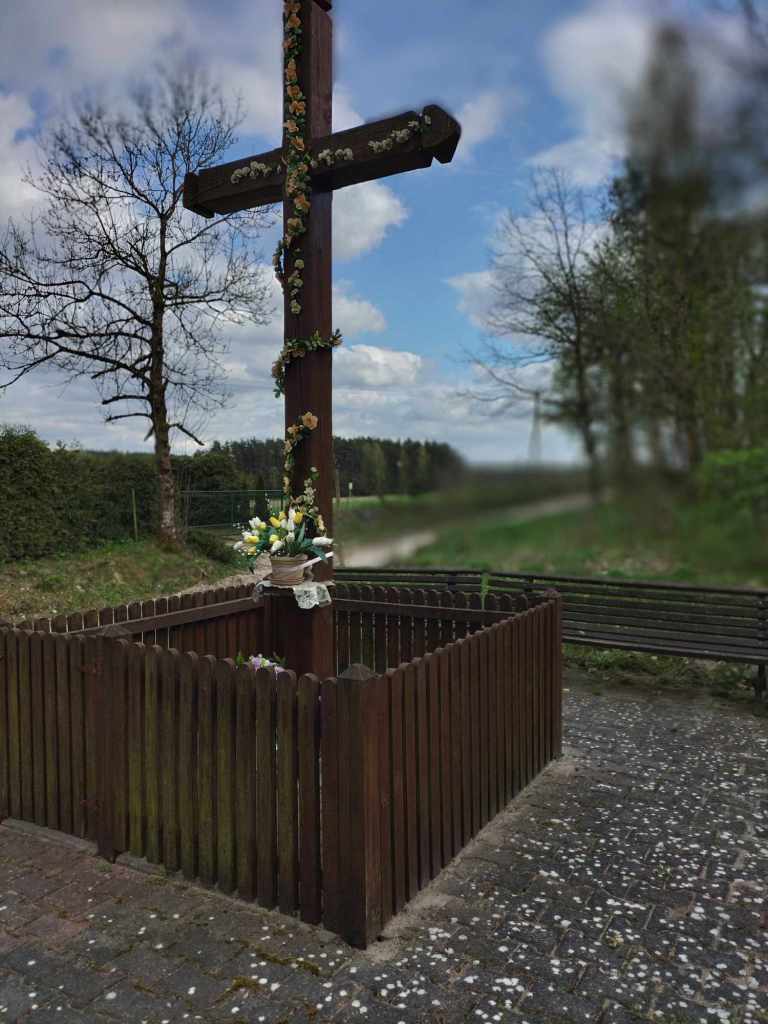
The Gorzynskis’ first stop in America was Glen Lyon, Pennsylvania where, in 1881, the wheelwright became a laborer for the Susquehanna Coal Company. The family photo suggests that Marian was tall. It’s an attribute he passed on. The men (and some of the women) in immediate family range in height from 6’0 to 6’7″. If Marian was anything over six foot tall, he probably found it challenging to work under ground.

from: Growing Up In Coal Country by Susan Campbell Bartoletti

Given his experience in carpentry, I imagine him as one of the men tasked with timbering tunnels.

From Growing Up In Coal Country by Susan Campbell Bartoletti

Meanwhile, above ground, Great-Grandma Franciszka had babies. The miners were paid in scrip that could only be spent at company stores. There was never enough to feed a family, and it was the women’s job to figure out how to make it last.
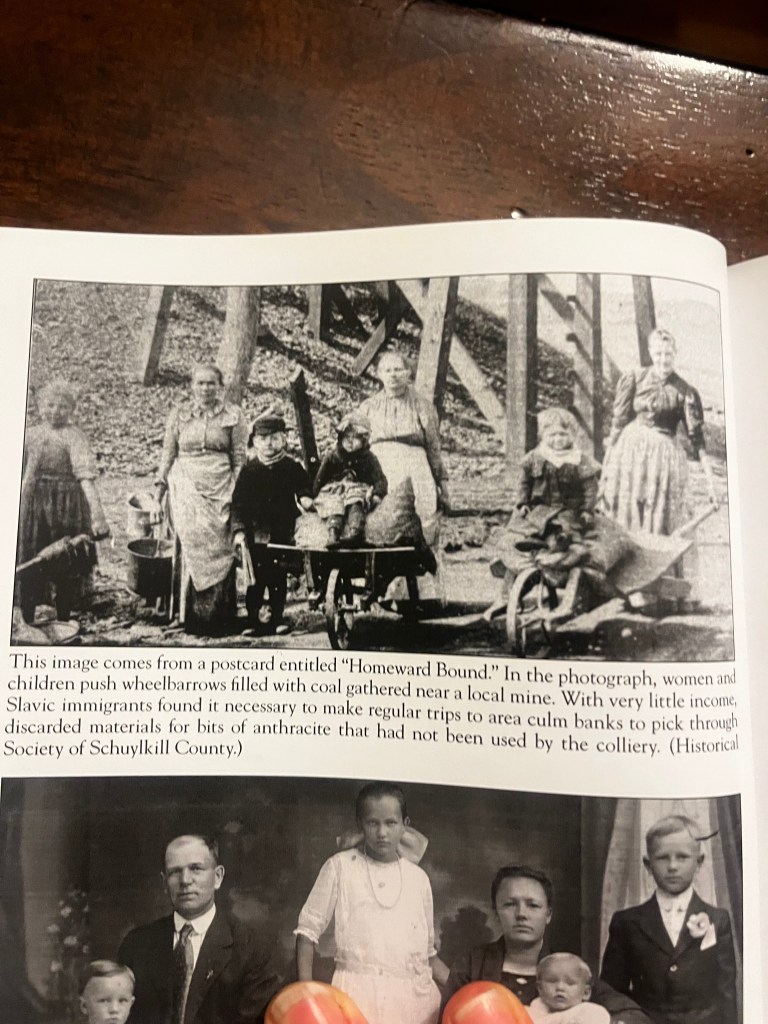
From Images of America: The Anthracite Coal Region’s Slavic Community by Brian Arden

Franciszka was the first of Thomas Gołembiewski’s daughters to leave home. She arrived in Castle Garden September 25, 1883, accompanied by an eleven month old daughter (Honorata). In July 1884, the couple’s eldest son Ladislas was born in Nanticoke, Pennsylvania. Later called Walter, he’s the boy standing between his parents in the family photo. My grandfather, Jozef, was born across the river from Nanticoke, in Plymouth, Pennsylvania on November 1, 1888. A daughter named Tekla was born in Pennsylvania in 1887. In 1890, their son John was born in Buffalo, followed by Helena, born in Buffalo in 1892. Their next son, Alfons, was born in Cleveland in 1894, and their final child, Ildefons (Edward), was also born in Cleveland in 1897. Looking at the photo, I calculate my grandfather is between six and eight. If that is so, then the baby is Alfons, the little girl in front, Helena.

Somewhere along the line, these folks earned a reputation that my father and his mother didn’t want to pass on. My siblings and I heard rumors about rum-running and organized crime. And one of grandpa’s migrant kin supposedly knew Leon Czolgosz, President McKinley’s assassin. I have researched that particular rumor in depth and come up with circumstantial evidence. The Górzyńskis lived five blocks away from the Czolgosz family. Leon worked at the same rolling mill each of the Górzyński men worked at one point or another. Leon’s father ran a bar not far from the rolling mills. Given my family’s love of drink, I’m sure my great-grandfather, my grandfather and his brothers visited it once or twice. Any association may have been passing. Does that deserve estrangement? If so, then every man who enjoyed a good drink and worked in the rolling mills was implicated.

I’m a member of Polish Genealogical Societies in both Cleveland and Buffalo, and I’ve met several Poles with ancestors who knew Leon Czolgosz or his family. Most retained their Polish name and identity. Not even Leon Czolgosz’s father took an alias. Marian and Franciszka didn’t change their names, either. But their children did. Shortly before World War I, America’s cities developed Americanization programs that targeted these immigrants’ children of immigrants. Recognizing their potential as soldiers and workers, these programs taught American culture. Cities with large immigrant communities continued those programs into the 1920’s. My grandfather may have resisted participating for a while, but my grandmother was ambitious. She went to business school, and she’d already changed her name once. She was the force behind their assimilation. After they changed their name, they left Warsawa behind. In 1932 they bought a home in Fairview Park, a semi-rural village on the west side of Cleveland. Then four years old, my father grew up there. If his Polish grandmother wanted to see her newest grandson, she needed to find someone who owned a car. Fairview Park probably seemed like another country to her.

My family history research has focused on restoring my migrant ancestors’ dignity, and their past. This blog does that. My novel The Double-Souled Son strives to do that, too, while also acknowledging these folks were probably far from perfect. The first part of the book recreates the Poland they left behind: a traditional village in its third generation of Prussian occupation where it’s getting harder to keep their Polish language and culture alive. Essentially, they were traumatized before they ever left home, and the conditions they encountered in America only made it worse. In the second part of the book, the characters remedy their alienation by recreating their village life in urban Polish enclaves. There, ancestors’ traditions were passed on to their children. How they came to America was integral to their identity.

The novel is fiction. The “real” story is slightly different. This photo represents a high point in my family’s journey towards building an American home. The “true” story I’ve cobbled together about it deserves to be told:

Based on my timeline, the Gorzynskis were living in Cleveland when they visited Pannebecker Photography, a well known shop in Nanticoke, Pennsylvania. Why did the family return to Pennsylvania?

In 1939, on the occasion of the fiftieth anniversary of St. Adalbert’s Roman Catholic Church in Glen Lyon, the Wilkes-Barre Times Leader published an article listing the names of the miners who founded that church, in 1889. On the fifth line from the bottom I found the name Marian Gorzynski.

found in Newspapers.com 5 February 2021.

Marian arrived in 1881. St. Adalbert’s cornerstone was laid 20 November 1889. Between 1881 and 1889, Glen Lyon’s Polish mine workers had to travel to Nanticoke’s St. Stanislaus if they wanted to attend a Catholic mass delivered in their own language. St. Adalbert Parish’s first service was held in a basement in 1889. The original church building was dedicated in 1891. My Gorzysnki family photo wasn’t taken then, though. Given my grandfather’s age in the photo, I’m imagining Marian and his family returned for a service inside the new church when they could finally afford to travel with all those children.
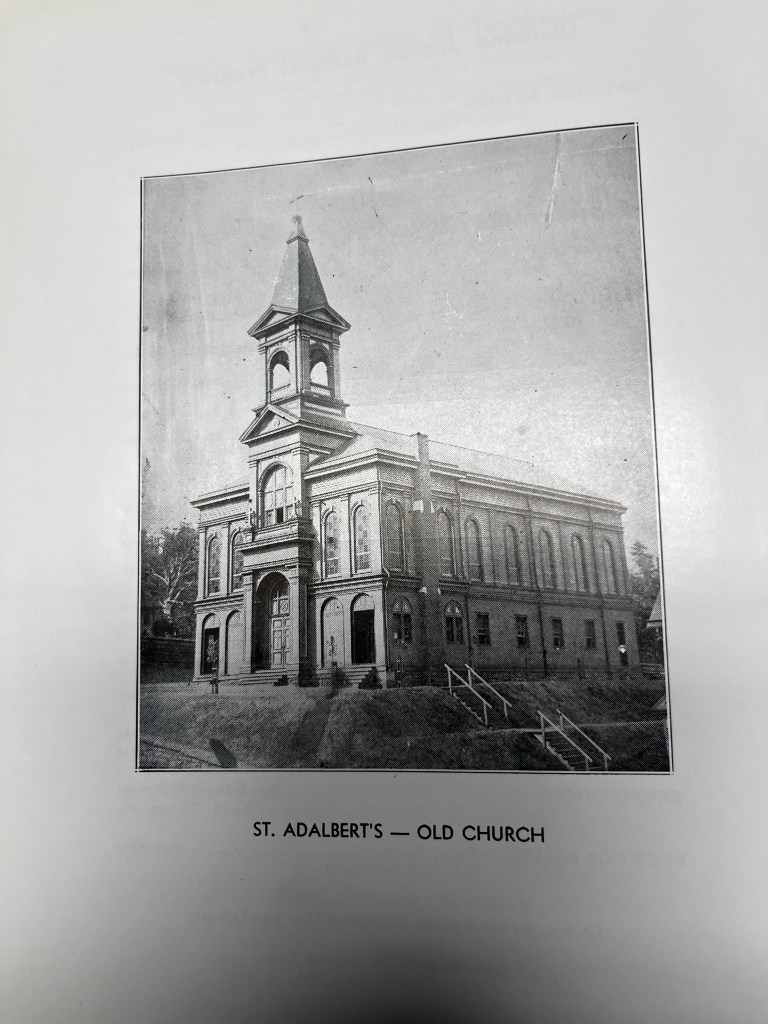
The family in my photo is far from silly. They’re happy. Perhaps for the first time since arriving in America, they’re proud. They’ve moved on to jobs that pay in United States currency, and they’ve saved enough of it to return to their first American home, and the church they helped build. This photo was a big expense for them. I’ll bet Franciszka made a new dress for it, and they surely had several copies made, one for each of their children, one for their own home, and one for Franciszka’s parents, who were still alive, living, in their home near the cross in Ostrowy.

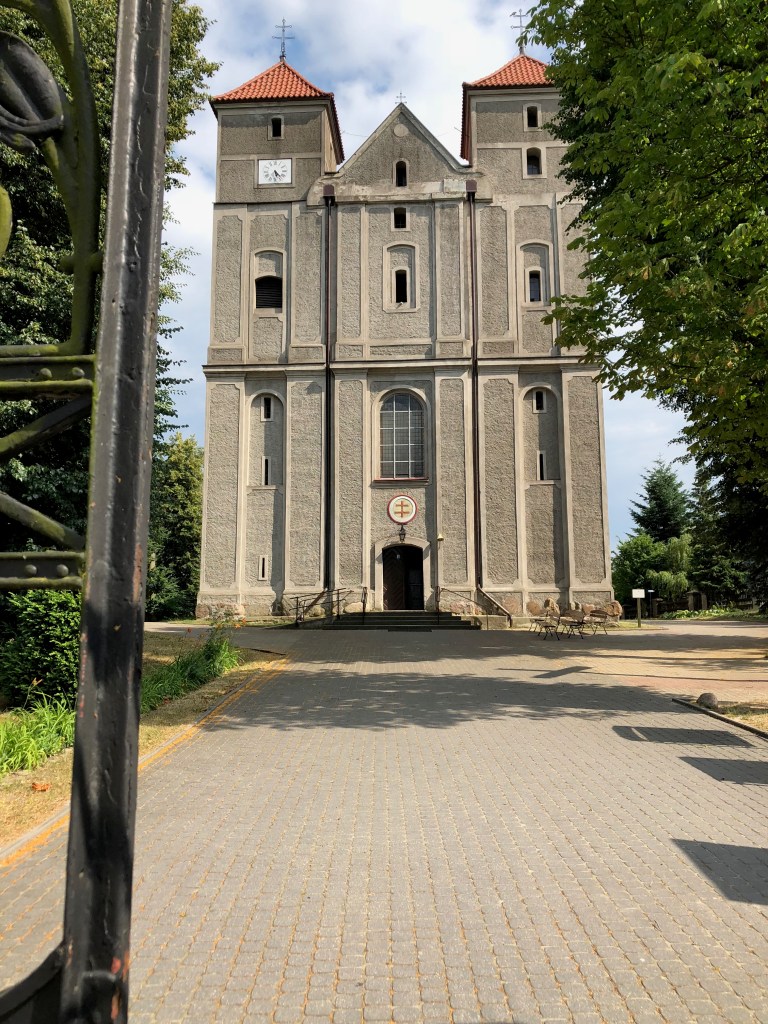
The current St. Adalbert’s in Glen Lyon, now known as Holy Spirit Church, and slated to close soon. My photo, taken May 2024.

What We Don’t Know

  This was my favorite family photo when I was a girl. It was taken June 10, 1950, the day my parents, Katie and Myron, began the story of the family that produced me.

  I’m not a child anymore. I still like the photo, but for different reasons.  At sixty-six, I’m retired from two careers: one in higher education, the other as my mother’s confidante.  Second eldest of Katie and Myron’s five children, I was the child who didn’t talk much. The one who hid in her bedroom most of the time.  The one who sat in the back of classrooms; the one who was the last to be picked on softball teams. In grade school, high school, and college I had trouble putting thoughts into speech. So, I spent a lot of time listening. And smiling.  Talking to me was probably a bit like talking to yourself. That, I believe, is why Mom told me the things she otherwise kept to herself. She needed to say them out loud, and I provided a sounding board. Even after my language aptitude began manifesting, she continued confiding in me.  My reading and writing skills matured quickly.  I liked writing stories; everything around me was fair game. Yet she kept telling me things she didn’t tell anyone else.  Did she want me to keep these as secrets? Yes, I concluded.  So, for forty years or so I didn’t write much, and when I wrote a story, it wasn’t one of those burning inside of me. I published a few, was short listed for a few awards. The stories were good, even though I wasn’t sure what they were about, and a reader could tell that.

Katie died Christmas Morning, 2020. I retired six months later. My mourning lasted four years, give or take a month or two. Writing a novel helped me through it. I revised and edited in rooms decorated with family photos, both my husband’s and mine. 

As I streamlined my narrative and solidified characters, I began seeing stories everywhere. When I meditated on my own family photos, I felt Katie standing behind me. She spoke to me from the beyond. Remember what I told you about that day? Remember what happens next? Oh, yes, I remember. What happened next was happy for a little while, before it turned tragic – imagine a 1970’s Cleveland suburban Othello meets Death of a Salesman – it left my siblings and I scarred. Even today, emotional roadblocks limit our ability to reach out to each other. Why? The answer might lie in this wedding photo.

So, look again.  Katie’s wearing a rented dress.  She always regretted not buying it.  And the flower girl’s dress was stolen from her father’s car later that day.  The wedding party spent plenty of time in cars, driving back and forth between two receptions.  Myron’s mother refused to celebrate with my mother’s kin.  You see, Katie was working class Irish. Her dad was a Cleveland cop who’d served for years on the streets before being promoted to City Court bailiff. 

Is that wedding party smiling?  Or simply posing?

From the look on her face, I can tell Katie already knew how to maintain her composure while screaming inside.  That was a skill she passed on to me. My family rarely shared what we were really feeling.   Anyone who did was deemed hysterical, or out of line.  

The bridesmaids are Katie’s sisters, my aunts Rosie and Mary Lou.  Their smiles are sincere; they’re happy for their big sister. They hope they, too, will snag a handsome, wealthy man. Though they’d never seen it (and they never would), they’d heard about Myron’s parent’s sweet little house in Fairview. Its big garden with an apple and a pear tree.  Roses everywhere! And two automobiles, which made Katie’s brother Jim jealous. Jim’s the man on the left. He’s not overjoyed.  He’s been suspicious of Myron all along.  But Jim loves his big sister and wants to support her, so he’s rising to the ceremony.  

I never met the best man.  The day I overheard my mother talking about his death I learned the word suicide.

These details may suggest a misalliance, but actually, Katie and Myron were meant for each other. They shared the same nebulous American Dream, inspired by movies, radio, and early television. They each endured a Depression era childhood. Both lost friends in the second world war.  Myron served as an Army military policeman in postwar Italy and France. Everywhere he went, he was greeted as an ambassador from the United States, the defender of democracy.  When this photo was taken, he was in college, thanks to the GI Bill.  Katie had a secretarial job. They both were good Catholics who agreed they were ready to embark on crafting a new American family identity, here in this land of the brave and the home of the free.  

 As with most new identities, theirs required a change of location.  The apartment they moved into after the honeymoon was chosen for being equidistant between parents. For Katie, her family was a bus ride away.  When they finally bought their Dream House in the suburbs, the Myron Hills were within walking distance of his mother.  Katie, on the other hand, had to learn to drive. Her parents still lived in a working-class neighborhood on Cleveland’s West Side.  She was the first in her family to move to the suburbs.

Myron was only three when his family migrated from the city, so he didn’t remember living anywhere else.  I grew up believing the Hills were one of Fairview’s founding families. Grandma Hill worked hard to perpetuate that myth. Grandpa Hill might have told us otherwise, but he died the year I was born. The hints he left behind were tantalizing.  That old punching bag in Grandma’s basement?  His.  He used to be a boxer.  That funny shed-like extension on the garage? It once housed Grandpa’s chickens and roosters.  He was a cock fighter.  Those heavy scissors were his: he used them to cut wallpaper.  That hammer – he got it from his father.  The men in his family were carpenters.  During the depression, Joe and Harriett signed a lease for the house Myron grew up in. What Grandma called her Dream House was unfinished when they bought it. Though it was the depression, they paid it off in six months, while Joe completed the interior work.  It provided the setting for Myron’s growing up.

We never know what we don’t know” became my mother’s motto as she grew older. In June 1950, she hadn’t realized its irony.  In the photo, her eyes betray her anxiety.   She was determined to be a good wife, to keep a good home, to bear healthy children and raise them in a loving home.  When it came to being an obedient daughter-in-law, she was already at a disadvantage.  Harriet Hill never hid her disappointment about her son’s choice.  When she first realized their relationship was growing serious, Harriet told Katie to break up with Myron. Katie obeyed. She stayed away until her best friend Jeannie (who was going steady with Myron’s bestie Richard) told Myron, who begged Katie to return to him.  Katie obeyed.  She was a good girl.  That’s what everyone said about her. What few understood was how smart she was.  Family and friends realized that after Myron died. But at twenty-two, Katie kept her “smarts” under wraps, lest it spoil her complexion or extinguish that glint in her eye.  

            Oh, what we don’t know.

Now recognized as the Greatest Generation, my parents and their contemporaries were heralded for the accomplishments they gained despite poverty, hunger, epidemic, and war.  As children or grandchildren of immigrants, many members of that generation still knew the stories of their ancestors’ journey from the Old Country. That only hardened their resolve to build a better America for their children. Sadly, many of those stories didn’t get passed down. Those that featured a lot of suffering were most likely to remain untold.   “What you don’t know won’t hurt you.”  That’s what my father and his mother used to say when I asked about family history.  “Let’s just say it was awful. Be grateful you’ll never have troubles like that.”   And thus, they kept my siblings and I locked in a suburban bubble where we were led to believe everything had its place and every ending was happy. Thanks to them, I’ve lived a lucky life. My successes, which surpassed my childhood dreams, were fueled by the naivety that comes with not knowing what my immigrant ancestors forfeited for me. Like much of my generation, I lived flamboyantly, performing my parents’ American Dreams admirably. With only a dim idea where my ancestors came from, I had no idea when and how they migrated. When I’d ask my father, he’d laugh and say “my parents found me under a rock.”

 Nations that keep their identity intact can survive history’s violent cycles.  The same can be said for families.  I learned that lesson from my mother’s Irish kin.  Some of my warmest childhood memories occurred on our two-week summer vacations to Pennsylvania’s Endless Mountains.  Today a mecca for hunters and nature lovers, I knew this Appalachian subregion as the location of the dairy farm where my Grandpa Malloy grew up.  The cows were sold when I was four years old, but Grandpa’s brother Rod and sister Marge maintained the remaining three hundred acres by renting them out for other farmers to harvest. The fields were neatly plowed; the barn and the outbuildings were all functional, and everything still smelled like cow manure. The farm’s hilltop position gave us a picture-perfect view of the nearby Roman Catholic Church, St. Anthony’s of Padua, erected in 1860 by the Irish potato famine migrants buried in the cemetery around it.  “You’re related to all of them,” Marge would say, when we accompanied her on our requisite annual walk through the graveyard.   My siblings and I were otherwise free to spend our daylight hours exploring the fields, rowing in the pond, jumping out of the hayloft, or shooting at targets. At night we’d sit on the front porch with Rod and Marge, drinking root beer floats and listening to stories.  Marge knew all the family gossip, and she told it. Who came from Ireland first, and who went back home. Who married who, who was an orphan. Which uncle went to prison; which cousin became a famous meteorologist. While Marge talked about people, Rod told us about the land. He loved every inch of their century farm, both tillable and forested. He had no desire to leave it. Only once, in his twenties, did he leave the farm, hopping a train to go to a Brooklyn Dodger’s game. After his team lost, he hopped another train back home. He realized he had to stay on the land that nurtured him. Its landscapes reminded him who he was.  He knew its legends.  Jimmy Hoffa was probably buried on the abandoned Murray farm.  Mountain lions lived in the forest. Bear, too.  Rod himself spotted a UFO over Tyler Mountain.  My mom egged him on, talking about the time she got attacked by a pig. In this reminiscing, family history and local legend merged. My siblings and I felt like we were part of it.

And yet we weren’t.  Our father was awkward at The Farm. Only once did he admit his father’s parents had lived nearby, in Nanticoke.  Otherwise, he didn’t speak much.

 What did he hold inside? Was he trying hard not to blurt out the thing Katie didn’t know back in June 1950? The thing she must never know? That Myron John Hill was a pseudonym, an Americanization of his paternal and maternal grandfather’s names, combined. “Myron,” when spoken a certain way, sounds like the Polish male name Marian.  As in Marian Gorzynski, the grandfather whose first American job was in Nanticoke’s mines.  “John” salutes Jan Dziedziach, aka Dziedziekowski, aka Doski, aka Doskey.  Hill is a translation of the góra in Górzyński.  This type of translation happened a lot, I’ve been told, when the children of Polish peasants who immigrated to the United States in the late nineteenth century decided to assimilate.  After the son of a Polish immigrant killed President McKinley in 1901, the pressure to melt into mainstream white America increased.  Especially in Cleveland, where the assassin Leon Czolgosz’s family lived.  Even after the assassination, Pavel Czolgosz and his other sons didn’t change their names. Didn’t move away.  The Czolgosz family’s migration story ended in Cleveland’s Polonia.  They intended to die there, and they did.  

 Myron died after a series of heart attacks late in 1978; a stroke killed his mother in 1984.  Katie died in 2020, of Lewy Body Dementia.  By 2017, I knew the truth about my father’s name, thanks to Ancestry.com, Family Search, and the Polish Genealogical Society of America.  In her final years, Katie grew brutally honest. She understood things about herself and Myron that she didn’t know when she married him, and she was angry.  (“I don’t know who I married! Whose children did I carry?” she said to me once, three years before she died.) When I presented her with the story of our real surname, I asked if she would have married Myron Hill had he been named Marian Gorzynski.  

 “I wouldn’t have looked twice at him,” she replied.  “My folks didn’t have anything to do with Polacks.”

What happened after my ancestors left Poland, part 4: Bilwinowo.

I’d never heard of Bilwinowo, Poland, until a few months ago. This tiny village has provided the most significant piece in the scattered genealogical puzzle pieces my father and his mother left behind.

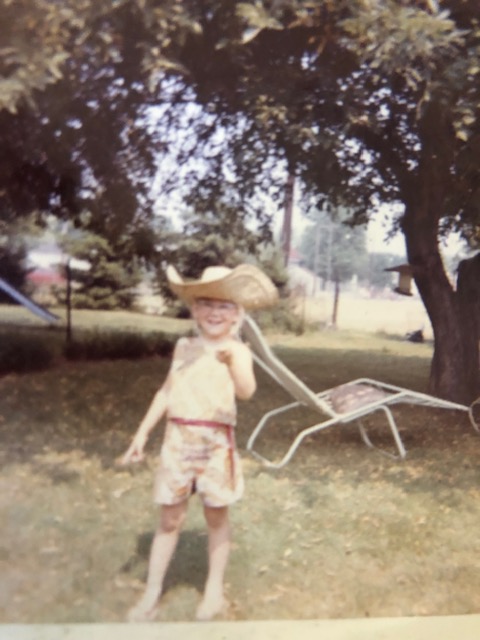
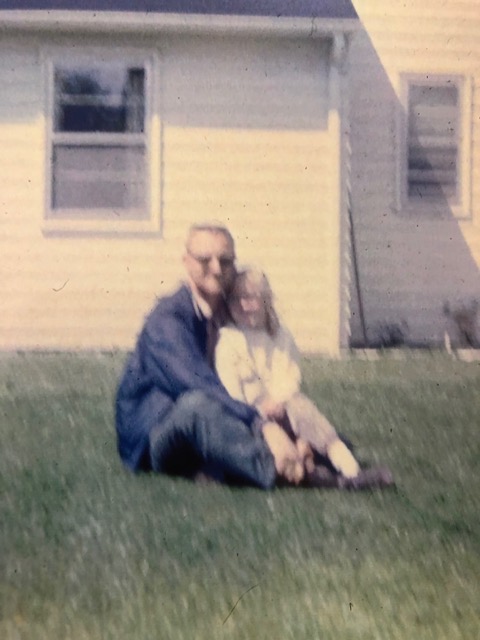
Growing up in a quiet suburb sixteen miles west of downtown Cleveland, my childhood was idyllic. One of my favorite places was my Grandma Hill’s backyard. I adored her apple tree. It was the only tree I was able to climb.

(Me, age four or five, in my grandmother’s backyard. Apple tree in background.)

Look at that kid. Why would that little girl want to know about the ramshackle Polish village where her great-grandfather was born? The thing is, I was very curious about family history. Even then. I liked hearing my Grandpa Malloy reminisce about my mother’s Irish ancestors. Grandma Hill had to have some of her own. More than once I’d heard her speak fondly of her dad, always ending with his most famous quote. “I’m the wealthiest man in the world! I’ve invested my future in seven different banks – my children!” If one of her grandchildren pushed for more information, she described him like a Disney character. He was a prince, humble and wise, from an aristocratic family somewhere in Europe. He loved to read to his children, and he valued education. He was a respected businessman in Berea, Ohio. No, he wasn’t Polish. Maybe Russian. Maybe German. Maybe Hungarian. But that’s not important. According to Grandma, we were 100 % American.

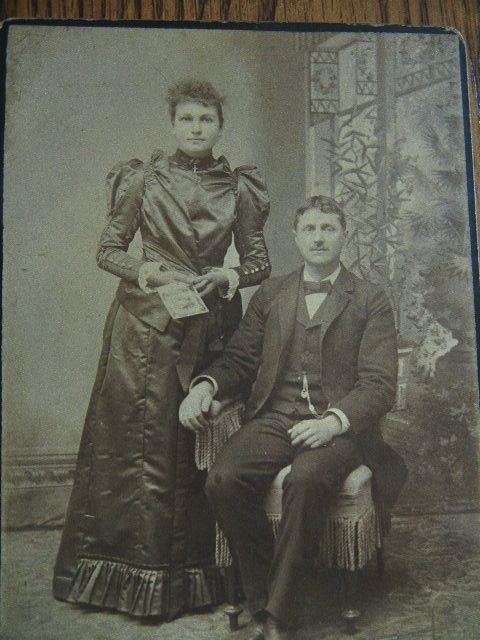
Grandma Hill’s parents:

Pelagia Szweda and Jan Dziedzikowski, 1892. The paper in her hand is their marriage license. This is the type of photo Polish immigrants sent back home to announce a marriage.

My grandmother, Harriet Doskey Hill, was the primary author of the fairy tale otherwise known as my childhood. Dated 1927, my father’s birth certificate was its first sentence: Myron John Hill, born, son of Joseph F. Hill and Harriet Doskey Hill. They’d been married ten years, without a child of their own. His birth provides the earliest example of them using their chosen Anglicized name on a legal document. In the records of St. Ignatius Church, their 1917 marriage is recorded under the names Jadwiga Doski and Jozef Gorzynski. Joe was a widower then, with a son named Frank. After they married, Hattie and Joe and Frank lived in the Gorzynski family house in Cleveland’s Warsawa neighborhood. My father’s birth was probably the reason for leaving the family behind. Jadwiga and Jozef re-created themselves as the All-American Hill family. Even Frank became a Hill before he ran away to join a carnival.

During the depression, Hattie and Joe signed loan papers for the unfinished shell of a foreclosed house in a rural Cleveland west-side village called Fairview. They succeeded in paying it off in six months. Buying this house provided them with a place to raise Myron HIll as a pure, unhyphenated American.

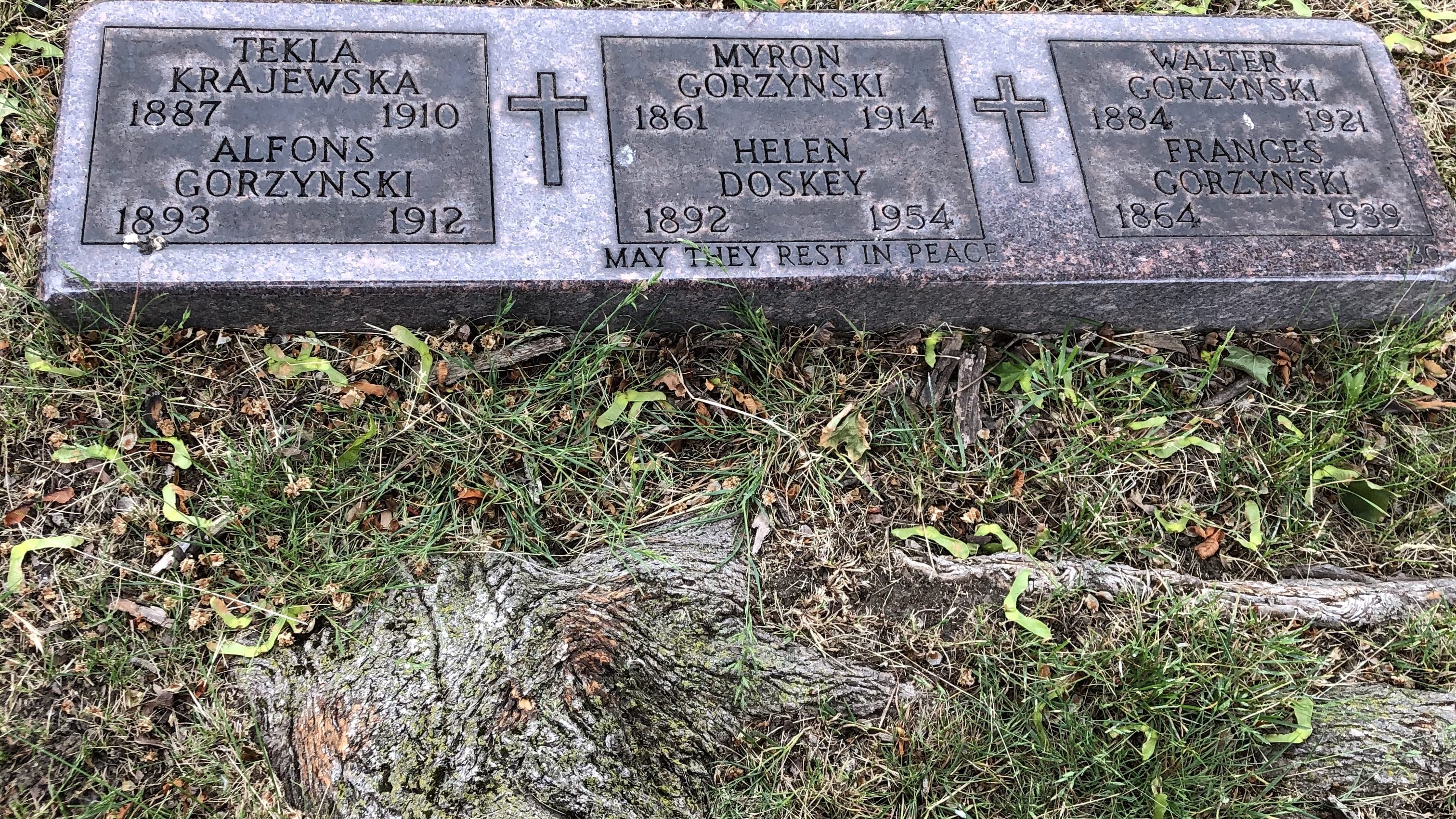
My grandmother’s penchant for changing names even extended to the dead. My father’s name, Myron, gestured towards the Polish tradition of naming a first-born son after his paternal grandfather. To secure her side of the story, she had it etched in stone: on my great-grandfather’s gravestone, his name is Myron Gorzynski. Judging by the age of the stone and the carving, it was placed there in the mid-1950’s, after grandpa’s sister Helen filled the plot. Gorzynskis had been dying since 1910, and I’m guessing an earlier, more honest, stone marked the spot. Great-Grandpa’s baptized name was Marian.

You’ll note grandpa’s sister Helen’s surname is Doskey. My grandfather’s sister Helen married grandma’s brother Clem. For the first few years of their respective marriages, they all lived together in the Gorzynski house, along with the matriarch, Frances (Franciszka) Gorzynski. Helen had a girl named Delma a few years before Hattie had Myron. Ultimately, both couples struck out on their own, leaving great-grandma Franciszka alone in a three family triplex. Censuses tell me she was illiterate and didn’t speak English.

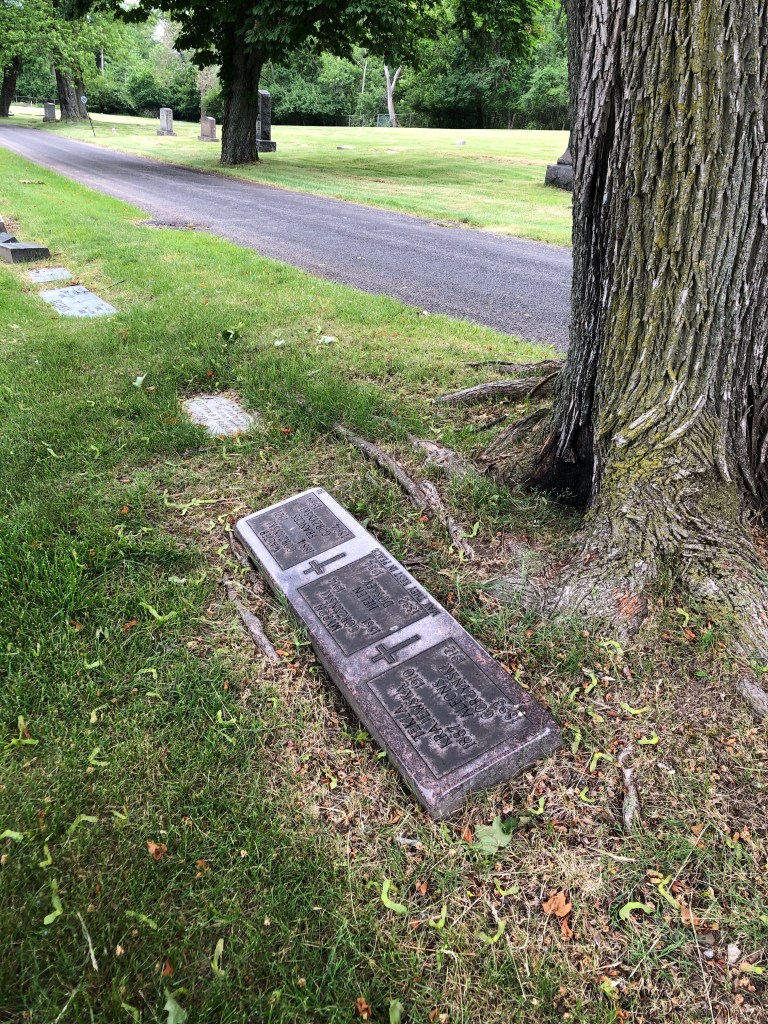
When I first saw this grave, I wondered if the stone was upside down. Or was the tree purposefully planted on top of the coffins? If so, did a Gorzynski plant it? Why? One thing’s for certain, once you’ve found the Gorzynski grave at Calvary Cemetery, you’ll always know where it is.

I suspect there was a feud between Hattie Hill and Helen Gorzynski-Doskey, and perhaps it was over the idea of changing a dead man’s given name. As the one who died last, my grandmother won. Taking control over the headstone, she altered details to her liking. Remarkably, she didn’t change the Gorzynksi surname. I like to think my grandfather refused to let her go that far in erasing his family’s memory.

My grandmother’s preserved receipts for “debts fulfilled” reveal a story of cemeteries. She paid for many headstones and their engravings, including her own. Except for the Gorzynski stone, they’re all located in the Doskey family plot in Holy Cross, Cleveland’s west side Catholic cemetery. Grandma even paid to exhume her father’s remains from the Polish section at Calvary and move him fourteen miles to his new resting place. The last time I visited Holy Cross, I couldn’t find any of them. I recognized names on some of the better-maintained graves in what I thought was their section, but the earth had all but consumed unattended grave-markers. I dug out a few, but found other names. I uncovered as many as I could until I lost heart. After all, I’d only stopped for a moment or two to visit my parents’ grave, before heading back to my home in Buffalo. I hadn’t any proper tools for unearthing headstones. Maybe another time. A warmer day. Luckily, I’ve seen the Doskey monuments before. The largest one memorializes John and Pauline Doskey, grandmas’s parents; the second largest is Harriet herself, beside her husband, Joseph Hill. Her younger brother Frank and his wife Irene are there too. Her sisters, Irene and Charlotte, lie nearby, as does brother Clarence, eternally estranged from his wife.

One night, only a year or two before she died, Grandma and I were alone together, drinking tea and talking. Again, I asked about my family’s Polish heritage. This time, she gave in. Sitting close beside me, she took my hand, and told a story about her father. He was the son of a Polish aristocratic family who lived on a forest estate in an area that was occupied by Russia. Their fortune was invested in lumber. One day, her dad was given a load of wood to deliver to the harbor and told to get a good price, take the money, and build a future in America. Here’s a modified version of this story from a letter my grandmother sent to my father’s cousin, Jack. He made sure I had a copy before he died. Here’s the important page:

Lucky Jack. He got the names she withheld from me. Suwałki. Dziedzikowski. But Jack was a historian by training, and a Doskey. She probably figured he deserved to know. I was a Hill, with an Irish mother. (My grandmother opposed her son’s marriage to a girl with my mother’s working-class Irish upbringing.)

When I gave the information from Jack’s letter to genealogist Iwona Dakiniewicz, her first reply was that Dziedzikowski was a ridiculous name. It was the kind of name peasants made up in America, so folks would think they’re aristocracy. She thought his name was really Dziedziach. Channeling my grandmother’s stubbornness, I told her I only wanted Dziedikowski records. She sent me a few.

Several years have passed since that research, and I’ve given in. Iwona was right. My great-grandfather’s name was really Dziedziach. In 2020, a DNA 3rd cousin who shared Doskey cousins with me appeared on Ancestry. His surname was Jessick. When I wrote to him, he told me his grandfather changed the family name from Dziedziach. Oh, how I admire this distant cousin’s style! The sound of “Jessick” is very close to the the Polish pronunciation of Dziedziach. With this varification, I turned to the Polish genealogy database Geneteka, and found the births of both my great-grandfather Jan and his brother, Stanislaus, who immigrated with him. In America, they both used the name Dziedzikowski and the pseudonym Doski or Doskey. When he died, great-grandpa’s name was given as John Doskey, and his father’s name given as Peter. Here’s the citation I found at Geneteka:

So, it would appear part of Jan Dziedzikowksi’s tale was true. His father’s name was Peter – Peter Dziedziach, and his mother had a name, too. Cesaria Mackiewicz. In the screen shot above,”Vesicle” indicates the Parish he was baptised in; Bilwinowo, the town of his birth. Through this database, I’ve traced two further generations back, discovering more ancestral names, both Polish and Lithuanian: Gieryk, Zdanowicz, and Sustkowki; Domalewski and Wyszenki. I traced each family back into the days of the Commonwealth. All lived in and around Bilwinowo. Notably, Bilwinowo is near Suwałki, as my grandmother said. Researching the greater Suwalki area during World War II, I watched the film “Legacy of Jedwabne” which documented those who remained in that village after the 1941 pogrom there. An interview near the end stopped me cold. It was with a man who, with his brother, cleaned up the remains of his incinerated Jewish neighbors. His surname was Dziedziech.

Bilwinowo is 132 km north-east of Jedwabne. Google Translate helped me read a Polish language wikipedia entry that calls my great-grandpa’s birthplace “The royal village of the Grodno economy.” This “royal village” designation harkens back to the Commonwealth days, when Bilwinowo was “within the Grodno district of the Trakai Voivodeship ”  “A characteristic feature of the Grodno district was the predominance of royal property over noble property, with a negligible share of clerical property. Within the Grodno district there were staroties: Filipów, Przewalski, Przerośl, Wasilków and smaller royal estates.” Bilwinowo was one of them. During the Polish Partition, as Russia tightened its control over the area, former Polish aristocrats or royals who lingered risked deportation, or worse. Geneteka tells me my 2X great-grandpa Peter died two years after his sons left for America. A year after his death, widowed Cesaria remarried Leonard Tylenda, and had a daughter. I’ve found some records in northern Michigan that suggest they came to America.

North-east of Suwalki, Bilwinowo is located in a borderland region known as the Suwałki Gap . Some consider this to be the most dangerous place on earth right now. “Stretching about 100 kilometers along the Lithuanian-Polish frontier, between Belarus in the east and the Russian exclave of Kaliningrad to the west, Western military planners warn the area would likely be one of the Russian president’s first targets were he ever to choose to escalate the war in Ukraine into a kinetic confrontation with NATO.” (Politico). Some think the third world war could ignite in the Suwalki Gap.

So, I don’t plan to visit there anytime soon. Luckily, the internet has informed me a little about Bilwinowo. From above, it looks like this:

Walking down that road, a visitor there would come across the crosses. It appears that Bilwinowo is famous for the crosses people have erected there, memorializing what stood, long ago.

This photo is taken from a Polish blog page titled “Bilwinowo“, which features many photos of the memorial crosses erected there. Again, I used Google Translate to read the account of these monuments. Here’s what it said:

Another cross is located in the center of the village, next to the recently built chapel commemorating 220 years of the existence of the village of Bilwinowo. There is an inscription on it:

Less of us in your care – a souvenir of the village of Bilwinowo.”

This is where May services are held. Almost the entire village gathers and at 7 p.m. a litany to Our Lady of Loreto is recited, and later songs are sung in honor of Mary.

This cross was made a long, long time ago and, like other crosses, it was initially made of wood, and in July 1986 it was made of gravel.

So, my great-grandfather’s tale of noble ancestry have some truth to it. However, evidence of his family’s fortune in the homeland has been destroyed by one hundred and fifty years of occupation and war.

Still, people live there. Not many. Stalwart types, I imagine. Survivors. Former royalty or nobility?

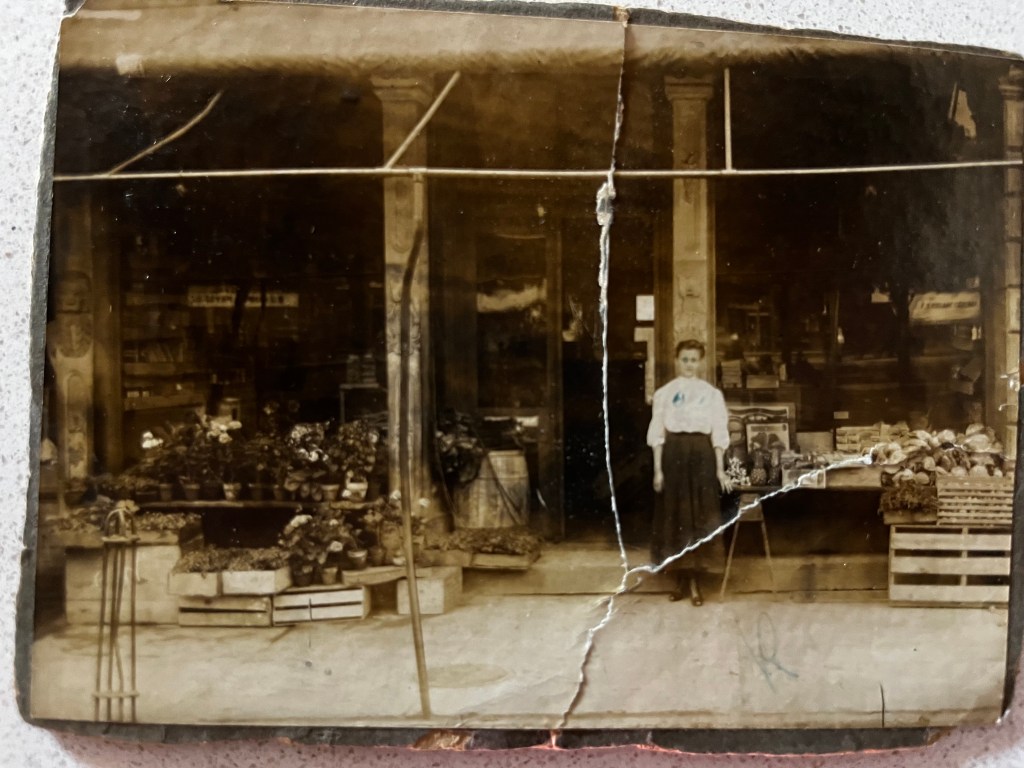
My Great Grandpa Jan Dziedziach/Dziedzikowski/Doskey, was a survivor, too. He operated a successful grocery store in Berea, Ohio for over a decade and raised and educated seven children. When he died, he owned his own home on the west side of Cleveland, Ohio. His was a Polish-American immigrant success story, largely due to his chameleon nature. Dziedziach, Dziedzikowski, Doski, Doskey. He assumed whatever shape the circumstances required of him, and from him my grandmother learned her dissembling ways. Harriet Hill was a force to be reckoned with: confident and well-spoken, she attracted admirers, well into her eighties. I’m forever grateful for the role model she provided; I am the continuation of her American success story. I honor her every day of my life. But how American was Hattie, really? Everyone, even her grandchildren, noticed that slight accent she couldn’t disguise, and how dark her olive-colored skin became if she went outside on hot, sunny days without a parasol.

Hattie Doskey, formerly Jadwiga Dziedzikowska, approximately 1916, aka “Grandma Hill”

What Happened After My Ancestors Left Poland, Part 3: Bryńsk

Thanks to Iwona Dakiniewicz’s 2017-2018 research in Poland and my own subsequent research on the Polish database geneteka.com, I can say my paternal grandfather Joe Górzyński’s family lived in and around the village of Bryńsk in Działdowo County, Warmia Masuria from approximately 1790 until 1910 or so. Maybe longer. His parents lived in two of Bryńsk’s colonies – Czarny Bryńsk and Ostrowy Bryńsk – before they immigrated to the United States in 1881. Were their families originally from this area? Maybe. The name Górzyński may be derived from the nearby town of Gorzńo. But they may have migrated here, by choice or force, from another part of Poland. A distant Ancestry DNA match told me that his Górzyńskis were from an area closer to Warsaw, on the Vistula River. The two families – likely cousins – immigrated to the Americas at roughly the same time. Our DNA tells us we have a common ancestor who lived sometime during the 18th century.

(View of Czarny Bryńsk from Ostrowy. I took this film in 2018, when my husband Phil and I toured our home villages with genealogist Iwona Dakiniewicz.)

Another American with links to Bryńsk, Kent Kolberstein, has a blog called Visit to Bryńsk that documents his visit to Bryńsk. His blog provides this Google translation of a description of Bryńsk’s history:

“Outline of the history of the village of Brynsk”

“First recorded in the sources, our Brynska name was “Brennitia” and comes from the year 1229. In 1410 the Teutonic Order used the name “Borausee”. Brynska areas were settled after the partition of Poland by arriving German colonists to Lidzbarka and its surroundings. The first houses were built along the channel of the river Brynicy. In time, expansive sustainable forestry led to the formation of large clearings, no locals whom they settled workers. Conducted at the beginning of the nineteenth century colonization of Prussia led to the creation of five large settlements of a common member Brynska ie. Brynska Krolewski (Royal), Brynska Szlachecki (knighthood), Brynska Kolonia (Colonie), Brynska Czarny (Black) and Brynska Fialka (no polish translation but it means “violet” in Russian). No area of sediment rapidly, operated brickyards, distillers, mill with a windmill and sawmills and inns. Brynska Szlachecki (knighthood)was at that time an important center industrial-commercial. Today in the area are preserved foundations of the tavern, a brickyard, and a kiln lime and tar. Currently, the village Brynski captivate the beauty and its rich history.”

Born in Bryńsk, my 2X great grandfather was baptised Johann Górzyński at the Catholic church in Górzno. The eighth child of Franciszek and Jadwiga (Renska)’s eleven, and the sixth son, I’d wager Johann couldn’t count on inheriting much of the family fortune. He became an itinerant carpenter. In 1854, he married his first wife, my great great-grandmother Julianna Falkowska. They had two boys, Jan and Marian (my great-grandfather), before Julianna died. A widower at 29, Johann remarried Ewa Lampert and returned to his traveling profession, producing thirteen more children in various villages throughout Masuria while, apparently, his two eldest sons remained in Bryńsk and Czarny Bryńsk. Johann died, around 1891, possibly in Mroczno. In 1895, Ewa and her children moved to Chicago. My great-grandfather’s half siblings had many children, some of whom are also trying to rediscover the Górzyński story. On first encountering the current generations of Johann and Ewa’s kin, I felt a bit like an interloper. Most of them knew their shared ancestors were a great-great grandma named Ewa Górzyński and her husband Johann aka Jan. They didn’t know Ewa was a second wife, and Johann had two elder children from another wife. Our DNA helped verify this. I’m especially grateful to my Górzyński third cousins Joanne and Paul, who corresponded with me about our DNA relationship. Together, we’re mapping out the story of the Górzyńskis in America.

My great-grandmother was Franciszka Gołembiewska, born up the hill from Czarny Bryńsk, in Ostrowy (also known as Ostrowy-Bryńsk). She was the eldest daughter of Thomas Gołembiewski and Anna Prusak. In her initial research in 2017, Iwona found several significant Gołembiewski records, including five of Franciszka’s sibling’s births and marriages, with husbands’ birth places, parents’ names and significant dates.

The fates of the Górzyński and Gołembiewski families summarize several of the choices made by Poles living under occupation in the late 19th and early 20th centuries.

The Wikipedia article “History of Poles in the United States” says that” Between 1870 and 1914, more than 3.6 million people departed from Polish territories (of whom 2.6 million arrived in the U.S.)” According to my Ancestry and 23&Me DNA matches, several Górzyńskis, Gołembiewskis, Prusaks, and Falkowskis ended up in Nanticoke, Pennsylvania; Buffalo and Rochester, New York; Chicago, Cleveland, Wisconsin, New Orleans, and Los Angeles. I have a few 4th cousins in England and Canada.

While the Górzyńskis scattered throughout the English speaking world, only two of the Gołembiewskis followed them. Others remained in Europe. One great-aunt, Josephine, married Franz Amenda in 1890. Recently, I discovered another tree on Ancestry that named Josephine Golembiewska and Franz Amenda as great-grandparents. This tree featured a photo of their daughter, Honorata. This name alone captured my attention: my grandfather’s eldest sister was an Honorata, too. And I thought I detected a resemblance between Honorata Amenda and my great-grandmother. I reached out to the researcher, and after a few exchanges, we both agreed we’re third cousins. The Amendas moved to Essen, Germany, probably before the first world war.

A few of the Gołembiewskis stayed in Poland. 2X great grandpa Thomas died in Ostrowy in 1895. My great aunt Julianna Gołembiewska married Johan Bartnizki in Bryńsk on November 22, 1903. A year later, her mother (my 2X great grandmother) Anna Prusak, died in Ostrowy. Julianna’s husband Johan died of old age or heart attack in 1944 in Dzialdowo. She died three years later, also in Dzialdowo.

The city of Dzialdowo is thirty three kilometers from Bryńsk. Its Germans name is Soldau. Early in World War II, the Nazis built a concentration camp there.

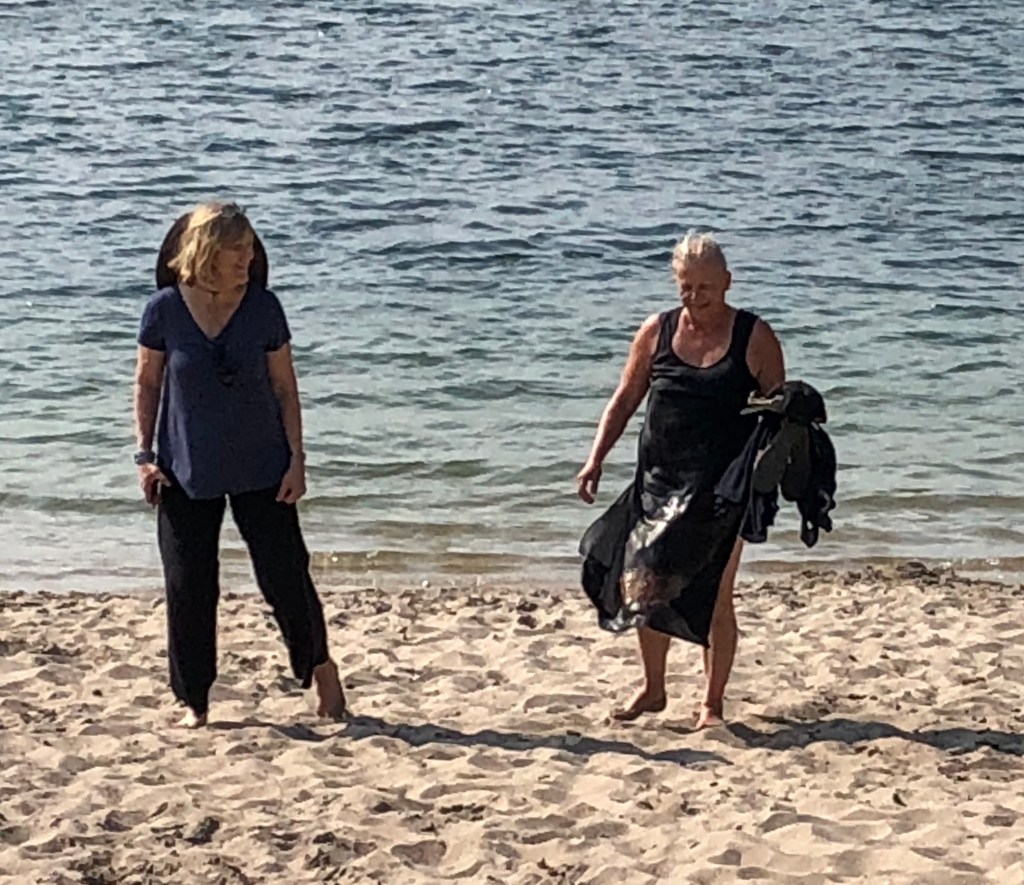
Flashback: It’s 2018, I’m standing knee deep in Lake Piaceszno, thirty kilometers west of Dzialdowo. A pristine lake with a stunning beach, it once provided the setting for a Prussian hotel. An odd place to be born. But according to my great-grandfather Marian’s baptismal record, he took his first breath by that lake. So in 2018, I ignored Iwona’s warning that there’s nothing much in Piaceszno and insisted it be one of the stops on our ancestral tour.

It was a sunny late spring day. We’d been driving around for hours. We pulled into a parking lot and looked around. Across the road from Lake Piaceszno were fields; behind the lake, forest. Mid-afternoon sun glinted on the rippling water. It was hot, and we’d been driving for a few hours. Without a second thought, Iwona dove in, totally clad. I wanted to join her, but, conscientious middle-aged American traveler that I am, I was wearing pants with a money belt underneath them. All I could do was roll up my pants’ legs and wade in. After a brisk little swim, Iwona joined me in the shallows, and we walked together to the beach.

“I couldn’t control myself,” she said. “This lake is perfect.” I agreed. I was smitten by the beauty of the land the Górzyńskis had left behind. As if reading my mind, Iwona said: “You know, your family didn’t want to leave here. They had no choice but to go. You have no one left here.”

It took a few years for me to understand what she was telling me.

This past summer, I read about some mass graves discovered near Działdowo. 17.5 tons of human ash were found. Officials estimated that least 8,000 were interred there. The BBC says “The bodies are thought to have been dug up and burned in a Nazi operation to hide traces of their murders. The Nazis murdered Jews, political opponents and members of the Polish elite at Soldau.”

An early report said these ashes included the remains of residents of the surrounding villages. I recently found additional evidence to confirm that, on a Facebook page I follow called Przystanek Górzno (roughly translated “Bus stop Górzno.”) On September 1, 2023, their commemoration of the Nazi invasion of Poland was the text of a monument erected in the middle of the Bryńsk square. Though FB’s translation was far from perfect, the meaning was clear. It seared into my heart. It described September 1, 1939 as a pleasant late summer day. No one in Bryńsk knew what was happening in other parts of Poland. A German soldier or two appeared, for what seemed a routine inspection. No one suspected. But the next day, German troops appeared and rounded everyone up, led them into the woods, and executed them. A few escaped and hid in the basement of an old schoolhouse.

Yet, great-aunt Julianna and her husband survived the war. They were both 70 years old when they died, apparently of natural causes, in the city of Soldau. Johann’s profession on his 1944 death certificate was listed as “laborer.”

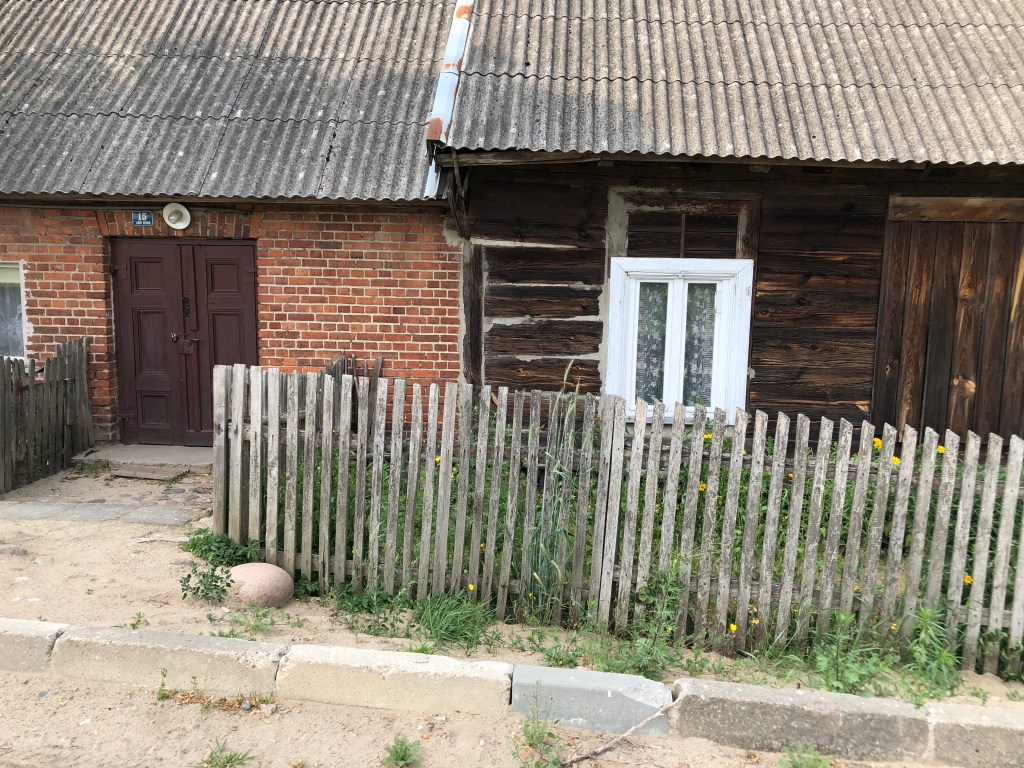
Today, Czarny Bryńsk houses the headquarters of the Gorzńo-Lidbark Landscape Park. A few houses. Farms. Lots of fields. Woods. Rivers. Lakes. Driving there, the roads weren’t good. Iwona feared for her tires. Finally, we came upon a sign, and I demanded that we stop. Regretably, I didn’t take a photo of the sign. This image was posted on August 18, 2023 at Przystanek Gorzńo:

“That building,” Iwona said, pointing to the wooden cottage. “Dates from the time your family was here.”

I examined it as closely as I could.

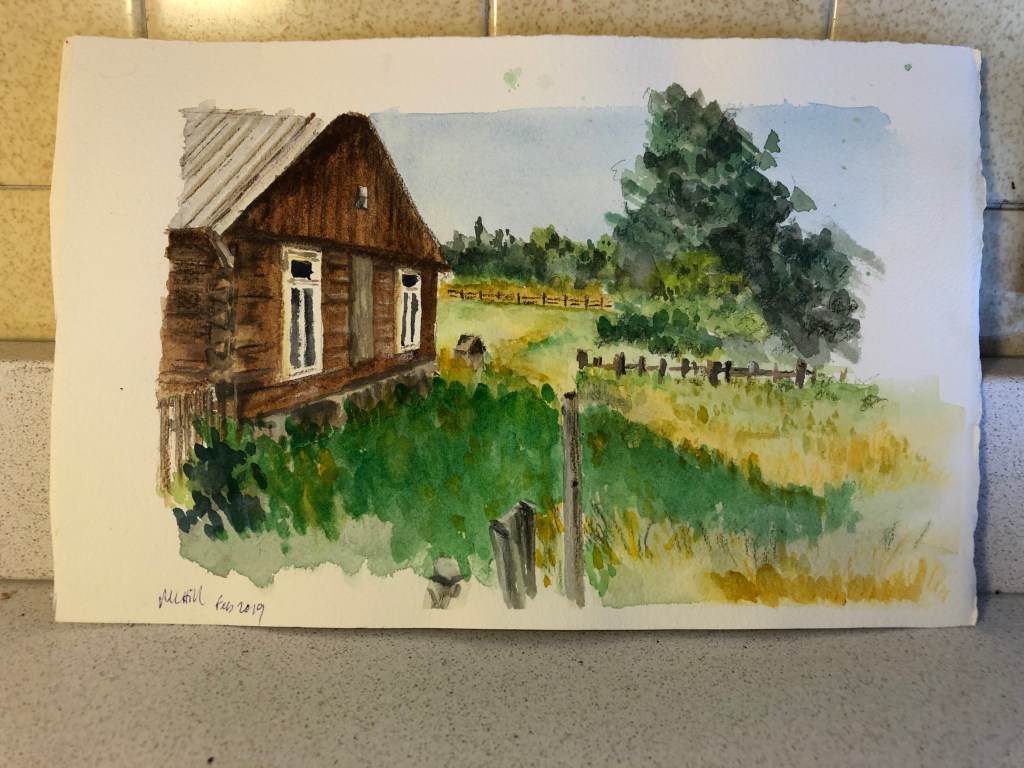
On that trip, we also visited Krakow, Warsaw, Toruń, and Gdańsk, as well as my husband’s grandfather’s birthplace of Turza Wielka. (Only twenty-six kilometers from Piascezno.) Once back home, I obsessed over these photos, especially those of that old wood cottage in Czarny Bryńsk. My Górzyńkis were carpenters, after all. Perhaps they helped build this relic. Finally, I painted a watercolor of it.

On the Gorzńo Facebook page, this house gets featured often. It’s obviously a landmark for those who know the area. People tell stories about, the most common being that it was a schoolhouse, a long time ago. Does it have a basement? I don’t know.

What Happened After My Ancestors Left Poland, Part 2: Sadki

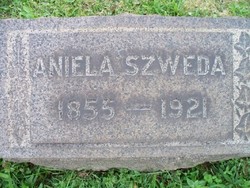
Jakup and Aniela Szweda are my Grandma Hill’s grandparents. They were the first of my Polish ancestors to arrive in New York harbor, on April 18, 1870, aboard a ship called the D. H. Watjen. I’m not sure how long it took them to get to Berea, Ohio, where these graves are located in St. Adelbert’s Cemetery. When we asked why our family settled in Berea, my father used to say that “Berea” meant “This is where the wagon wheel fell off.” I thought he was kidding. Seven years ago, I was contacted by an Ancestry DNA match – I’ll call her L – who knew a lot about this branch of the family. L told me that the Szwedas were part of a larger group that ended up in Wisconsin. (The name Szweda shows up several times in a list of Kashubians who settled in Canada, Minnesota and Wisconsin.) Only a few stayed in Ohio. Why? Perhaps my father wasn’t kidding, and Berea was where the wheel fell off. In the early 1870’s this rural community fifteen miles southwest of Cleveland offered a lot to immigrants looking for work and a new home. According to the 1911 installment on the United States Immigration Commission’s Immigrants in Industries part 24 Recent Immigrants in Agriculture (available in Google Books), “there is a large Polish population, both in the town of Berea and on small farms in the immediate vicinity, as a greater part of the employees in the stone quarry . . . are of that race. . . A large number of the Poles either own small farms of from 1 to 10 acres, with a house, and work in the quarries, or rent small tracts of improved land.” The report concludes “Because of the opportunities for outside employment and because most of the {land} purchasers have bought only small tracts, for which they could soon pay, the immigrants at Berea have suffered few of the pioneer hardships frequently experienced by immigrants in purely rural locations.” So, my grandmother’s migrant ancestors’ story had a happy ending, if they could avoid getting crushed in the sandstone mines.

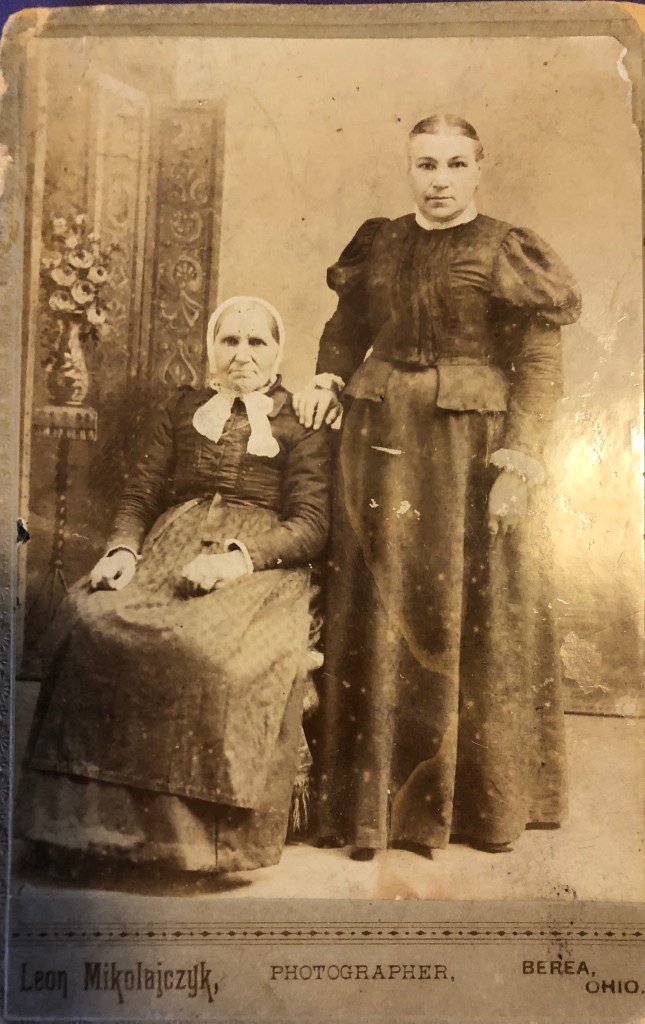
The standing woman below is Aniela, with her mother, Mary Januszik Skorcz, who also rests in the Berea cemetery.

“L” told me to check the Poznan Project database for their home in Poland. And sure enough, I found Jakup (Jacobus) and Angela 1865 marriage in the Catholic Parish in Sadki.

Through the Poznan Project, I could confirm the origin of several other Berea residents, including many of Jakub and Aniela’s siblings and cousins. If not from Sadki, they came from nearby villages. Did every resident of this corner of Poland migrate to Wisconsin or Ohio or where ever in America their particular cart lost its wheel? I don’t know. I imagine a stubborn few remained. The elders and their caregivers. Hopefully, they had all died off or moved away by 1939.

Thirty-eight kilometers west of Bydgoszcz in northern Poland, Sadki currently has 2,000 inhabitants. Wikipedia tells me this region has been part of Poland since the tenth century, when it was a royal village. Prussia occupied this area throughout the nineteenth century and into the twentieth. The Versailles Treaty returned it to Poland in 1919, but that only lasted until September of 1939. According to Wikipedia, “During the German occupation of Poland (World War II), the local forest was the site of executions of 86 Poles from Sadki and other nearby villages, perpetrated by the S.S. and Selbstschutz in October and November of 1939 as part of the Intelligentzaktion.

May they rest in peace.

Other than this Wikipedia image of St. Adalbert church there, I’ve found very few photos of Sadki.

Notably, the church built in the 1870’s by the new Polish residents of Berea, Ohio was also called St. Adalbert’s. This postcard image from the church’s centennial anniversary book may have been sent to relatives back in the Old Country.

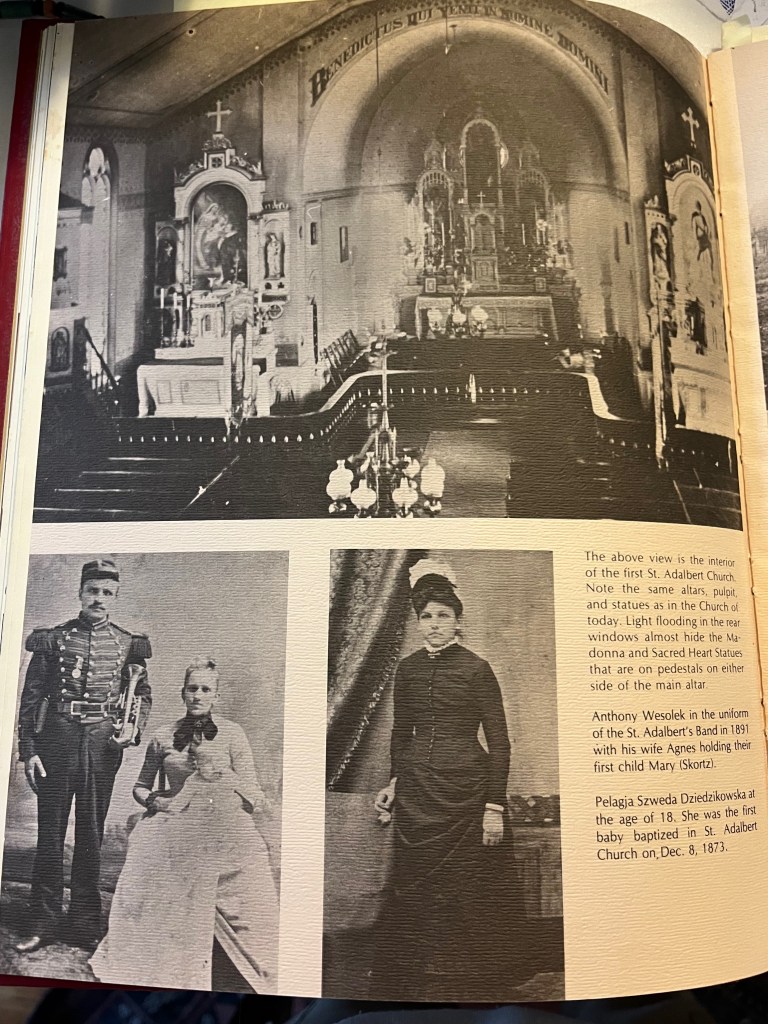
As with all of the churches built by Polish immigrants who settled in the United States, Berea’s St. Adalbert’s interior was lavish, as can be seen below. (The annotation says this is the interior of the “first” St. Adalbert Church. When, in the early 1930’s, it was determined that the steeple and the foundation of the original building needed extensive, expensive repairs, the Polish community in Berea opted to build a new church instead.)

As the last annotation on the right says, Berea’s St. Adalbert’s first baptism was celebrated on December 8, 1873. The child was the first American-born child of Aniela and Jakub Szweda. That girl, Pelagja, married a Polish immigrant named Jan Dziedzikowski and had seven children. My grandmother, who was baptised Jadwiga Dziedzikowska, was their eldest.

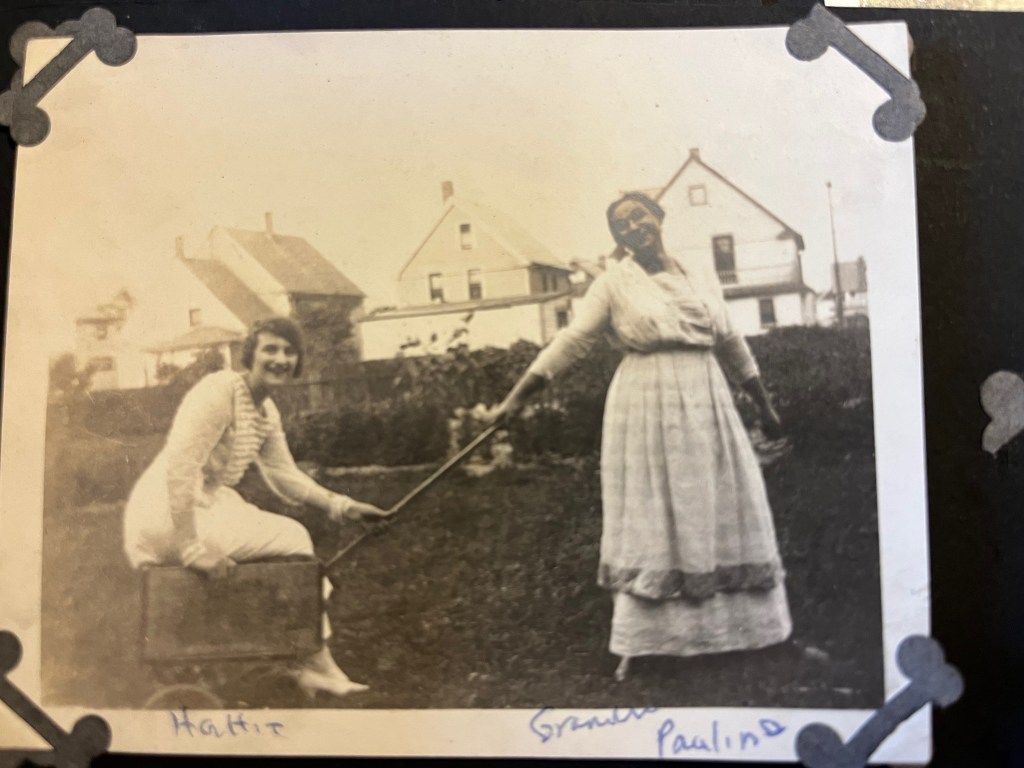
Pelagia (later known as Pauline) playing with her eldest child, my grandmother, Jadwiga (Hattie). Approximately 1917.

What Happened After My Ancestors left Poland, Part I

It was inevitable.

As an obsessive family historian and researcher, I knew someday I would have to seriously approach the question of what happened to my Polish ancestors who stayed in the homeland.

For over a decade, I’ve been restoring the severed Slavic branch of my family tree: Grandpa Hill’s family. We considered them our black-sheep. Some of my siblings thought it best to honor our grandmother’s stated desire to never speak of them, but I resisted. I couldn’t help it. When I looked in the mirror, I could see them looking back at me. I needed to know why we became estranged. They must have done something truly awful. But what awfulness could justify keeping children from knowing their grandfather’s story? We learn from our parents’ and grandparents’ mistakes, after all. Their hard-earned lessons are our inheritance. Repressing past stories silences important lessons.

For years, I thought my Anglo name was randomly chosen. I was in my fifties when I finally learned that my surname – Hill – is a translation of the “gora” in Gorzynski. Anyone in the 1920’s rustbelt Polish-American community would have recognized the code. My father and his mother chose not to pass it on to me when I was born in a Cleveland suburb, in 1958. Family Search and Ancestry led me to my correct surname, and my great-grandparents’ story. I’ve since traced their American journey backwards to their arrival at Castle Garden. Then, with the help of Iwona Dakiniewicz, a genealogist I met through the Polish Genealogy Society of America, I located all my family’s offshoots in Poland. Where once I barely knew grandparents, now I know at least three generations.

My father’s pedigree represents three different Polish cultural regions. Dad’s paternal grandfather was a Górzyński who was baptized in Górzno in Brodnica County, Kuyavian Pomeranian Voivodeship. Great-grandpa’s father and grandfather were baptized in nearby Bryńsk. Górzno public records document the 1859 birth of my great-grandmother, Franciszka Gólembiewska, in nearby Ostrowy. Her parents were married in Górzno, too. Her mother’s family, the Pruszaks, appears to go back several generations in this area. So far, I can’t say that for her father. Perhaps he was itinerant, as my great-great grandfather Górzyński was.

Elevation of the Holy Cross Church, Górzno, Poland. Photo taken by me June 19, 2018.

My grandmother’s father came from the Suwałki Region. He immigrated in 1881. Grandma’s mother was the first American-born child of immigrants from Pomerania. I’ve yet to visit these areas, but my husband and I were able visit the Górzyński homeland in 2018. With Iwona’s help, we saw some of what’s left in the villages of Bryńsk, Czarny Bryńsk, and Ostrowy. The lands around them are a landscape park now.

A view from our cabin at Hotel Dworek Wapionka, Górzno, Poland. My photo, taken June 19, 2018.

Taken at Pałac Myślęta Hotel, My photo, taken June 18, 2018. (This is not in the Górzno-Lidzbark Landscape Park; it’s forty minutes away from there, in Uzdowo.)

I fell in love with the landscapes of my homeland. To honor my ancestors’ lost memory, I wrote a novel in which I imagined rural Poland, one hundred and fifty years ago. This was a time when Poland didn’t exist, having been partitioned during the 1790s by its neighbors, Prussia, Russia and Austria. In West Prussia, where my family lived, Polish language, history and culture were prohibited. What was the breaking point that caused them to finally decide to leave this beautiful homeland? The Górzyński migration took them first to the Susquehanna Coal Company mines of Nanticoke, Pennsylvania. After ten years there, they moved to Buffalo, New York; a decade later, they resettled in Cleveland. My great-grandfather died in a house he co-owned with his sons. A nice ending to a tumultuous journey. Their story really isn’t remarkable, though; it’s the story of thousands of Poles who migrated to industrial America. Proud, hard workers, they didn’t always assimilate well. In fact, some planned on returning home. Some did. Americans, for the most part, weren’t kind to Poles. In 1901, when a “Polack” shot President McKinley at the Pan American Exhibition, anyone Slavic became even more marginalized. That infamous event ends the book. I’ve been marketing it under to titles: The Double-Souled Son and The Polish Assassin. I’m hoping a publisher or agent will help me decide which is better.
I’m three generations away from the Górzyński family’s migration – enough time to forget any Polish patriotism my family ever felt. I have no known relatives in Poland, though Polish records indicate some of them stayed. Did they survive? They were rural folk. In each of my ancestral home regions, villages were destroyed, if not by the Germans, by the Russians. What I’ve learned about my family’s villages keeps me up nights. One early morning, while sipping warm milk and honey, I remembered a similar autumn night, forty years ago. I was drinking tea with my grandmother, and I asked her if we still had family in Poland. Slapping her hands over her ears, as if I’d screamed at her, she shook her head. “It’s too horrible to tell.” After that, she clammed up.

I had a blissful childhood, thanks to her. I remained naive about the world’s evils well into adulthood, thanks to her. I don’t blame her for her choices, but I’m glad I now know what she kept from us. Because it’s happening again. The current Russo-Ukraine war harkens back to what happened in Poland, not so long ago. If we think of ourselves as our families, ancestors and all, we’ve all been forced to migrate before, and given our current climate crisis, it’s likely to happen again.

This is the first in a series of photo essays about the events in my Eastern European home regions after my great-grandparents left. I like to engage in a lot of other art forms while I’m working on a novel. Watercolors were significant to my process writing The Double Souled Son. These blog entries are process writings for a new novel. Tentatively titled American Limbo, the next Górzyński novel imagines my Polish-American grandparents’ coming of age in jazz age and depression-era Cleveland, Ohio. Based on what little my grandmother told me, the news from abroad during those years contributed to her decision to opt for total assimilation.

Each entry will briefly describe the family that left that given area, when they left, and what happened in those villages after they left. To sweeten the bitterness of forthcoming content, I’ll stick to facts alone, while including photos and paintings of my ancestral landscapes as they are today. I couldn’t imagine a more beautiful place.

A field in Czarny Bryńsk, Poland. Taken by me, June 18, 2018.

Here Lies Frank .

  1. The Biggest Mystery in the Hill Family Tree

I was probably eight before I heard one of my parents mention him. 

Frank. My father’s only sibling, his half brother Frank.

What? Dad had a brother? My brothers and sisters and I thought he was an only child!

 “Yep,” my father told us. “He ran away to join the circus. He was a circus barker.”

He laughed that ironic laugh of his. I always read it as both sarcasm and discomfort.

Why?  To a kid, Circus Barker seemed both a viable and interesting profession.

“Don’t ask your grandmother about him, though,” he added.  “She’ll get upset.”

(Me, age four or five, in my grandmother’s backyard.)

My parents already owned a bungalow on the west side of Cleveland when my grandfather died. I was six months old, their second child. When I was three, we moved to a new house near Grandma. She lived in the house Grandpa built for her in Fairview Park.  For their family.  In her mind, that meant her son, Myron.  Not Frank. 

Myron – my father – grew up in that house.  He spent a lot of time alone. In fact, he was probably one of the first “latch-key” kids.  Grandma was proud to say she was a working woman. 

(Myron Hill, Grandma’s desk photos, on Grandma’s desk.)

Grandma was eighty-five when Myron died, at fifty-one. Many of her friends and family were already gone.  My mother, my siblings and I all took turns visiting her.   I enjoyed my Tuesday visits.  We’d sit alone in her living room, drinking tea and talking.  She asked about my schooling, my job, my boyfriend.  (She liked my boyfriend and ventured to give me advice about how to manage him. I had a bachelor’s degree by then, too. She was awed by that.) But I was managing a medical office. Or working in a hospital. I was a secretary, just as she once was. What did I do to relax? Baking, I told her.  “I get up and bake if I can’t sleep.”  “Me too,” she said, her voice quivering. We talked a little more about things I liked to do – reading, music, being quiet.  “You are more like me than I thought” she said one night. 

Until those evening teas, I sensed that she favored my two sisters.  They both inherited her dark skin tone and hair.  Her rebellious spirit. She didn’t see much similarity between my father and me. I had my mother’s Irish complexion and nervous giggle.   My mother told me later Grandma Hill made it clear very early in their relationship that she did not want her son to marry a working class Irish girl. When her attempts to block their marriage failed, she refused to celebrate with my mother’s family.  On their wedding day, my parents had to attend two receptions, one in Cleveland, and one in Fairview.

In the 1980’s, my grandmother and I became friends on those Tuesday nights. So much so that on one night, I felt I could venture into forbidden territory.    

“So, what can you tell me about our Polish background?”  I said.

She stalked away from me, into the dining room. Before she disappeared into the kitchen, she turned and said: “Why do you insist on asking this again?” 

“It’s because it’s who I am,” I answered, thinking it a weak reply.

It hit a nerve.  Her face fell.  She disappeared into her kitchen, returned with some cookies, sat down next to me and told me about her father, who came from a place called Suwałki.  Yes, that’s in Poland now, but it was in Russia for a long time.  I knew her dad’s grave said “John Doskey,” what she didn’t tell me was the name was changed. After she died, I discovered his name was Jan Dziedzikowski.  (Another fake name, but that’s another story.)

I asked about my grandfather’s folks.  She grew frustrated, tried to explain the Polish Partition to me, then said “his people came from all over.  Germany, Austria, some Russia.  Mostly Germany.”    

When I asked about Frank, her voice rose and grew agitated: “He was a bad man! Don’t ever speak of him again!

(My paternal grandparents, Joe and Hattie Gorzynski, 1917/8, right after they married.)

Impossible.

Frank haunted me.  Came to me in dark clouds at night. Made appearances at Ouija board sessions. As a spirit, he was unpredictably nasty.

After hearing me inquire about Frank several times, my mother told me what she could: dad’s brother was “a little” older.  He ran away to become a “circus barker.” Mom thought he was married for a while, maybe even had kids.  Somewhere around Boston.  He died in Florida, “where the circus workers winter.”

“So now you know,” she concluded. “Don’t tell your grandmother I told you.”

Frank died March 26, 1958; I was born that September; my grandfather died March 22, 1959.  When Dad found Frank’s death certificate under some papers on his mother’s desk, he didn’t know his brother had died. Reportedly, it was one of the few instances he lost his temper with his mother.  When he demanded they exhume the body so Frank could be buried in a Catholic cemetery, Mom said he encountered roadblocks. Read: his mother. Grandma won, like she won most of the time.

Frank haunted him, too, though. 

Around ten years later, my parents were on their second vacation in Siesta Key when my father announced he wanted to look for Frank. He went alone. After some time, he returned, more silent than usual.  Finally, he told my mother he found nothing.

I know all this because Mom told me. When I realized I had someone who was willing to talk, I asked for more details.

“Did you ever meet him?” I asked. 

Yes. Once, after they became engaged, she went to the Fairview house to meet him. He was home. He’d totaled his car and he needed money. “He was really tall!”  (My dad was 6’4.”) According to mom, Frank was taller, very handsome, very charismatic.  He “checked her out” and made some comment on how my father nabbed a sexy babe. Or something like that.

“I didn’t think he was that bad, but your grandmother sure didn’t like him. Your father loved him.”

My father didn’t show much emotion towards anything.  So, if Dad loved him, then Frank was worth knowing about. 

2. How to do genealogical research on a Carny.

The death certificate was not in my grandmother’s final papers. She probably burned it. Around twelve years ago, I found our true family name – Gorzynski – and wondered if he used the name Frank Gorzynski, and that’s why my father couldn’t find him. No. With the correct surname in play, Ancestry.com kept yielding new insights. New family members. My grandfather was one of eight kids.  At nineteen, when he was still Jozef Gorzynski, he married his first wife Sophia Rucinski , age seventeen.  A year later, in July 1909, Sophia bore a son. Frank Joseph Gorzynski.  In 1912, when Joe was 23 and Sophia 21, she died.  Frank and Joe moved back to his parents’ house.  There, three months after losing his wife, Joe’s seventeen year old brother Alfons died. Tuberculosis, same as Sophia.  In 1914, six months after his sister Tekla succumbed to post-delivery sepsis, Joe’s father Marian died. From Diabetes. (Insulin hadn’t been discovered yet.) In 1917, Joe married Hatti Doski, formerly Jadwiga Dziedzikowska, my grandmother.  Jadwiga and Jozef Gorzynski lived with their “son” Frank in the Gorzynski family home in Cleveland’s Warszawa neighborhood for ten years. During that time, Joe lost two more of his brothers. Frank didn’t finish high school. He worked as a “driver.”  In 1927, the year my father was born, Joe and Hattie became “Hills” and moved to their own apartment, and Frank Hills moved with them.  They shared the same address until 1930 when Frank was counted twice on the national census: in his father’s household and in the household of his Sophia’s sister in Elwood, Indiana, about an hour away from Peru, Indiana, which is where the circuses wintered at that time.  By then, Frank Hill was 21. My father was 3.

International Circus Hall of Fame, Peru, Indiana

When I found this museum, I wrote to them about possible records.  The man who replied was very polite when he informed me no one kept records on the carnies.  There were too many of them.  I detected my father’s short ironic laugh in between his lines. 

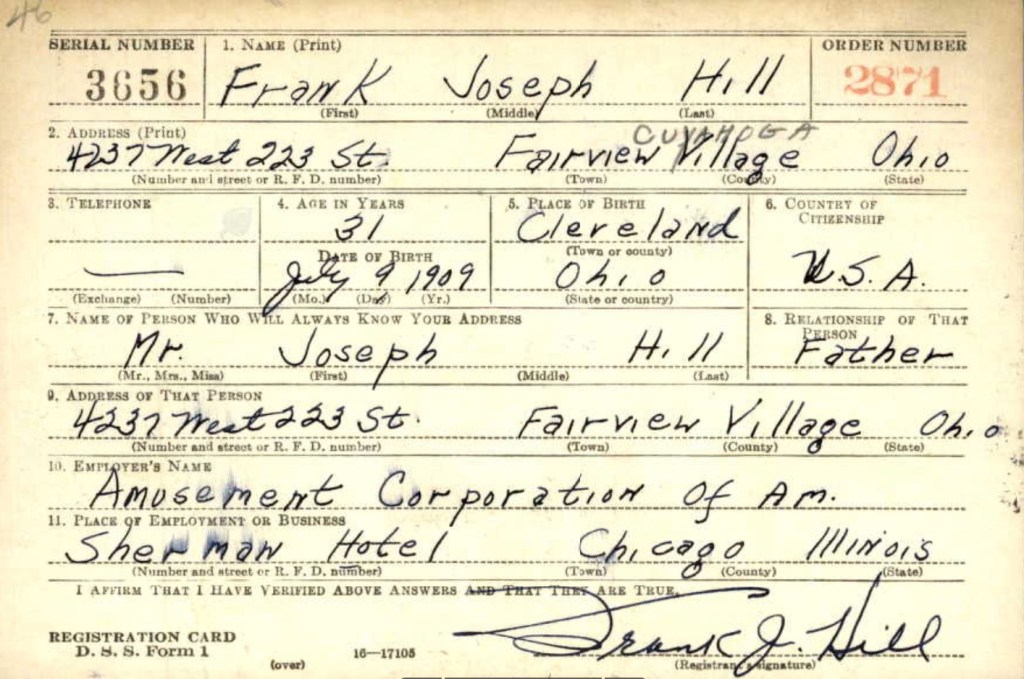
Six months ago, I found Frank’s World War II draft registration, dated 1940.

Though he was in New Orleans at the time, his employer – Amusement Corporation of America (AMA) – was in Chicago, and he was still using my grandparents’ home address as his own. I wrote back to the man at the International Circus Hall of Fame. All he could do was confirm AMA ran carnivals. He referred me to the International Independent Showmen’s Museum. They didn’t have records on individual carnies, either, but the link accesses a trade magazine article about the Amusement Corporation of America.

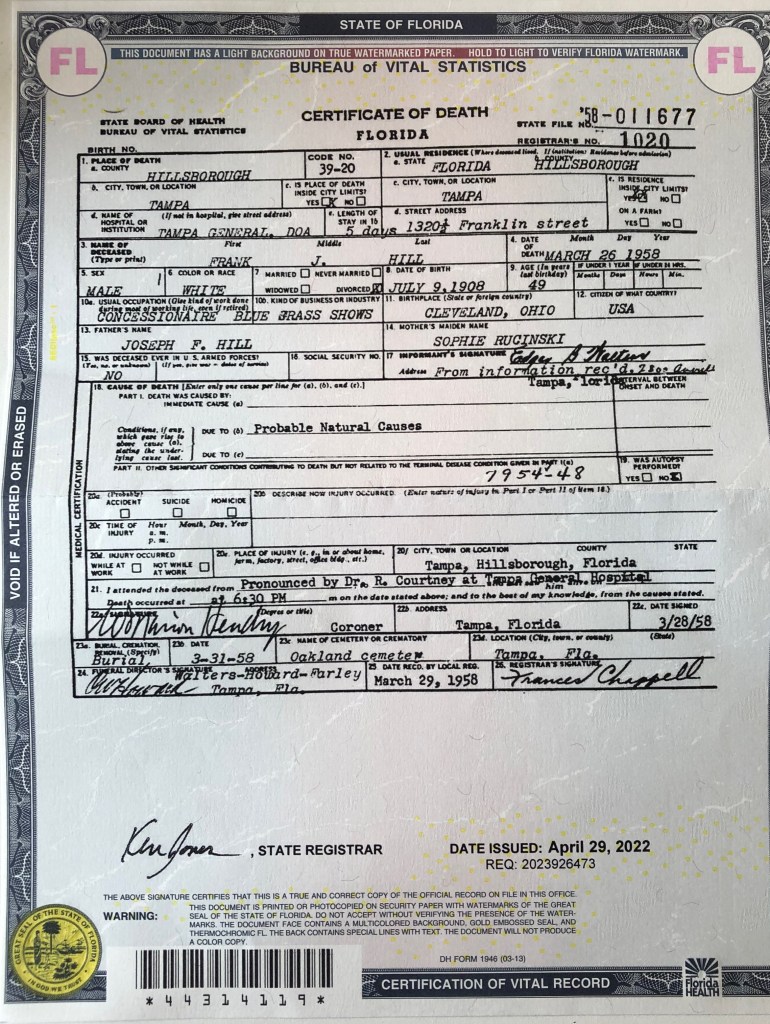
A year ago, a death document for a Frank J. Hill of Hillsborough County Florida appeared on Ancestry.  I was hesitant to request it. I had found another Frank J. Hill who lived in Tampa and died around the same time. I didn’t want to receive some stranger’s death certificate.  So I ignored that recurring suggestion, for a while.  It wouldn’t go away.  Finally, I requested it.  Here it is:

3. Contemplations on a Death Certificate.

What was Frank’s life like before his corpse appeared in the ER that night?  Who delivered him?  There’s a street address: 1320 ½ Franklin Street.  Today, it’s a parking lot.  There’s a profession: Concessionaire Blue Grass Shows. No place of employment.  My guess is he lost his job with the Amusement Corporation of America and had to freelance. (I can’t help but think about Nightmare Alley’s Stanton Carlisle. )

The details about Frank’s birth and parentage are correct, suggesting the information came from someone in the know.  However, Edgar B. Walters, the informant, turned out to be no one significant: he worked part-time worker at the Walters-Howard-Farley funeral home, which handled the burial.  The father of one of the partners, Edgar was a retired barber who had the people skills required to get information out of difficult relatives  Lucky him. He got to call my grandmother.

The cemetery.  Oh, the cemetery. Oakland Cemetery, aka Home Cemetery or Old Home Cemetery, was once grounds of an Old Folks Home, now gone.  There are some marked graves in the lot, not Frank’s.  There’s a large open field, with plenty of space to bury abandoned corpses.

images from flgenweb

My siblings and I wager that when my father saw the death certificate, he noticed the five days his brother’s remains spent in the hospital morgue. I’m guessing he copied the information. Several years later, on that hot summer day during his vacation, he came here. He beheld its emptiness. And for a moment, perhaps this parched open downtown grassy area had a rare glimpse of my father’s heart. He may have even cried. (My father rarely cried.)  I’m sure he went to a bar and had a drink or two for Frank.

The click of my grandmother’s phone resonated across the years.  Everything on the death certificate confirmed the story my mother told me.  So strange. It was so long ago, and I’ve heard this story so many times.  Why was my heart breaking so . . . ?

For one thing, I really had hoped to discover Frank died happily somewhere in Gibsonton, where all good carnies retire.  I wanted to find him buried in a circus cemetery, alongside other one-time circus “talkers.”  (No self-respecting carny would use the word “barker.”) As long as he was with other circus people, I didn’t care if his grave was unmarked.

Strangely, I felt responsible. As if I were the sole witness.  A tardy mourner.  Born six months after his death, coming to awareness sixty some years later, I arrived far too late to mark his grave.

I’m not pretending my Uncle Frank was a nice man, but I am suggesting he was a victim of circumstances beyond his control. Born into a Polish speaking first-generation immigrant family, eight years after a Pole assassinated President McKinley, he was orphaned at two, and likely raised by his immigrant grandmother during a time when “Polacks” in America were shunned. To my grandmother, who wanted to shed that label, Frank represented everything she disliked about Joe’s earlier life: his first wife and his family’s Old Country ways. With Joe, she wanted to create a new American family. She felt she was doing the right thing, for her son and for his children, to erase her story and start again. Her treatment of Frank, indeed her treatment of all of my grandfather’s immediate family, may have actually given me a “leg up.” As a Hill, I was born without that tell-tale “ski” name into a world where Polacks were still the butt of many jokes. I could pass.

4. Contemplating heredity and inheritence:

I’m grateful for the opportunities born on my grandmother’s compromises. Still, I now see her gallant decisions as acts of violence. She hated Frank. She hated the Gorzynskis.

The thing is: I’m a Gorzynski.

Researching my forgotten Gorzynski ancestors has revealed a pattern to me: Frank’s not the only member of this family to suffer an unmarked, unrecognized burial.  It happened to Joe’s brother John. He died in a city hospital and was buried in their grounds when he was 35.  Cause of death: Cirrhosis of the Liver.  It took quite a bit of research to find John – I’d never heard his name before. He was the first in the family to use the name Hill. Nor had I heard about Uncle Eddy Gore, who died alone in Sandusky.  Sudden heart attack.  He had a wife in Cleveland who cared enough to bury him with a headstone, in a Lorain cemetery halfway between Sandusky and Cleveland.

Joe’s sister Helen’s burial raises suspicions, too.  Though she married and had a child with Grandma’s brother, Clem, and they lived together until she died, wife and husband are buried in separate cemeteries.  Helen was buried in the Gorzynski grave at Calvary Cemetery.  Clem was buried on the other side of town in Holy Cross Cemetery, with my grandmother’s clan, now officially the Doskeys.

My father’s family has a pattern of division and self-imposed alienation. He suffered from it, too. He was an enigma, a man who said little and drank a lot to numb his pain.  As he aged and produced more children, he grew bitter. In his 40’s, he took a job based in California.  Mom and us five kids stayed in the Fairview house. Every year, he stayed away from us a little longer than the year before.  One hot August day, his heart exploded, in the middle of our living room floor.  For forty years he lay in a grave marked by the government issued military stone we got for free.  No one visited.

I still love and identify with my father. When I was a girl, his friends joked that I was “Myron in a skirt.”

(Me and Dad in the backyard of our new Fairview house.)

One of my life’s goals has been to earn a stone for my grave, and to help make sure a decent one appeared on his. Last summer, after mom was laid to rest, dad finally received his proper treatment.   

Could this be my family’s inheritance? And our curse?  Perhaps the accumulation of all our ancestors’ traumas, all balled up and covered with COVID-like spikes, lodged inside a gene, mutated, and manifested as what we are today: functioning, “passing” as normal, yet emotionally crippled.

DNA tells me I’m 100% European. In other words, Pure White. In 1950, when my parents wed, Poles were still treated as an inferior ethnic group. The Irish, too, but not to the same extent. They had a language advantage. In Cleveland, they also had a good hold on the police department. (My maternal grandfather was an Irish cop.). Still, something attracted my parents, as it attracted all the other cross-pairings in second generation European American families. Some “similarities” enticed them to venture into groups their parents prohibited. First, they shared a desire to discard their past and live the “American Dream.” Second, they shared troubled family histories. I have long felt that the most common feature of “White America” is that we are all products of people who, at one point or another in our ancestry, left a beloved homeland either by choice or by force to join the American work force. Once in America, they faced extreme disappointment. Some found themselves living in conditions far worse than what they left behind. The luckiest overcame. It took grit to do that, sometimes in less than one generation. It took pride. It took resilience. It also took a lot of compromise.

I believe that all Americans suffer from some degree of epigenetic family trauma. In fact, this is the conceptual core of the two-part magical realist family saga I’m writing right now.  Since I didn’t know these people, I mythologized them, with the outrageous goal of adding the 19th century Polish migrant into the canon of Polish myths. Almost two years ago, after beginning the second novel – the one about Frank – did I realize I was writing a fabulist allegory about migration for white Americans. Frank’s death certificate told me how it would end, which meant I needed to revise the beginning, which as of April 2025, I’ve completed. Now it’s time to tell Frank’s story.

Oh, and you wonder what Frank looked like. My grandmother left behind several books of unmarked photos of herself and her relatives. After analyzing them in terms of era and context, I’ve identified four that I believe represent Frank. Here is one of them. I calculate his age to be eight or ten. This was taken at the Gorzynski home in the first years of my grandparents’ marriage. I suspect she dressed him up and put him on this donkey.  She did something similar to my father, a dozen years later. (second photo). Dad got a pony.