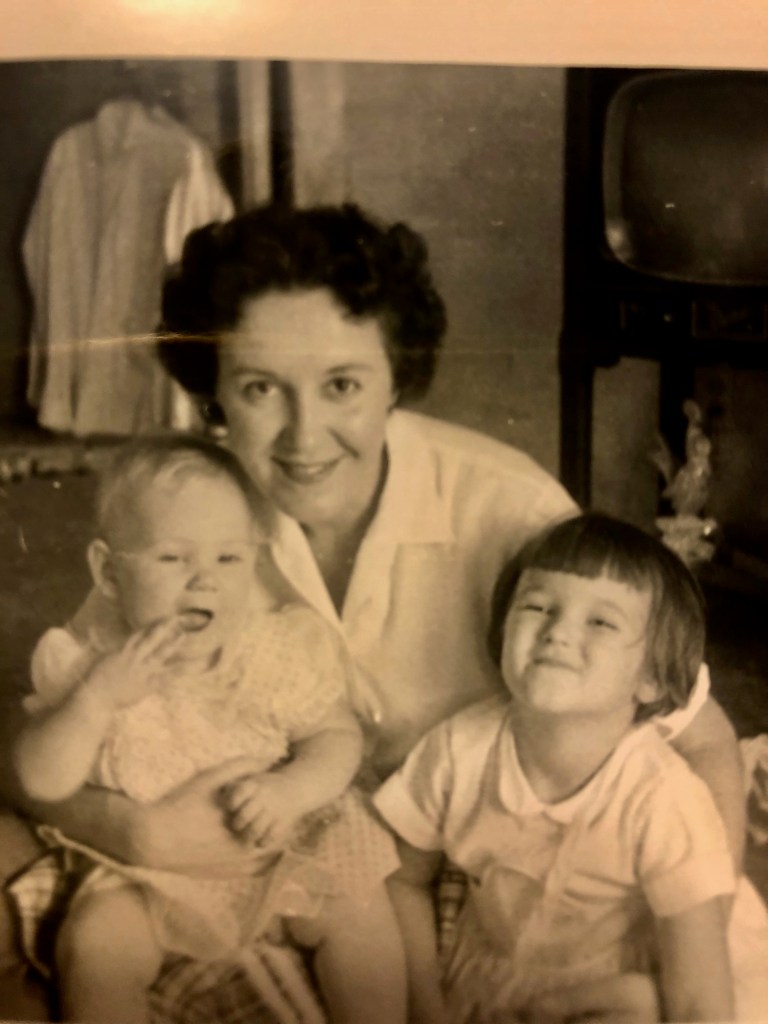
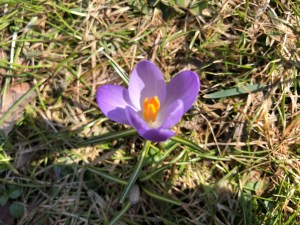
Baba Yaga’s Professional and Writing Biography

            I’m always a little surprised when I look at this blog’s statistics and see the number of hits. I don’t get thousands, but I have more than I expect. To those of you who are reading this, I thank you. I feel I owe it to you to tell a little bit about who I really am.
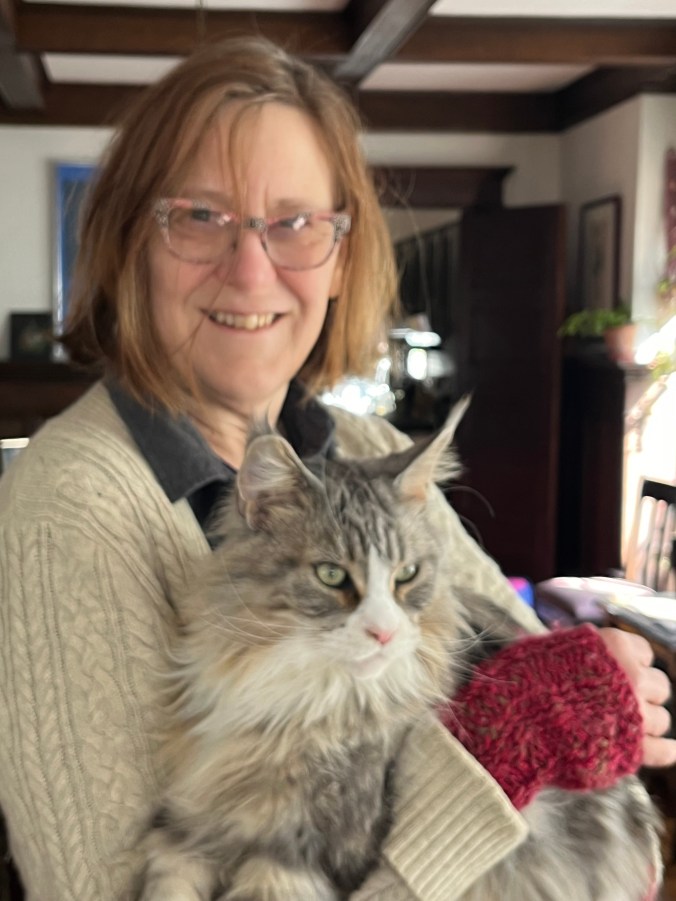
Me and Augustus (Gus)

 I’m a retired academic who always wanted to write fiction. Though the artistic part of my brain was badly fried by thirty-five years of teaching college composition, I managed to draft three novels and several short stories while fulfilling the requirements of a career that grew more demanding as the small liberal arts college I worked in drifted towards financial ruin. In the middle of COVID 2020, six months before my mother died, I retired. Revising my third novel pulled me through my grief. During my first couple drafts, I was worried I’d lost my ear. I credited that to having done very little reading for pleasure during my quest towards tenure at a small college in Buffalo. My workload at the Turkish university I worked at before that gave me enough personal time to savor reading fiction that wasn’t on one of my course syllabi. Umberto Eco, Gabriel Garcia Marquez, Isabel Allende, Salman Rushdie, Orhan Pamuk, and Yasar Kemal became my companions. Since retiring, I’ve added Richard Powers, Olga Tokarczuk, Susannah Clark, Elif Shafak, Anthony Doerr, George Saunders, China Mieville, Louise Erdrich, Joy Williams, and Karen Thompson Walker to my list. Their books have helped me resuscitate the writerly soul I’d repressed beneath the armor I had to build to function in my job.

 My adult life and my academic career began in the summer of 1985, when I was awarded a teaching assistantship and admission to Syracuse University’s Masters in Fiction Writing program.  At the end of my second year, my story “Tonto, In The Trees” won the department’s Stephen Crane Award for short fiction. That same story appeared in the Nebraska Review and was named their Best Short Story of 1987. Syracuse was a turning point for me. My teaching assistantship gave me a career I enjoyed more than the medical secretarial work I was doing back in my hometown of Cleveland. So after finishing my M.A., I set off to become an academic who wrote fiction on the side. While some of my Syracuse colleagues went on to write their first best-selling novel, I completed a Ph.D. in Performance Studies at New York University’s Tisch School of the Arts and became a university professor.  My dissertation, When The Voice Must Be The Body: Feminism and Radio Drama won the Tisch School of the Arts’ Cynthia Jean Bull Cohen Award for Academic Excellence in 1997. Chapters were published in Women in Performance and an issue of TDR that later became a book. An academic press offered to publish my dissertation if I was willing to edit.  Go figure. I didn’t do it.  I didn’t really want to write scholarly stuff. I wanted to write fiction. And I wanted to teach. You see, my family and friends were amazed when I finished a Masters degree. Many couldn’t believe I actually earned a Ph.D.. Especially me. I’d begun graduate school driven by the need to show myself what I was capable of. By the time I finished, I felt that if someone like me could accomplish what I had, others could, too.  And I wanted to help them.

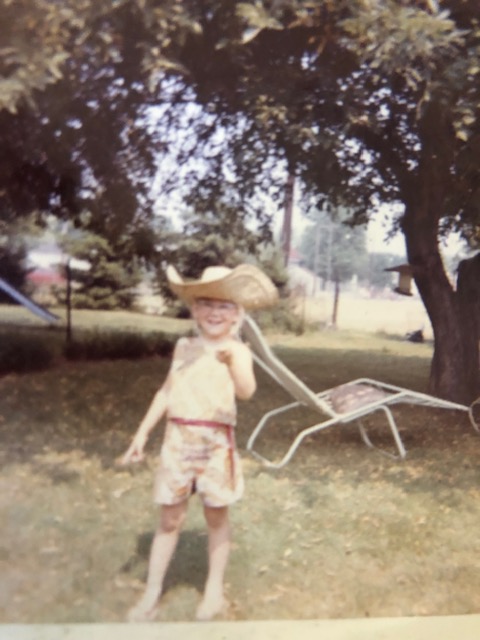
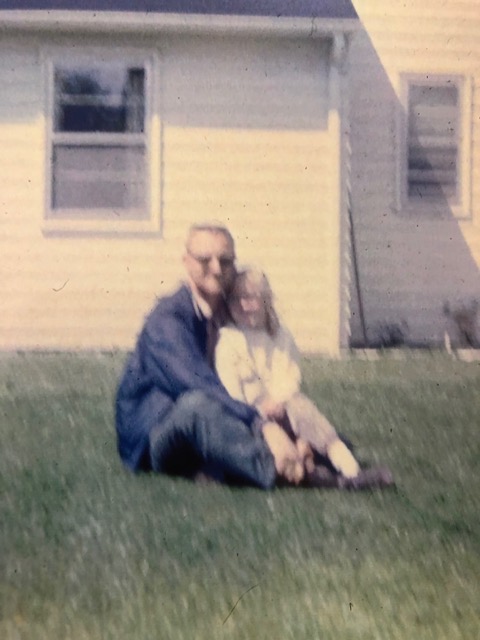
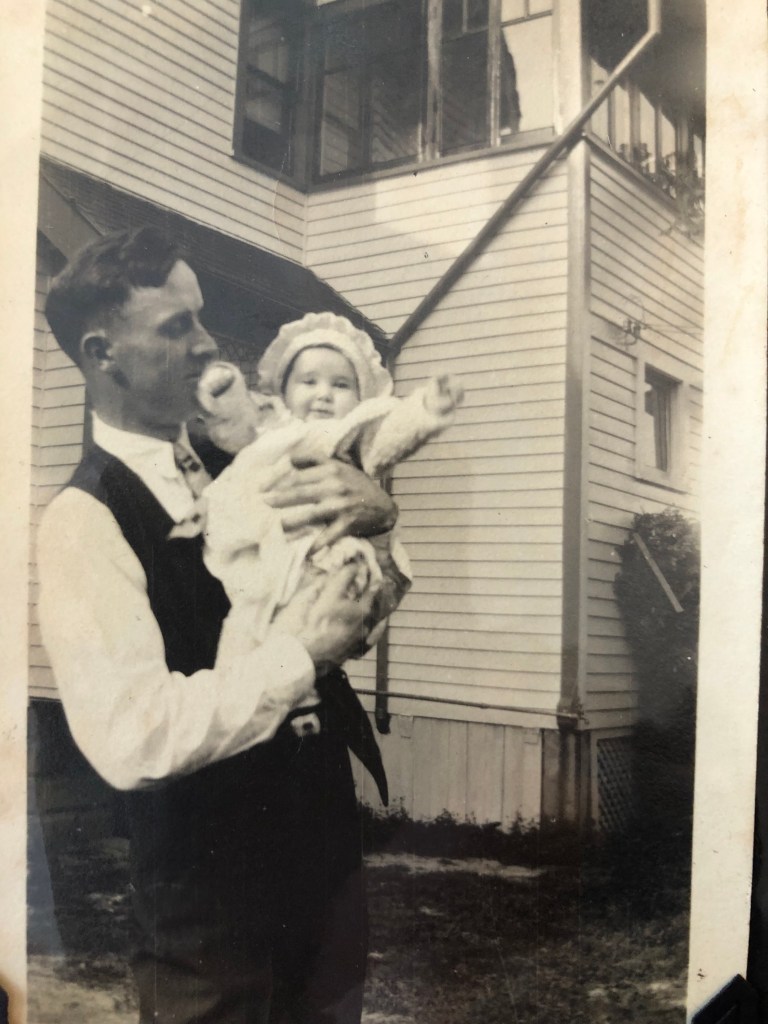
My father and three-year-old me, during our first year in the suburban home I grew up in.

PAST REMEDIES

            So, who is someone like me

I was the second daughter in a family with three girls and two boys. We were your garden-variety dysfunctional family growing up in a brand new suburban development on the west side of Cleveland, Ohio. One step away from working class, my parents (and probably all of our neighbors, too) worked hard to pretend they’d attained the American dream. And yet, they maintained a working class attitude. Josh Robert Thompson describes the milieu of my childhood well during his appearance on the Honey Dew Podcast #117, “Cleveland has an interesting philosophy . . . don’t try too hard and don’t be proud of your work.” Furthermore, “growing up in a Catholic alcoholic family, you keep everything to yourself.” Listening to that podcast reminds me of my father’s alcohol cupboard. By the end of each month, the family would be eating bologna for dinner, but dad always had good gin. He taught me how to appreciate a good martini. Alcoholism was probably what attracted the different branches of my family tree – the Gorzynskis, the Dziedzikowskis, the Malloys, and the Thompsons – to each other. Yes, Thompsons. I’m related to Josh Robert Thompson. Second cousin, by adoption. I’ve never met him, though. But I knew his grandfather. Josh’s grandpa was my mom’s youngest uncle. On her mother’s side. My mother and grandmother boasted of him being an opera singer. On this podcast, Josh describes him as a gruff old World War II fighter pilot. Which he was, but my mom preferred to emphasize his more genteel side when he dropped by for a drink or two. What would Josh have to say about that? I don’t know. Estrangement from rough and tumble city relatives was integral to being a successful first generation suburbanite during the 1960’s and ’70’s.

Even if we had met, Josh wouldn’t remember me. I was the quietest kid in a family that kept to themselves. I was that Catholic school girl who showed up freshman year at the local public high school and never succeeded in fitting in. That girl who sat in the back of English class and didn’t talk.  When teachers discovered I was a good writer and an astute reader, I was placed in Honor’s English and History, but I was never inducted into the National Honor Society.  My mother called the school to complain, but they didn’t budge. I was socially clumsy.  In retrospect, I suspect people thought there was something wrong with me.  But there are degrees of “something wrong,” right? The biggest thing wrong about me was that socializing and talking didn’t come easily. But writing did.

 I experienced my undergraduate English degree at Cleveland State University as a first-generation college student. I had no role models.  Sure, my father had earned a college degree on the GI Bill, but he was rarely home.  Luckily, I had compassionate teachers who made it a point to tell me I was a very good writer. One recommended me to work in the tutorial center, so in 1978 (the same year my father died) I began learning how to talk to strangers about something I knew a lot about: English composition. I discovered that I enjoyed the reciprocality of teaching language to someone from another country. We both grew from knowing each other. During my Master’s, I took TESOL methodology courses alongside my writing and literature courses but never gained a certification. I continued tutoring and teaching international students at N. Y. U. and the Cooper Union. By the end of my Ph.D., I’d begun developing ideas about how to use performance theory in the ESL classroom. However, I felt that, to be an effective language teacher, I needed to learn what it felt like to be a foreigner in a land whose language I didn’t speak. My first full-time teaching position (1999-2003) was in the Department of American Culture and Literature at Baskent University in Ankara, Turkey. There, I taught expository and creative writing, performance theory and world fiction and drama.  I helped build a composition curriculum and a Master’s program.  In my spare time, I wrote a novel – an updated Othello set on modern Turkish Cyprus called Past Remedies.  That unpublished novel received an Honorable Mention in the 2004 Peacewriting Contest.

My Turkish colleagues and neighbors were kind to me before, during and after 9/11, but when the United States invaded Iraq, anti-American sentiment grew.  I encountered it in grocery stores and on busses. My stepfather died in March 2003, leaving my mother alone in a big house outside Cleveland, and I decided it was time to go home.  A former colleague helped me secure a one-year position at Alcorn State University in Mississippi, where I was able to do an in-country search for a tenure track job as close to Cleveland as possible.
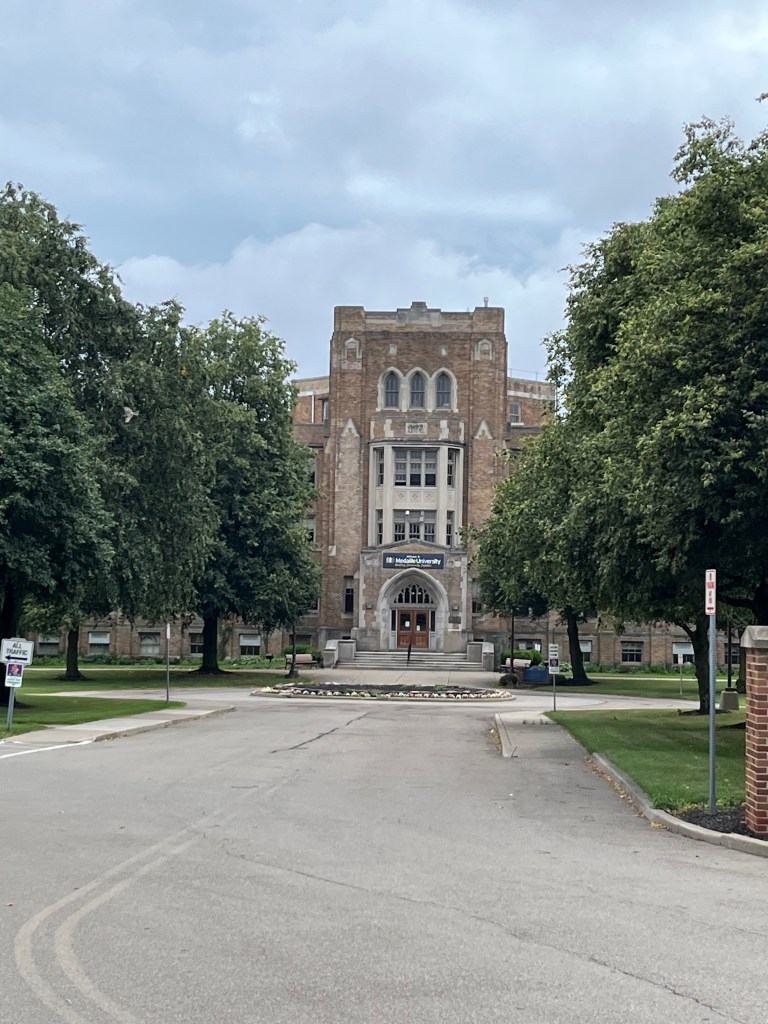
Medaille College during its final year, when it became a University.

YOU LOOK GREAT TOGETHER

 Medaille College in Buffalo, New York was full of first-generation college students who reminded me a lot of myself. Among the Medaille faculty, I found many other overachievers from working class families. We all did our best to give our largely urban student population a leg up.  I took it upon myself to teach my American students global literacy. During my first six years at Medaille, former Turkish colleagues and I worked on building cross-cultural writing wikis where students from America and Turkey collaborated on assignments. At conferences I attended in America and abroad, I was one of few discussing digitally enhanced collaborative writing assignments.  My pedagogical innovations waned as my administrative duties increased.  During my years at Medaille, I held the following titles: Humanities Chair, English Chair, and Humanities Division Head.  I helped build Medaille’s International Program. When I retired, I managed the Write Thing Reading Program as part of my duties as English Program Director. I was also building remedial reading and writing programs.  I spent hours every night grading student papers.  

 Rust belt cities like Buffalo and Cleveland are full of small colleges like Medaille. Today, many of these colleges are facing closure, if they haven’t closed already. Many have stories similar to Medaille’s case. “The Sisters of St. Joseph of Medaille opened the Institute of the Sisters of Saint Joseph in 1875” on the land that later became Medaille’s campus. The school became known as Mount Saint Joseph Teachers’ College, and it started offering degrees 1937 (“Medaille University” Wikipedia). In the 1960’s and 1970’s, families looking for a small college where their Baby Boom and Gen X children could get personal attention were happy to send them to places like Medaille. As student numbers dwindled at the turn of the twenty-first century, those schools became more specialized in order to survive. Some didn’t. Medaille closed in 2022. When I joined its faculty in 2004, the signature program was Veterinary Technology. Medaille’s Vet Tech students inspired me to draft a mystery novel, You Look Great Together. The sleuths are triplet sisters: one a vet, another a vet tech, the third, a doggy day care owner.  The mystery begins when a prize-winning German Shepard is abandoned at day care and the sisters find themselves solving a mysterious disappearance when they go looking for his owner.  It was a fun book to write, but as with Past Remedies, it was set aside because of the increasing demands of my job.  Reading Richard Osman’s Thursday Night Murder Club has me itching to revise You Look Great Together and begin a sequel, where the pet that initiates the mystery is a Maine Coon. 

Me and my kitty Frankie (Francesca) in 2017, one of the years the Medaille’s Write Thing Reading Series collaborated with the Freshman Read program. That Fall, students read The Art of Racing in the Rain and participated in two days of special activities before Garth Stein visited us. In this activity, faculty showed off their pets.

My annual performance review at Medaille required that I account for scholarship, service, mentorship and teaching, with the last three being the most important. This emphasis on student teaching and community building was why I stayed at Medaille. Our evolving student population demanded creativity and risk taking. One day one of my non-traditional female students approached me after a lecture on The Fool in King Lear that featured my tarot cards. She wanted to begin a new club – a paranormal society – and she needed a faculty sponsor. I seemed like someone who would do it. She was right. I was the Medaille College Paranormal Society’s faculty advisor for several years before handing it off to a more psychic colleague. By the time Medaille closed its doors for good, it was the most popular club on campus.
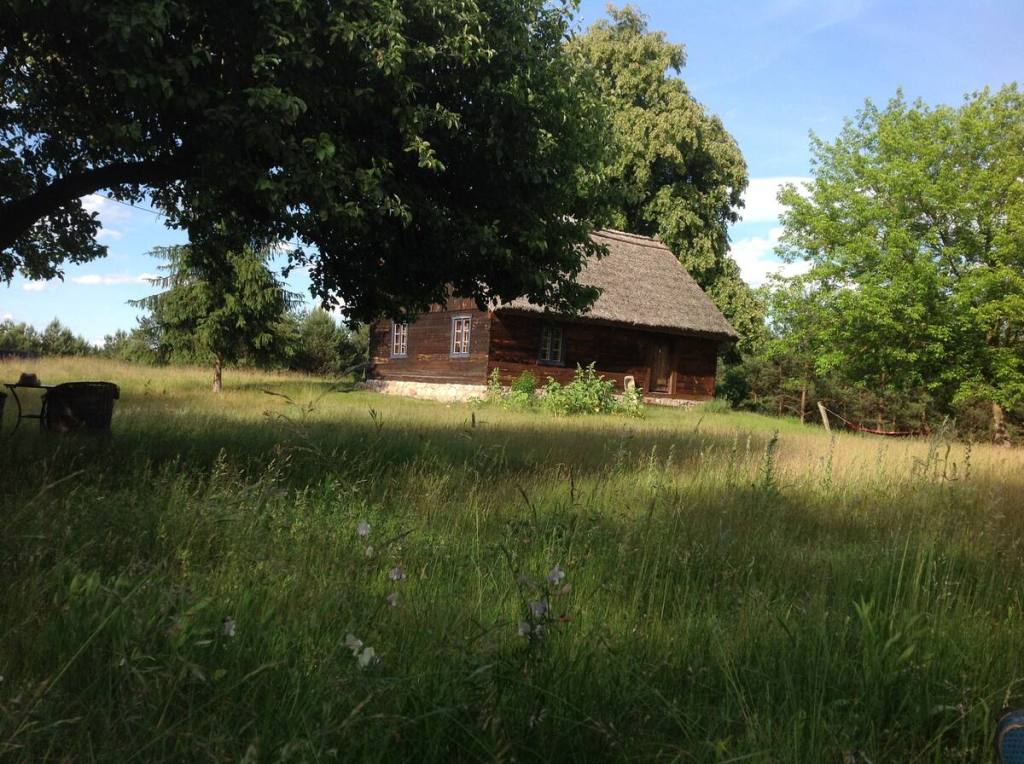
A cottage in Czarny Bryńsk, Poland

THE DOUBLE-SOULED SON

Two years before my 2020 retirement, I took my first and only year-long sabbatical. That was when I drafted The Double-Souled Son, the novel I’m marketing now.  Based on research into my father’s mysterious family, it’s a paranormal-psychological literary family saga of a late nineteenth century misfit couple’s migration from Poland to America. Taking its cue from Mohsin Hamid’s line “we’re all migrants in time,” The Double-Souled Son imagines the psychological traumas these ancestors suffered before, during, and after their migration.  The characters were conceived to embody the multiple personalities Poles had to negotiate during the nineteenth century. One was religious: “Scholars who investigated Slavic folk beliefs in the nineteenth century were astounded by the extent to which the peasants, while practising [sic] Orthodox Christianity, were still connected to their pagan inheritance. The phenomenon became known as dvoeverie, or ‘dual faith.'” (Myth and Mankind: Forests of the Vampire: Slavic Myth). This was especially true in rural Poland, where the peasants proudly maintained their Polish language and traditions while also dealing with Prussian, Russian, or Hungarian occupiers. When they arrived to in America in 1881, they were already psychologically damaged. Life in a mining company town in Pennsylvania, Buffalo’s stockyards, and Cleveland’s industrial Polonia only compounded it.

Medaille’s second largest program was Psychology. Student research papers about trauma sparked my own interest, as a family historian, in epigenetic trauma. I theorized that unresolved trauma that gets passed on from one generation to the next produces dissociated personalities. Around the time I retired, I began untangling my own dissociations, tracing them to the stages in my life that induced them, and I found some predate my memory.  They may have been sparked by an initial trauma that occurred generations ago. Back then, no one talked about “dissociative identity disorder” or “multiple personality disorder.” Pre-modern cultures made sense of these conditions with superstition and myth.  In rural Poland, people believed that someone with contradictory personalities had two souls. One of those souls was an average soul, the other supernatural: a strzyga. Graves of the suspected double-souled provide evidence that this belief continued into the twentieth century. My 2019 visit to Krakow’s Rynek Underground Museum included a display of corpses decapitated, secured, and buried face down.

Seem extreme? Well, the strzyga is a cousin to the vampire, capable of inhabiting cast-off bodies and returning to life. My interpretation of being double-souled emphasizes the human over the demon.  CulturePL’s video “The Strzygon Soul And How To Deal With Him” offers a humorous depiction of this affliction. In this video, the body, possessed by its supernatural soul, climbs out of his grave, returns to his wife and has more children.  He’s only half-bad, after all. And even when he’s bad, he has a good sense of humor. In the book, I’ve imagined a family known to produce double-souled children. The entire village is on high alert when the protagonist is born. The signs are clear from the infant’s first holler: he’s born with teeth and has a strange birth marks. And here’s the hitch: his curse won’t go away, even when he and his family migrates.  In a place like America, the double-souled son may still be half demon on the inside, but to his immediate community, he’s crazy.

Therein lies the inspiration for The Double-Souled Son.  This novel begins in Prussian-occupied Poland in 1861 and ends in Buffalo, New York, in 1901, where every Polish immigrant’s reputation was further tarnished by a young man named Leon Czolgosz who he assassinated President McKinley.  This is the first of two books on how “starting in the late 19th century, traditional sources of identity such as class, religion, and community slowly began to be replaced with an emphasis on personal growth and happiness,” (“A Family Therapist Looks to Historians for Insight on the Changing Forms of Family Estrangement“). There’s a sequel in progress called American Limbo, in which the strzygon soul reincarnates during the 1920’s in Cleveland’s Polonia.  Ten years after his mother’s early death, his father remarries a younger woman who insists they assimilate when she has her own child. The newly minted American family moves to the suburbs, and the outcast strzygon becomes a carnival worker, and his migrations continue.

 Though it occasionally goes off theme, Baba Yaga’s Journal is primarily a collection of sources from my research.  It recaptures stories about the Poland my ancestors left behind, including what happened in my ancestors’ home villages during World Wars I and II, and beyond.  These were the stories my father’s family opted not to tell me.  My grandmother said she did it to protect me. And, dare I say, to make me pure American. And therein lies the heart of my proposal: that researching family history and studying the socio-political conditions that caused a family to migrate can increase anyone’s awareness of how we are all historically constructed global citizens.  Indeed, we are all migrants in a complex web of time, and our children will continue to be so, into the future.

What Happened After My Ancestors left Poland, Part I

It was inevitable.

As an obsessive family historian and researcher, I knew someday I would have to seriously approach the question of what happened to my Polish ancestors who stayed in the homeland.

For over a decade, I’ve been restoring the severed Slavic branch of my family tree: Grandpa Hill’s family. We considered them our black-sheep. Some of my siblings thought it best to honor our grandmother’s stated desire to never speak of them, but I resisted. I couldn’t help it. When I looked in the mirror, I could see them looking back at me. I needed to know why we became estranged. They must have done something truly awful. But what awfulness could justify keeping children from knowing their grandfather’s story? We learn from our parents’ and grandparents’ mistakes, after all. Their hard-earned lessons are our inheritance. Repressing past stories silences important lessons.

For years, I thought my Anglo name was randomly chosen. I was in my fifties when I finally learned that my surname – Hill – is a translation of the “gora” in Gorzynski. Anyone in the 1920’s rustbelt Polish-American community would have recognized the code. My father and his mother chose not to pass it on to me when I was born in a Cleveland suburb, in 1958. Family Search and Ancestry led me to my correct surname, and my great-grandparents’ story. I’ve since traced their American journey backwards to their arrival at Castle Garden. Then, with the help of Iwona Dakiniewicz, a genealogist I met through the Polish Genealogy Society of America, I located all my family’s offshoots in Poland. Where once I barely knew grandparents, now I know at least three generations.

My father’s pedigree represents three different Polish cultural regions. Dad’s paternal grandfather was a Górzyński who was baptized in Górzno in Brodnica County, Kuyavian Pomeranian Voivodeship. Great-grandpa’s father and grandfather were baptized in nearby Bryńsk. Górzno public records document the 1859 birth of my great-grandmother, Franciszka Gólembiewska, in nearby Ostrowy. Her parents were married in Górzno, too. Her mother’s family, the Pruszaks, appears to go back several generations in this area. So far, I can’t say that for her father. Perhaps he was itinerant, as my great-great grandfather Górzyński was.

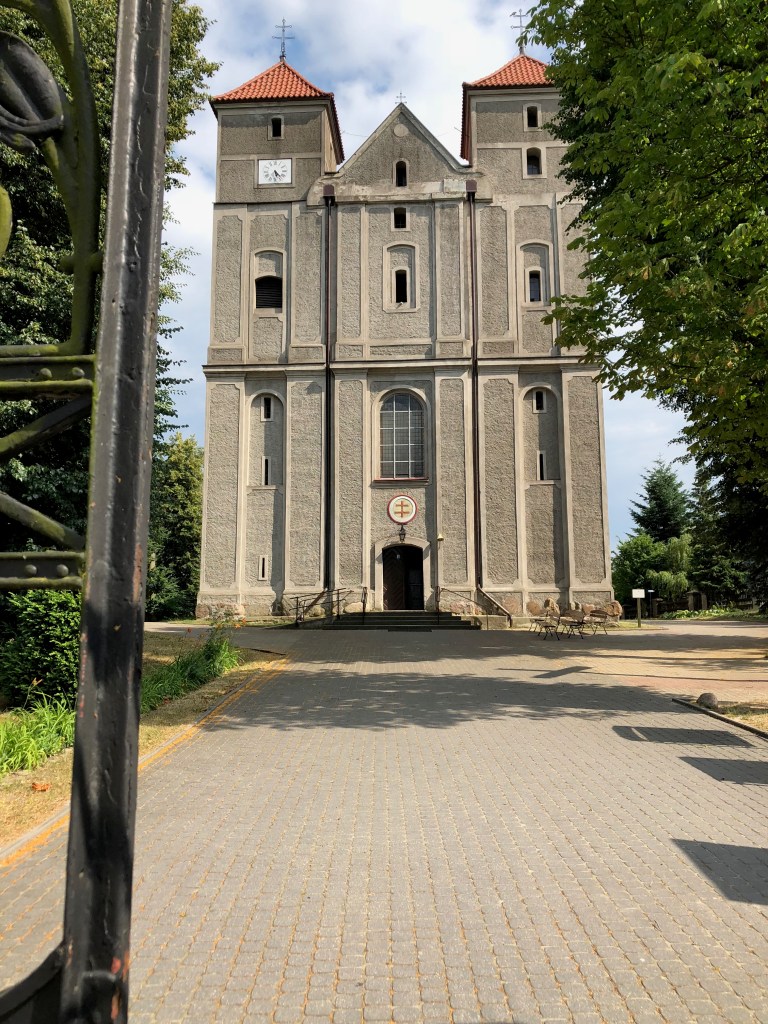
Elevation of the Holy Cross Church, Górzno, Poland. Photo taken by me June 19, 2018.

My grandmother’s father came from the Suwałki Region. He immigrated in 1881. Grandma’s mother was the first American-born child of immigrants from Pomerania. I’ve yet to visit these areas, but my husband and I were able visit the Górzyński homeland in 2018. With Iwona’s help, we saw some of what’s left in the villages of Bryńsk, Czarny Bryńsk, and Ostrowy. The lands around them are a landscape park now.

A view from our cabin at Hotel Dworek Wapionka, Górzno, Poland. My photo, taken June 19, 2018.

Taken at Pałac Myślęta Hotel, My photo, taken June 18, 2018. (This is not in the Górzno-Lidzbark Landscape Park; it’s forty minutes away from there, in Uzdowo.)

I fell in love with the landscapes of my homeland. To honor my ancestors’ lost memory, I wrote a novel in which I imagined rural Poland, one hundred and fifty years ago. This was a time when Poland didn’t exist, having been partitioned during the 1790s by its neighbors, Prussia, Russia and Austria. In West Prussia, where my family lived, Polish language, history and culture were prohibited. What was the breaking point that caused them to finally decide to leave this beautiful homeland? The Górzyński migration took them first to the Susquehanna Coal Company mines of Nanticoke, Pennsylvania. After ten years there, they moved to Buffalo, New York; a decade later, they resettled in Cleveland. My great-grandfather died in a house he co-owned with his sons. A nice ending to a tumultuous journey. Their story really isn’t remarkable, though; it’s the story of thousands of Poles who migrated to industrial America. Proud, hard workers, they didn’t always assimilate well. In fact, some planned on returning home. Some did. Americans, for the most part, weren’t kind to Poles. In 1901, when a “Polack” shot President McKinley at the Pan American Exhibition, anyone Slavic became even more marginalized. That infamous event ends the book. I’ve been marketing it under to titles: The Double-Souled Son and The Polish Assassin. I’m hoping a publisher or agent will help me decide which is better.

I’m three generations away from the Górzyński family’s migration – enough time to forget any Polish patriotism my family ever felt. I have no known relatives in Poland, though Polish records indicate some of them stayed. Did they survive? They were rural folk. In each of my ancestral home regions, villages were destroyed, if not by the Germans, by the Russians. What I’ve learned about my family’s villages keeps me up nights. One early morning, while sipping warm milk and honey, I remembered a similar autumn night, forty years ago. I was drinking tea with my grandmother, and I asked her if we still had family in Poland. Slapping her hands over her ears, as if I’d screamed at her, she shook her head. “It’s too horrible to tell.” After that, she clammed up.

I had a blissful childhood, thanks to her. I remained naive about the world’s evils well into adulthood, thanks to her. I don’t blame her for her choices, but I’m glad I now know what she kept from us. Because it’s happening again. The current Russo-Ukraine war harkens back to what happened in Poland, not so long ago. If we think of ourselves as our families, ancestors and all, we’ve all been forced to migrate before, and given our current climate crisis, it’s likely to happen again.

This is the first in a series of photo essays about the events in my Eastern European home regions after my great-grandparents left. I like to engage in a lot of other art forms while I’m working on a novel. Watercolors were significant to my process writing The Double Souled Son. These blog entries are process writings for a new novel. Tentatively titled American Limbo, the next Górzyński novel imagines my Polish-American grandparents’ coming of age in jazz age and depression-era Cleveland, Ohio. Based on what little my grandmother told me, the news from abroad during those years contributed to her decision to opt for total assimilation.

Each entry will briefly describe the family that left that given area, when they left, and what happened in those villages after they left. To sweeten the bitterness of forthcoming content, I’ll stick to facts alone, while including photos and paintings of my ancestral landscapes as they are today. I couldn’t imagine a more beautiful place.

A field in Czarny Bryńsk, Poland. Taken by me, June 18, 2018.

Here Lies Frank .

  1. The Biggest Mystery in the Hill Family Tree

I was probably eight before I heard one of my parents mention him. 

Frank. My father’s only sibling, his half brother Frank.

What? Dad had a brother? My brothers and sisters and I thought he was an only child!

 “Yep,” my father told us. “He ran away to join the circus. He was a circus barker.”

He laughed that ironic laugh of his. I always read it as both sarcasm and discomfort.

Why?  To a kid, Circus Barker seemed both a viable and interesting profession.

“Don’t ask your grandmother about him, though,” he added.  “She’ll get upset.”

(Me, age four or five, in my grandmother’s backyard.)

My parents already owned a bungalow on the west side of Cleveland when my grandfather died. I was six months old, their second child. When I was three, we moved to a new house near Grandma. She lived in the house Grandpa built for her in Fairview Park.  For their family.  In her mind, that meant her son, Myron.  Not Frank. 

Myron – my father – grew up in that house.  He spent a lot of time alone. In fact, he was probably one of the first “latch-key” kids.  Grandma was proud to say she was a working woman. 

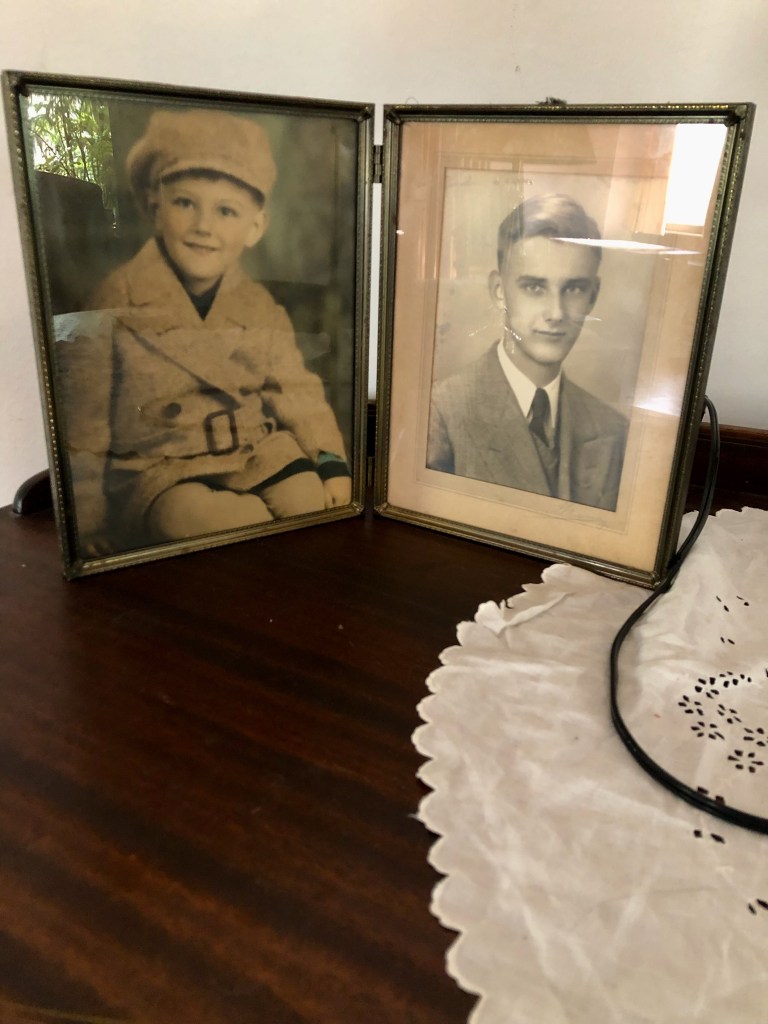
(Myron Hill, Grandma’s desk photos, on Grandma’s desk.)

Grandma was eighty-five when Myron died, at fifty-one. Many of her friends and family were already gone.  My mother, my siblings and I all took turns visiting her.   I enjoyed my Tuesday visits.  We’d sit alone in her living room, drinking tea and talking.  She asked about my schooling, my job, my boyfriend.  (She liked my boyfriend and ventured to give me advice about how to manage him. I had a bachelor’s degree by then, too. She was awed by that.) But I was managing a medical office. Or working in a hospital. I was a secretary, just as she once was. What did I do to relax? Baking, I told her.  “I get up and bake if I can’t sleep.”  “Me too,” she said, her voice quivering. We talked a little more about things I liked to do – reading, music, being quiet.  “You are more like me than I thought” she said one night. 

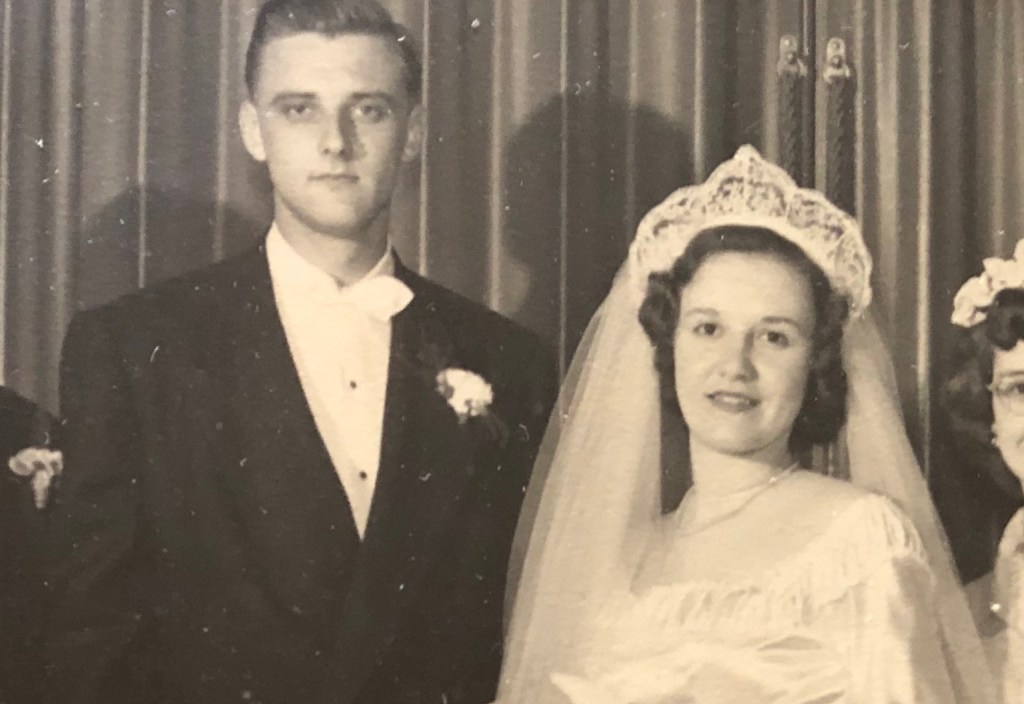
Until those evening teas, I sensed that she favored my two sisters.  They both inherited her dark skin tone and hair.  Her rebellious spirit. She didn’t see much similarity between my father and me. I had my mother’s Irish complexion and nervous giggle.   My mother told me later Grandma Hill made it clear very early in their relationship that she did not want her son to marry a working class Irish girl. When her attempts to block their marriage failed, she refused to celebrate with my mother’s family.  On their wedding day, my parents had to attend two receptions, one in Cleveland, and one in Fairview.

In the 1980’s, my grandmother and I became friends on those Tuesday nights. So much so that on one night, I felt I could venture into forbidden territory.    

“So, what can you tell me about our Polish background?”  I said.

She stalked away from me, into the dining room. Before she disappeared into the kitchen, she turned and said: “Why do you insist on asking this again?” 

“It’s because it’s who I am,” I answered, thinking it a weak reply.

It hit a nerve.  Her face fell.  She disappeared into her kitchen, returned with some cookies, sat down next to me and told me about her father, who came from a place called Suwałki.  Yes, that’s in Poland now, but it was in Russia for a long time.  I knew her dad’s grave said “John Doskey,” what she didn’t tell me was the name was changed. After she died, I discovered his name was Jan Dziedzikowski.  (Another fake name, but that’s another story.)

I asked about my grandfather’s folks.  She grew frustrated, tried to explain the Polish Partition to me, then said “his people came from all over.  Germany, Austria, some Russia.  Mostly Germany.”    

When I asked about Frank, her voice rose and grew agitated: “He was a bad man! Don’t ever speak of him again!

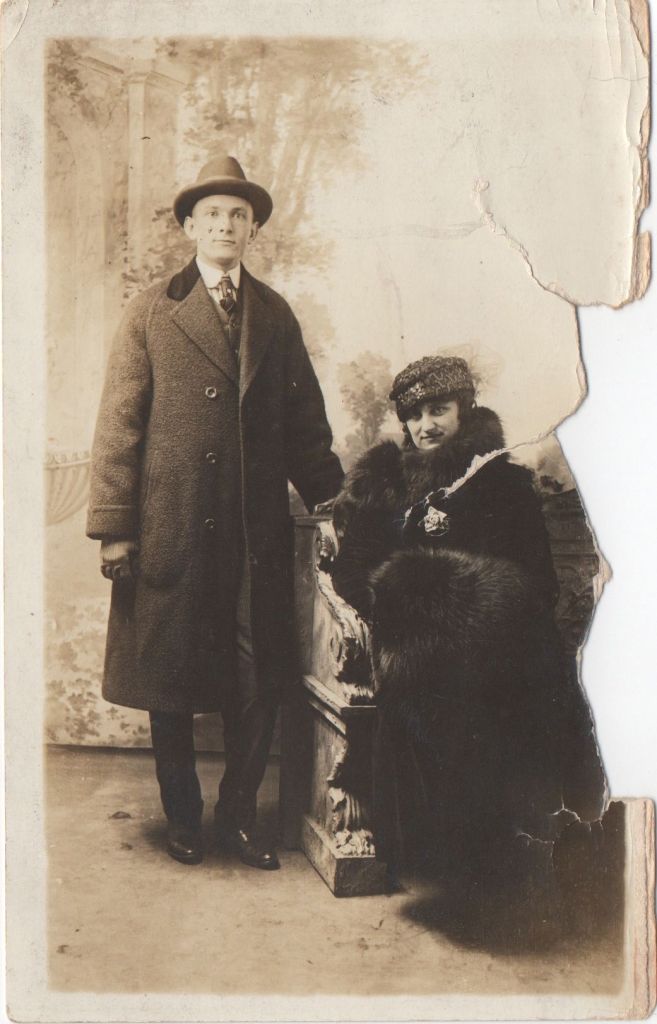
(My paternal grandparents, Joe and Hattie Gorzynski, 1917/8, right after they married.)

Impossible.

Frank haunted me.  Came to me in dark clouds at night. Made appearances at Ouija board sessions. As a spirit, he was unpredictably nasty.

After hearing me inquire about Frank several times, my mother told me what she could: dad’s brother was “a little” older.  He ran away to become a “circus barker.” Mom thought he was married for a while, maybe even had kids.  Somewhere around Boston.  He died in Florida, “where the circus workers winter.”

“So now you know,” she concluded. “Don’t tell your grandmother I told you.”

Frank died March 26, 1958; I was born that September; my grandfather died March 22, 1959.  When Dad found Frank’s death certificate under some papers on his mother’s desk, he didn’t know his brother had died. Reportedly, it was one of the few instances he lost his temper with his mother.  When he demanded they exhume the body so Frank could be buried in a Catholic cemetery, Mom said he encountered roadblocks. Read: his mother. Grandma won, like she won most of the time.

Frank haunted him, too, though. 

Around ten years later, my parents were on their second vacation in Siesta Key when my father announced he wanted to look for Frank. He went alone. After some time, he returned, more silent than usual.  Finally, he told my mother he found nothing.

I know all this because Mom told me. When I realized I had someone who was willing to talk, I asked for more details.

“Did you ever meet him?” I asked. 

Yes. Once, after they became engaged, she went to the Fairview house to meet him. He was home. He’d totaled his car and he needed money. “He was really tall!”  (My dad was 6’4.”) According to mom, Frank was taller, very handsome, very charismatic.  He “checked her out” and made some comment on how my father nabbed a sexy babe. Or something like that.

“I didn’t think he was that bad, but your grandmother sure didn’t like him. Your father loved him.”

My father didn’t show much emotion towards anything.  So, if Dad loved him, then Frank was worth knowing about. 

2. How to do genealogical research on a Carny.

The death certificate was not in my grandmother’s final papers. She probably burned it. Around twelve years ago, I found our true family name – Gorzynski – and wondered if he used the name Frank Gorzynski, and that’s why my father couldn’t find him. No. With the correct surname in play, Ancestry.com kept yielding new insights. New family members. My grandfather was one of eight kids.  At nineteen, when he was still Jozef Gorzynski, he married his first wife Sophia Rucinski , age seventeen.  A year later, in July 1909, Sophia bore a son. Frank Joseph Gorzynski.  In 1912, when Joe was 23 and Sophia 21, she died.  Frank and Joe moved back to his parents’ house.  There, three months after losing his wife, Joe’s seventeen year old brother Alfons died. Tuberculosis, same as Sophia.  In 1914, six months after his sister Tekla succumbed to post-delivery sepsis, Joe’s father Marian died. From Diabetes. (Insulin hadn’t been discovered yet.) In 1917, Joe married Hatti Doski, formerly Jadwiga Dziedzikowska, my grandmother.  Jadwiga and Jozef Gorzynski lived with their “son” Frank in the Gorzynski family home in Cleveland’s Warszawa neighborhood for ten years. During that time, Joe lost two more of his brothers. Frank didn’t finish high school. He worked as a “driver.”  In 1927, the year my father was born, Joe and Hattie became “Hills” and moved to their own apartment, and Frank Hills moved with them.  They shared the same address until 1930 when Frank was counted twice on the national census: in his father’s household and in the household of his Sophia’s sister in Elwood, Indiana, about an hour away from Peru, Indiana, which is where the circuses wintered at that time.  By then, Frank Hill was 21. My father was 3.

International Circus Hall of Fame, Peru, Indiana

When I found this museum, I wrote to them about possible records.  The man who replied was very polite when he informed me no one kept records on the carnies.  There were too many of them.  I detected my father’s short ironic laugh in between his lines. 

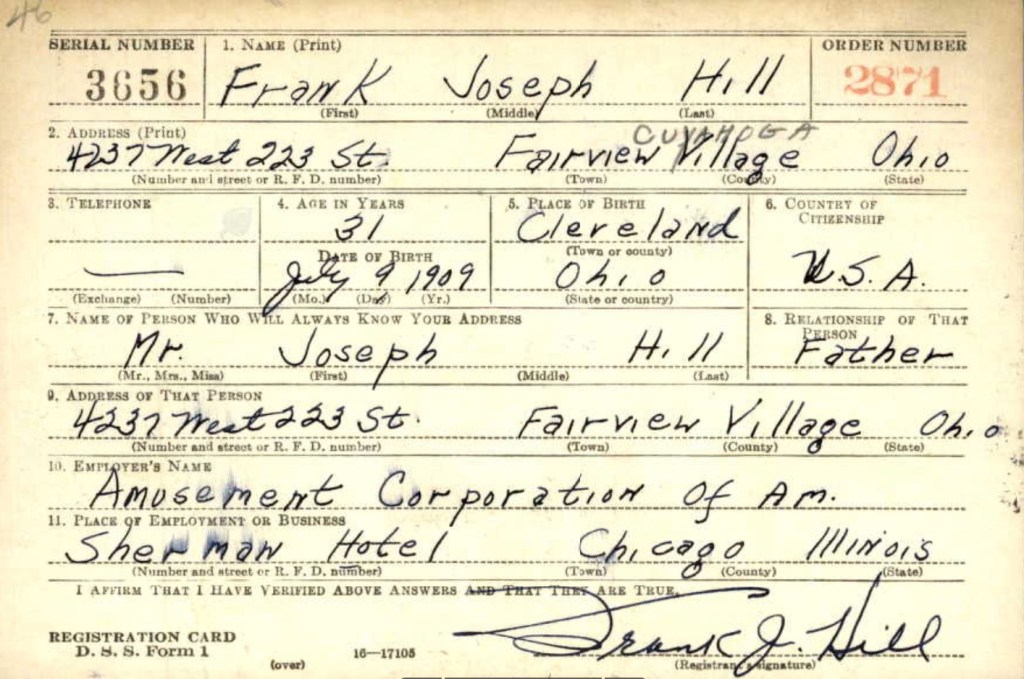
Six months ago, I found Frank’s World War II draft registration, dated 1940.

Though he was in New Orleans at the time, his employer – Amusement Corporation of America (AMA) – was in Chicago, and he was still using my grandparents’ home address as his own. I wrote back to the man at the International Circus Hall of Fame. All he could do was confirm AMA ran carnivals. He referred me to the International Independent Showmen’s Museum. They didn’t have records on individual carnies, either, but the link accesses a trade magazine article about the Amusement Corporation of America.

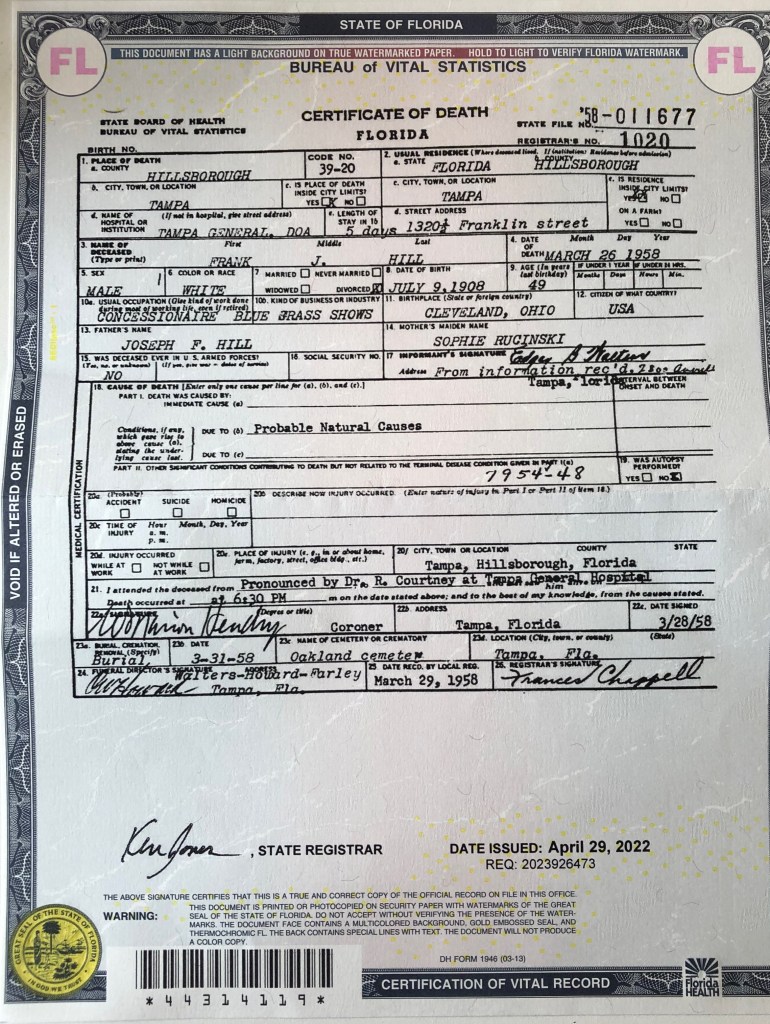
A year ago, a death document for a Frank J. Hill of Hillsborough County Florida appeared on Ancestry.  I was hesitant to request it. I had found another Frank J. Hill who lived in Tampa and died around the same time. I didn’t want to receive some stranger’s death certificate.  So I ignored that recurring suggestion, for a while.  It wouldn’t go away.  Finally, I requested it.  Here it is:

3. Contemplations on a Death Certificate.

What was Frank’s life like before his corpse appeared in the ER that night?  Who delivered him?  There’s a street address: 1320 ½ Franklin Street.  Today, it’s a parking lot.  There’s a profession: Concessionaire Blue Grass Shows. No place of employment.  My guess is he lost his job with the Amusement Corporation of America and had to freelance. (I can’t help but think about Nightmare Alley’s Stanton Carlisle. )

The details about Frank’s birth and parentage are correct, suggesting the information came from someone in the know.  However, Edgar B. Walters, the informant, turned out to be no one significant: he worked part-time worker at the Walters-Howard-Farley funeral home, which handled the burial.  The father of one of the partners, Edgar was a retired barber who had the people skills required to get information out of difficult relatives  Lucky him. He got to call my grandmother.

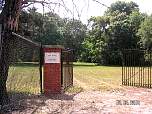
The cemetery.  Oh, the cemetery. Oakland Cemetery, aka Home Cemetery or Old Home Cemetery, was once grounds of an Old Folks Home, now gone.  There are some marked graves in the lot, not Frank’s.  There’s a large open field, with plenty of space to bury abandoned corpses.

images from flgenweb

My siblings and I wager that when my father saw the death certificate, he noticed the five days his brother’s remains spent in the hospital morgue. I’m guessing he copied the information. Several years later, on that hot summer day during his vacation, he came here. He beheld its emptiness. And for a moment, perhaps this parched open downtown grassy area had a rare glimpse of my father’s heart. He may have even cried. (My father rarely cried.)  I’m sure he went to a bar and had a drink or two for Frank.

The click of my grandmother’s phone resonated across the years.  Everything on the death certificate confirmed the story my mother told me.  So strange. It was so long ago, and I’ve heard this story so many times.  Why was my heart breaking so . . . ?

For one thing, I really had hoped to discover Frank died happily somewhere in Gibsonton, where all good carnies retire.  I wanted to find him buried in a circus cemetery, alongside other one-time circus “talkers.”  (No self-respecting carny would use the word “barker.”) As long as he was with other circus people, I didn’t care if his grave was unmarked.

Strangely, I felt responsible. As if I were the sole witness.  A tardy mourner.  Born six months after his death, coming to awareness sixty some years later, I arrived far too late to mark his grave.

I’m not pretending my Uncle Frank was a nice man, but I am suggesting he was a victim of circumstances beyond his control. Born into a Polish speaking first-generation immigrant family, eight years after a Pole assassinated President McKinley, he was orphaned at two, and likely raised by his immigrant grandmother during a time when “Polacks” in America were shunned. To my grandmother, who wanted to shed that label, Frank represented everything she disliked about Joe’s earlier life: his first wife and his family’s Old Country ways. With Joe, she wanted to create a new American family. She felt she was doing the right thing, for her son and for his children, to erase her story and start again. Her treatment of Frank, indeed her treatment of all of my grandfather’s immediate family, may have actually given me a “leg up.” As a Hill, I was born without that tell-tale “ski” name into a world where Polacks were still the butt of many jokes. I could pass.

4. Contemplating heredity and inheritence:

I’m grateful for the opportunities born on my grandmother’s compromises. Still, I now see her gallant decisions as acts of violence. She hated Frank. She hated the Gorzynskis.

The thing is: I’m a Gorzynski.

Researching my forgotten Gorzynski ancestors has revealed a pattern to me: Frank’s not the only member of this family to suffer an unmarked, unrecognized burial.  It happened to Joe’s brother John. He died in a city hospital and was buried in their grounds when he was 35.  Cause of death: Cirrhosis of the Liver.  It took quite a bit of research to find John – I’d never heard his name before. He was the first in the family to use the name Hill. Nor had I heard about Uncle Eddy Gore, who died alone in Sandusky.  Sudden heart attack.  He had a wife in Cleveland who cared enough to bury him with a headstone, in a Lorain cemetery halfway between Sandusky and Cleveland.

Joe’s sister Helen’s burial raises suspicions, too.  Though she married and had a child with Grandma’s brother, Clem, and they lived together until she died, wife and husband are buried in separate cemeteries.  Helen was buried in the Gorzynski grave at Calvary Cemetery.  Clem was buried on the other side of town in Holy Cross Cemetery, with my grandmother’s clan, now officially the Doskeys.

My father’s family has a pattern of division and self-imposed alienation. He suffered from it, too. He was an enigma, a man who said little and drank a lot to numb his pain.  As he aged and produced more children, he grew bitter. In his 40’s, he took a job based in California.  Mom and us five kids stayed in the Fairview house. Every year, he stayed away from us a little longer than the year before.  One hot August day, his heart exploded, in the middle of our living room floor.  For forty years he lay in a grave marked by the government issued military stone we got for free.  No one visited.

I still love and identify with my father. When I was a girl, his friends joked that I was “Myron in a skirt.”

(Me and Dad in the backyard of our new Fairview house.)

One of my life’s goals has been to earn a stone for my grave, and to help make sure a decent one appeared on his. Last summer, after mom was laid to rest, dad finally received his proper treatment.   

Could this be my family’s inheritance? And our curse?  Perhaps the accumulation of all our ancestors’ traumas, all balled up and covered with COVID-like spikes, lodged inside a gene, mutated, and manifested as what we are today: functioning, “passing” as normal, yet emotionally crippled.

DNA tells me I’m 100% European. In other words, Pure White. In 1950, when my parents wed, Poles were still treated as an inferior ethnic group. The Irish, too, but not to the same extent. They had a language advantage. In Cleveland, they also had a good hold on the police department. (My maternal grandfather was an Irish cop.). Still, something attracted my parents, as it attracted all the other cross-pairings in second generation European American families. Some “similarities” enticed them to venture into groups their parents prohibited. First, they shared a desire to discard their past and live the “American Dream.” Second, they shared troubled family histories. I have long felt that the most common feature of “White America” is that we are all products of people who, at one point or another in our ancestry, left a beloved homeland either by choice or by force to join the American work force. Once in America, they faced extreme disappointment. Some found themselves living in conditions far worse than what they left behind. The luckiest overcame. It took grit to do that, sometimes in less than one generation. It took pride. It took resilience. It also took a lot of compromise.

I believe that all Americans suffer from some degree of epigenetic family trauma. In fact, this is the conceptual core of the two-part magical realist family saga I’m writing right now.  Since I didn’t know these people, I mythologized them, with the outrageous goal of adding the 19th century Polish migrant into the canon of Polish myths. Almost two years ago, after beginning the second novel – the one about Frank – did I realize I was writing a fabulist allegory about migration for white Americans. Frank’s death certificate told me how it would end, which meant I needed to revise the beginning, which as of April 2025, I’ve completed. Now it’s time to tell Frank’s story.

Oh, and you wonder what Frank looked like. My grandmother left behind several books of unmarked photos of herself and her relatives. After analyzing them in terms of era and context, I’ve identified four that I believe represent Frank. Here is one of them. I calculate his age to be eight or ten. This was taken at the Gorzynski home in the first years of my grandparents’ marriage. I suspect she dressed him up and put him on this donkey.  She did something similar to my father, a dozen years later. (second photo). Dad got a pony.

Loss During Lockdown

I have been miserable this past week. Absolutely miserable. Cranky and achy. This winter sucks.

But! Every night has been wonderful! I’ve gone to bed early,

drifted off to sleep easily.

And dreamed vivid dreams.

All my dreams have been set in the same long, wood-framed, white-washed corridor. Leaflets and schedules flutter on the wall to my right. Wood benches line it. The other side? No benches. No wall. A void. Like a train station: this is a waiting place.

Since Monday, each night, I’ve returned to that same dream site, like returning to a theatrical set. People mill about. Mostly strangers. Sometimes, someone I know appears. Last night, it was the young couple whose cat we’re taking care of for a week. Then more strangers. A couple clowns. A sideshow talker. And each night, at one point or another, my mother has appeared. Everything stills, and we chat.

Anyone who has read my last few entries knows I’m mourning my mother’s death. I really feel like I should be done with this. She’s been gone for more than a year. And yet I’m not done. It’s as if she just passed.

I wonder if others who suffered the death of loved-ones during the pandemic lockdown feel the same way? Loss during lockdown for me was entirely mediated. There was no authentic passing – all was viewed through a frame. One day I was talking to her on Zoom, the next, leafing through photos for her obituary.

So it’s as if she never left. As if somewhere, the original for all my photos is still here. Memory has become actuality, merged with dreaming. Each time I realize I can no longer call her, I experience the shock of her death once again.

In my dreams this past week, she always looked like the Katie in this photo:

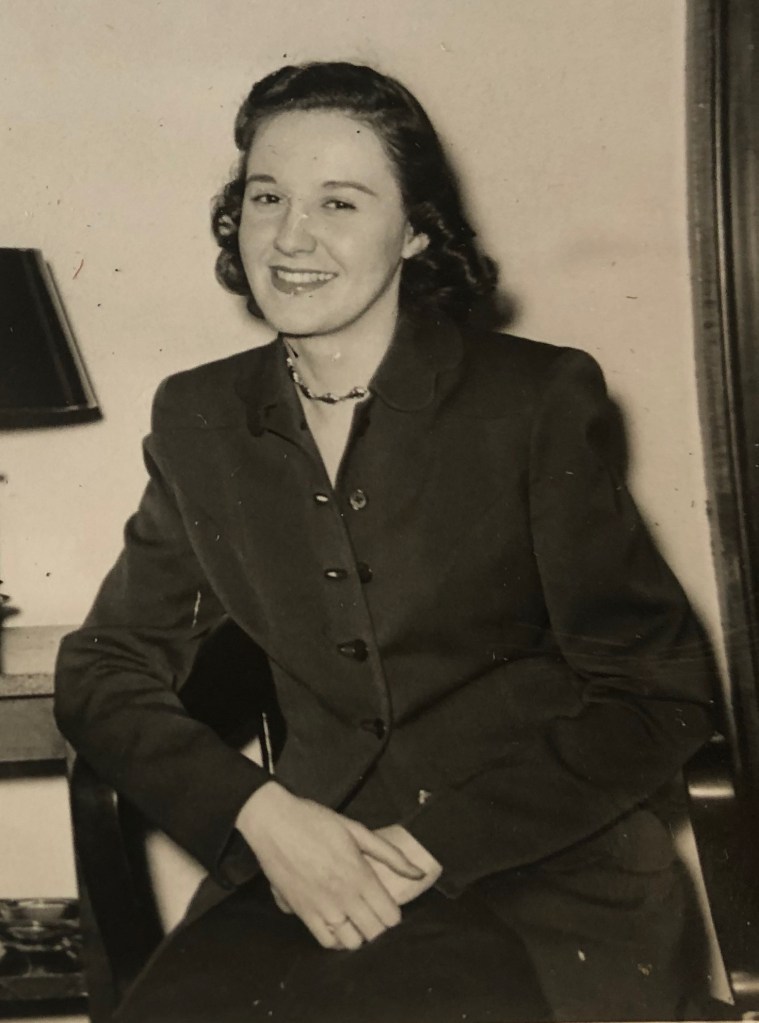
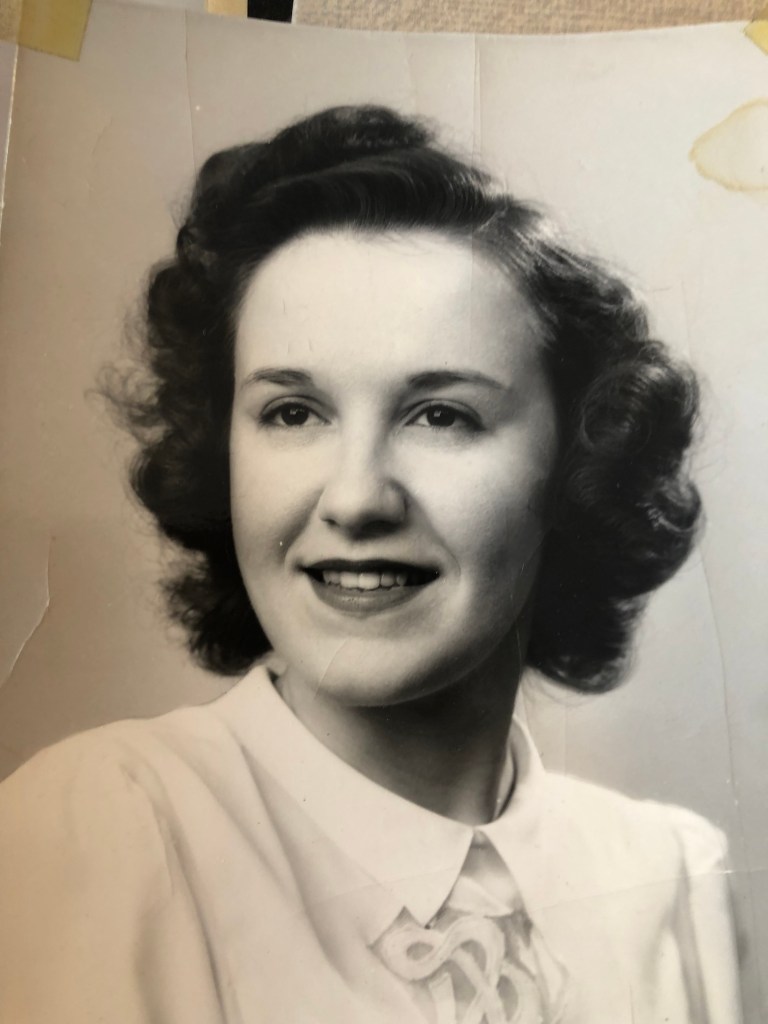
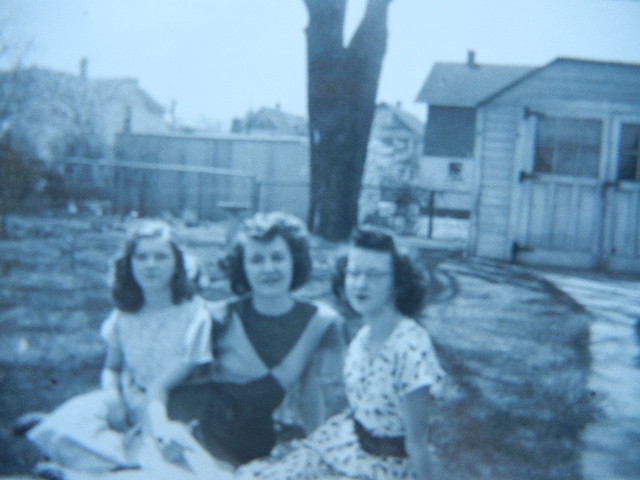
Ann and Katie 1950

During my lifetime, I never saw her look this relaxed. Katie’s about 22 years old here. Judging by the ring on her finger, she’s engaged to my father. She has a full-time job. She’s planning on paying the bills while he finishes college. And she did. At the time of this photo, Katie and Myron were probably already looking for their first apartment in Lakewood. Yes, that’s a Last Will and Testament hanging on the wall. I think Ann and Katie worked at a law firm. Mom went to an all-girls Catholic secretarial high school. Her dream was to get a job like this. More than once, she told me how much she enjoyed being a working girl.

At my dream station, she’s wearing her nicest suit. She has all the money and time in the world and only one bag, but that’s all that she needs. She’s headed for all the places she always dreamed of seeing. Ireland first, I’m sure. She always wanted to see Ireland.

So, she catches my attention and we sit for a minute or two. She’d like me to come along. I tell her I’d rather not.

“It doesn’t matter, one way or the other. You’ll live on in dreams,” Mom said to me. “As long as there’s someone to remember you.”

“Don’t forget I’m writing about my ancestors,” I replied. “The forgotten ones. I’m not done with the Gorzynskis yet. I still have to get to the Thompsons.”

Her gaze suddenly stilled by a lifetime’s worth of wisdom, she nodded a familiar nod.

“Keep writing, Babe,” she said. “Keep writing.”

Happy Birthday, Mom.

The older I get, the more I believe that eternity and memory exist in the same domain. What we remember remains eternal, as long as the capacity for memory lasts.

The internet and social media have become storage places for memory. The permanence it offers punctures the restrictions of a single human life. Once something is posted, it remains eternally. Imagine this blog, if you will, as a dot on a radio wave, arcing through the heavens at this moment, to remain there in an eternal loop long after this planet is gone.

I feel a great compulsion to remember forgotten people by writing about them, in one form or another, in order to give them their own little star in the constellation of universal memory.

So on this day, February 12, 2022, I remember my Mom, Katie, who shared her birthday with Abraham Lincoln. The last time I saw her, on her birthday, 2020, her Lewy Body Dementia was fairly advanced. She was prone to hallucinations and to saying exactly what she was thinking. During that birthday visit, I told one of her caregivers it was Katie’s birthday, adding: “Mom shares a birthday with Abraham Lincoln!” (The caregiver was young enough to not know February 12 was Lincoln’s birthday.) Mom’s immediate reply:”Yeah, Abe Lincoln. Lucky him!”

The caregiver said, in her sweetest voice: “why is Abe Lincoln lucky Katie?”

Mom’s reply: “He’s dead!”

Katie and Me, February 7 (five days before her birthday) 2020

Now, there are a few things I know about my Mom, and one of them is that she would hate that picture of her and me . Yeah, she looked pretty good for 92, but if she had her way, she would have never ended up old and demented. She liked looking pretty. She felt she owed it to whomever she encountered to look her best.

I suspect most people have a favorite age – an age when we felt most comfortable in our own skin. I liked my 30’s and 40’s. But I’m also quite content with now. For others, like Katie, it was their 20’s: the years when she worked, met my dad, and had her first two children. (She was happy with her other children, too, for sure. Unfortunately, I suspect things were dicey with my dad then. Though we would have never guessed it at the time, this also became apparent in the last year of her life, when, in her hallucinations, she yelled at him and complained about him.)
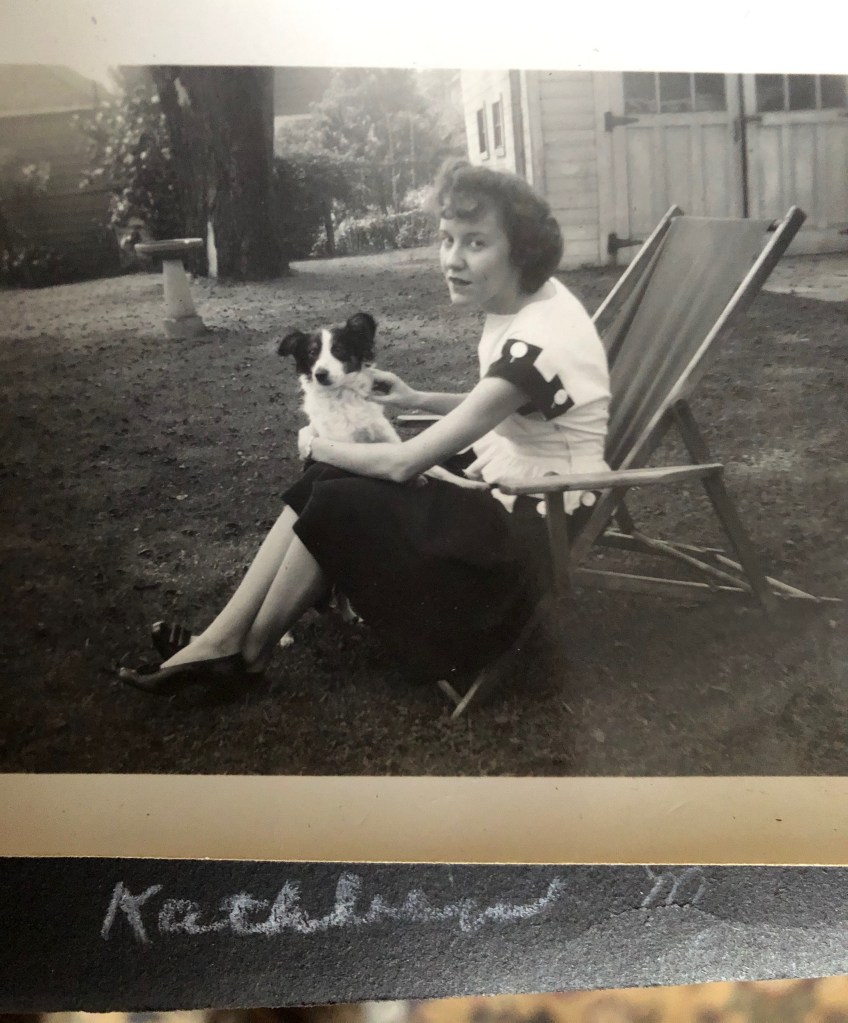
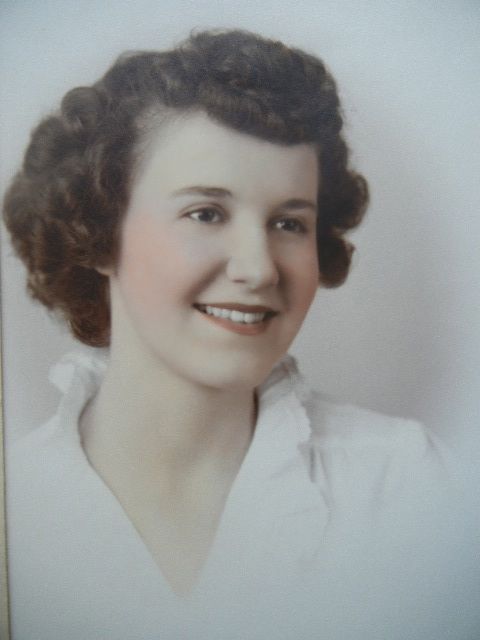
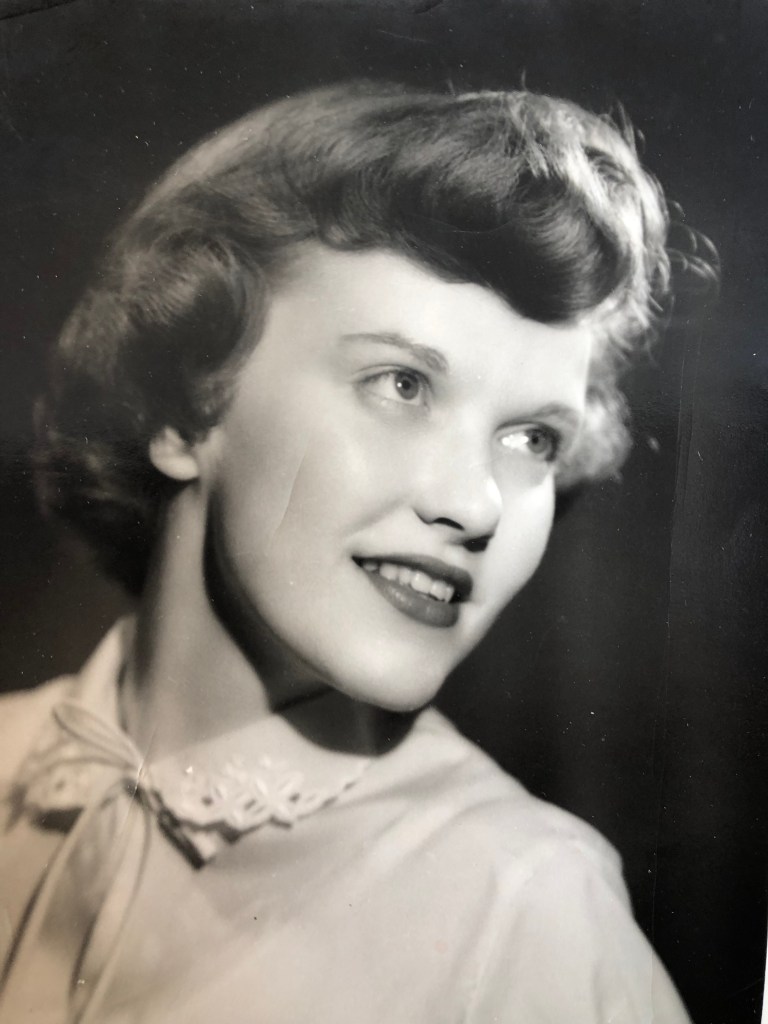
Mary Kathleen, graduating from St. Stephen’s High School, Cleveland, around 1945.

A significant difference between Lewy Body Dementia and other dementias is the hallucinations. While she was still at home, Mom was constantly seeing something on the roof of the neighbor’s house. Sometimes it was a man, just standing there. Sometimes he was mowing the lawn. Climbing a tree. Lighting a fire. The nights I stayed with her, I experienced her night hallucinations. She saw ghosts. They were often behind me. When I asked her to describe them, she told me they were making faces at me. The most common ghost was her mother, Christiana Thompson.

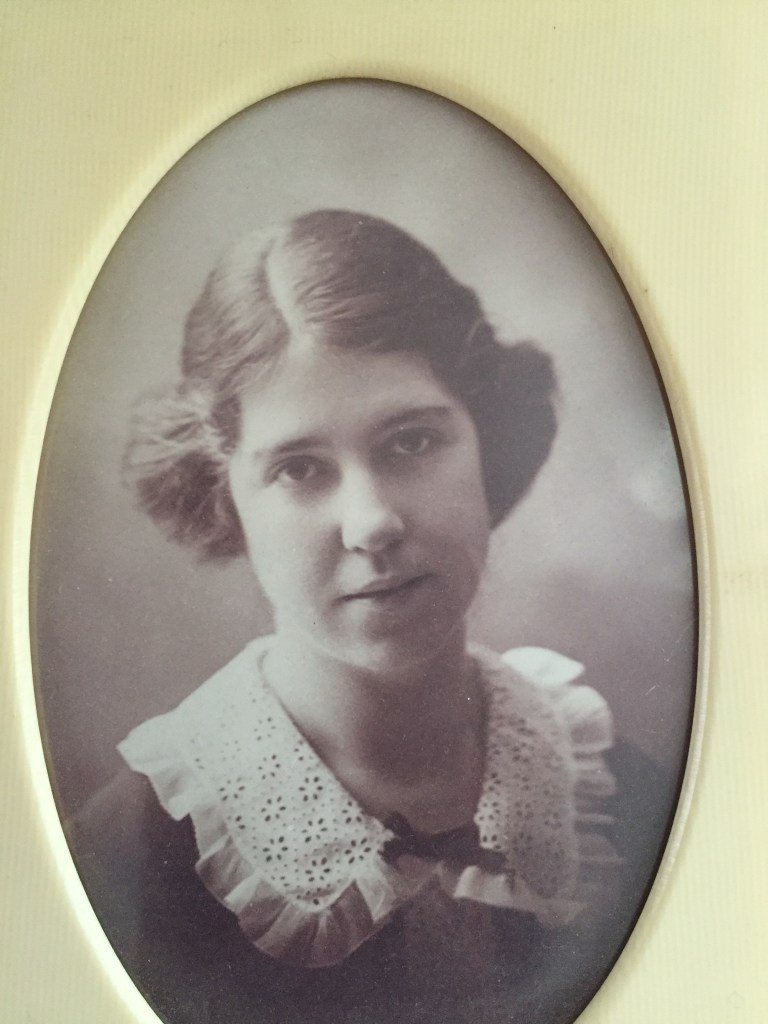
Christiana Loretta Thompson

Now, this didn’t surprise me too much. A psychic once told me that my maternal grandmother was my guardian angel. I believed her, because I needed an angel like her.

When she appeared in my mom’s hallucinations, Christiana (Chris) probably looked like this.

Gus and Chris, 1948

Being married to an Irishman named Gus, Christiana became Chris.

Katie adored Gus. In the last months of her life, she told me he was with her all the time.

Gus and Baby Katie,

During those transitional months, I read Dr. Christopher Kerr‘s book Death Is But a Dream. As the Chief Executive Officer of Buffalo’s Hospice and Palliative Care center, Kerr and his team specialize in ELE’s – End of Life Experiences. In this book, Kerr walks a fragile line between pragmatism and and spirituality. Everyone, he reports, hallucinates as they approach death. Even the most tormented individuals end their lives in peace, accompanied by vivid hallucinations of those who loved them most.

Like my mother did. As she lingered at death’s door, Gus never left her side. Her mother Chris was there beckoning, as was her baby brother Jim, who preceded her by three months. Her sister Rose Marie probably greeted her with some comment like “what took ya so long?” Three months after Katie, her sister, my namesake Aunt Mary Lou, followed.

Considering the way my mom talked to me at the end of her life, I believe that in her near-death dreams, she saw herself as young again. (I asked her once how old she was. Her response: “well, I’m younger than you! Look at you! How did you get so old?”) Young, too, were her parents. Her brother. Her sister. Her lifelong best friend, Jeannie. Ultimately, my father. She had trouble with her memories of my father, but he was there in the end, too.

I have the photo album Katie kept, when she was in her late teens/early twenties. It was preserved well, and she meticulously labeled each photo. She looked at it often as she grew older, to remember who she was when she was happiest.

Today, as I look at it, I let myself believe that this is how my mother looks in her afterlife. Happy Birthday, Mom.

Thanksgiving Reflection #1: Mom’s Stuffing – a recipe.

My first room in Syracuse, 1985.

I’m experiencing my “year of firsts” after the death my mother. Mom passed away on December 25, 2020. That’s right: Christmas Day. I could write a whole article on the Curse of the See-Sawing Meaning of Christmas Day in my family. I won’t. You might be able to figure it out if I tell you that this year, my 27 year-old nephew Danny (who was born on Christmas Day) and his girlfriend are expecting a daughter, due on Christmas Day, the first anniversary of Mom’s death.

But back to my year of firsts. Thanksgiving. I was dreading this Thanksgiving. Preparing a 20 pound turkey for a large group was sure to bring back many memories, some painful. As it turned out, Phil and I participated in a Thanksgiving Eve COVID-friendly food exchange with Phil’s son and daughter-in-law, her mother, and her aunt. We exchanged our favorite side-dishes. Each attendee received a few cups of Mom’s stuffing. I baked theirs as a casserole. I baked our stuffing portion Thanksgiving day, under a five pound turkey breast. Phil and I ate alone, with the cats. Our solitude eased the pain. As did the stuffing. Making only the stuffing, I found myself engaged in a ritual that honored the time I spent with my mother on Thanksgiving. Today, I realize how grateful I am for stuffing.

I was the eldest child living at home on August 10, 1978 when my father suffered a near-fatal heart attack in our living room. Mom resuscitated him with CPR. He never recuperated. Dad died December 29 of that year. He was 51. Mom was 50. She and I were always close, but those years, we grew closer. A student at Cleveland State University with two jobs, I did my best to help her negotiate her own grief and the grief of my three younger siblings. (We had another elder sibling who was grieving alone at another university.) While many resorted to excessive drink, I did not. I became anorexic, but that’s another story. Mom leaned very heavily on me during those years; I helped with housework, cooking. If she had no income or fell short, I paid bills for her.

I’m not sure any of us were fully mended in 1985, when I left for Syracuse University’s Creative Writing Program. Mom was remarried to a patient man named Bill, which added six more daughters to her clan. Mom escorted me to Syracuse twice: first to help me find a room in the house of a young, female lawyer. Second: to help me move. Her oldest and best friend, my Aunt Jean, came along. Jean presented me with a soup pot as my going-away gift. “You’ll always be fine if you have a pot to make soup in,” Jean declared. She was right. I still have it. After I was secured in my new home, we all went down to my mother’s father’s family farm in Stowell, Pennsylvania. We stayed with mom’s aunt and uncle for a few days before Mom and Jean headed for Cleveland, and I returned to Syracuse. My mother cried. Probably because I did not. I was eager and ready to go.

I never moved back to Cleveland. Except for the four years during which I lived in Ankara, I spent every Thanksgiving that I could with my mother. The Thanksgiving routine became part of me: unless I-90 was snowbound – and if it was, Mom insisted I stay in Syracuse, or Buffalo, or where ever I might live at the time – I would drive on Wednesday. The years passed and my Cleveland-based siblings’ lives became more demanding, so I was often the only person with Mom the night before Thanksgiving. I always brought a bottle of wine. I am grateful to both of my husbands, first Bill and now Phil, for agreeably joining me on these visits. Both enjoyed Mom – Katie, to them. She was very good company. On Thanksgiving Eve, she and I sipped wine together while we broke the dried stuffing bread into the roaster. (How much? Oh, about two loaves’ worth.) Also the night before, we sauteed an onion with a few sticks of celery and some garlic, cleaned out the bird, boiled the giblets. Retained the broth for the stuffing, strained the giblets, and cut them up for the cat. We laughed a lot. Those were sweet evenings. The following mornings were pleasant too, when we rose together, made bacon and eggs for whomever was there to eat them, then readied the bird for the oven.

As she aged, Mom could not stand for long because she had spinal stenosis. So, she sat at the kitchen table with a loaf of good bread, fruit preserves, a slab of butter, and a cup of coffee. Each year, she spent more time sitting at the table. She monitored my actions. By the time her dementia was noticeable, I knew the basics, but I always had to check with her for the finer details. No matter if she was hallucinating a man pushing a lawnmower across the neighbor’s roof, or a knight chasing a giant golden chicken around the backyard, she could always tell me how to make stuffing.

As I gathered the materials for my stuffing this year, I felt blank. I found myself googling how to make sausage stuffing. I found a recipe that looked a bit like Mom’s and suddenly realized. I didn’t need a recipe. My Mom’s recipe was my inheritance.

Phil brought ciabatta bread from the co-op. As I sliced it and lay it flat on cookie sheets, I knew my Mom was with me, and she was a little aggravated that I was going to make the stuffing and not put at least some of it into a bird. It’s going to be very bland. You’ll have to work hard for the flavor. I had chicken broth I’d made from the remains of a whole chicken a few nights before. That will help. Still, it’s not enough.

Mom was disappointed too, to see the sausage from the co-op was precooked. We sipped some wine, stripped off the sausage’s thin casing, cut it into pieces, and sauteed it enough in a little olive oil to make a juice. Removed the sausages, then sauteed a large sweet onion in its drippings with some garlic and celery. Always olive oil. A little butter would help! I couldn’t argue.

The next day, continuing the ritual, those memories of mom continued whispering in my ear: Wash your hands, and keep washing them as you work. You always make a mess of things! I washed. Between each stage, I washed again, rinsed well.

With my hands, I mixed the bread crumbs with the sauteed onion, garlic and celery. Added the cooked sausage. Cracked one egg into it. Only one! (She always reprimanded me, when I reached for the second.) My fingers worked it into the mix.

Then I poured a cup of the warmed giblet water into it. You never know how much you’ll need, so have at least two cups more ready. It doesn’t matter if some of it is cold. I added the rest slowly, until I had no more crunchy pieces of bread. I smooshed, started to mush. Don’t let it get too mushy! she scolded.

In those latter years, when Mom needed a walker, then a wheelchair, I always realized, too late, that I had forgotten to set my seasonings out. She’d be sitting at the table, coffee in hand, unable to help. My gooey hands left bready goo all over the cupboard door, the poultry seasoning container, and the salt and pepper shaker when I went to get them. Mom would shake her head and mutter, Mary Lou! This year I had my poultry seasoning, salt and pepper ready before I did anything else. Once the stuffing was ready for the seasoning, I started adding, first a tablespoon of each. Then a bit more poultry season. How much? So much relies on taste! Mixed it in with my hands, then we both tasted it. Mom knew the adjustment every time. More poultry season and salt! Taste again. Mom had the final word. Our last few years making stuffing together, I had to bring the roaster full of stuffing over to her for her approval. Her quivering, arthritic fingers would pick some out, raise it to her lips. She’d nibble. “That’s good Babe,” she’d say. “I think you got it.” Then she giggled that silly laugh of hers, and urged me to sit down and drink coffee with her.

I reminded her we still had to stuff the bird and get it in the oven. 375 degrees, I believe. She let me handle the bird. She really didn’t like touching raw poultry. She didn’t like the taste of turkey, either. So it was my job to make sure our bird was clean and buttered inside and out, before I started stuffing. I stuffed both ends and bound them carefully. Secured the openings. I always used a cooking bag. Mom held it open while I slid the stuffed bird in. That was a feat, believe me: we rarely had a bird less than twenty pounds.

It was usually around that stage that we always realized we needed the roaster – which still had plenty of extra stuffing in it – to cook the bird. The extra stuffing went into casserole dishes, dotted with butter. One of us cleaned the roaster. The turkey went in. The extra stuffing joined it, for the last 45 minutes.

Around then my siblings would begin to appear, Mike with his pies, Chris with salads, rolls and home-made blue cheese dressing, Nancy with the potatoes. Vegetarian for Dan. Even after Mom’s second husband died, his daughters brought their families. Partners, spouses, children. Dogs. Grandchildren. A busy house. That was when my mother was happiest.

My stuffing this year was extra special, even though none of it saw the insides of a turkey. As I was preparing my materials, I realized I had no poultry seasoning. None. Mom scowled in my head. “Don’t you dare go to the store,” she said. “You can make it.” I had never made poultry seasoning before. I googled it. The recipe I found had nutmeg in it. Sounded interesting. I used the proportions of rosemary, thyme, pepper, celery and onion powder, and salt that it called for. And sage.

It didn’t seem like enough sage. It isn’t, Mom whispered. Use more. I’ll tell you when to stop.

I listened. She told me.

It was perfect.

Mom and I, outside her front door, circa 1990.

To say . . .

To say . . .

To say I miss you

        is not enough.

To say I’m lonely

        even when I’m not alone

         comes nowhere near

the way I feel. To say

         this room is not big enough

          to hold my pain

misrepresents space and containment.

There is more life to live,  I know that:

                  Life in another hue, without you, is vast and empty.

                  Like a desert,

                  It demands that I must be

Very attentive

To

Signs of

Blossoming.

(Written two months after losing my 92 year old mother, who I could not be with at the end, because of COVID)

by: Mary Louise Hill (3/10/2021) photo by Phil Nicolai, taken the morning of 3/10/2021 in Buffalo, NY