To all my fellow academics and students in Buffalo, New York

I’ve been a full-time academic in Buffalo, New York since 2005.  That’s when I joined Medaille College in a tenure-track position in English. The first 10 years of my academic life here, I went to Kleinhans Music Hall maybe three or four times a year. Maybe only once.  Always at least once.  The most important trip to Kleinhans, when you’re an academic in Buffalo, New York, is the one that comes around this time of the year: the graduation ceremonies.

Five years or six years ago, I moved into the Kleinhans neighborhood, so now a walk around Symphony Circle is a daily occurrence.  I go to concerts and events here more often now. When I’m working, I drive by this place at least twice every day. Still, that graduation day remains a unique and special experience of Kleinhans.

When I was out on my COVID constitutional today, part of my route went by Kleinhans. When I got to that block of Porter Avenue, I had a flashback to all those graduations. The nagging excitement, and the aggravation of it all.  It’s a rule: graduations in Buffalo must always be on the first beautiful Saturday of the year when I had absolutely no grading or class planning to do, and here I would be, having to spend the entire day watching students go absolutely insane.  So, I would always wait until the last minute, even though that meant the parking and traffic was abysmal.  Goddamn those narrow streets! Who planned these roads?  What’s the big deal with this traffic circle?  All of that aggravation, plus the tedium of it all.  I mean seriously: it’s a beautiful thing for the students, but faculty are generally an ornament.  We play games on our phones, read magazines inside our programs, take votes on which of our students is wearing the best shoes, count the number of Honors students, listen to the mistaken pronunciation of students’ names, anticipate the announcement of which faculty member would receive the coveted Brian Shero Award.  I won it once.  That was the year I actually didn’t make it to the graduation. I was in Spain.  The president of the College made an excuse for me: “she’s doing research abroad.”

Oh, there’s refreshments.  Groups of faculty always go to Allen Street during the two hour break between the Graduate Student ceremony and the Undergraduate Ceremony.  Most of us are pleasantly buzzed by the time of the insanity of that second event.  And the cookies afterwards.

Yeah, it’s just cookies, but traditionally, this has been my time to shake my students’ hands, give hugs, or just nods across the room, to say “congratulations” and wish a beautiful life.  It’s always so anticlimactic. Still, I’m always so grateful to have been there, for that event, not to mention for those four years of each students’ lives.  During those four years, I often witness the transformation from kid to adult.  It’s an awesome responsibility and an honor to be a college professor.  Especially at a small urban college, where my students are so diverse.  So many are first generation college students.  Just making it to Kleinhans probably seemed an impossibility for most of them when they first started. So when they saunter across that stage, and their parents are screaming, and they stop in the middle and do a jig, well, I applaud them.  Or when they rush across in sensible flats, shyly shake a couple hands, then hurry down the steps.  I applaud them.  Or when they’re wearing their best Sunday clothes, walking tall, feeling proud.  I applaud them. It’s an amazing sight to behold.

So today I was walking by Kleinhans.  And when I had this flashback. I started filming what I saw as I walked.  Today is so typical of the day I’d be required to be at Kleinhans.  But it’s pretty deserted.  You’ll notice there’s a group of kids meeting in the parking lot, in a perfectly spaced, socially distant circle.  They’ve been there every day this past week.  The other day, I saw a young woman, standing all alone in front of the building, dressed in her graduation gown. It blew in the wind as she took a selfie in front of Kleinhans.  I applauded from the sidewalk, but she didn’t see me.  She got in her car and drove away.

You’ll notice too that that Tai Chi place is for sale. And that community garden that is supposed to be Shakespeare’s Garden is awaiting someone to obsess over making sure all its blooms are Elizabethan.  It was beautiful a couple years ago.  Last year, not so much so.

I dedicate this to all of my colleagues, and to all of the students whose lives have been part of mine, in one way or another.

Mask

“I thought it would be a good opportunity for me to be here, to be able to speak to these researchers, these incredible health care personnel, and look them in the eye and say thank you.”  (Mike Pence, on why he didn’t wear a mask to the Mao Clinic.)

That’s me, walking down Summer

Street, headed for Richmond

Street, dressed for a pandemic,

only my eyes to see and be seen:

61 year old white woman eyes.

It’s one of those almost-Spring days, trees

Daring to blossom, sky clear blue,

Bright, but chilly enough to warrant

This coat, this hood, these gloves. The streets

Empty and wide, I feel like an explorer in a new land,

Pandemic land, where viruses can lurk anywhere,

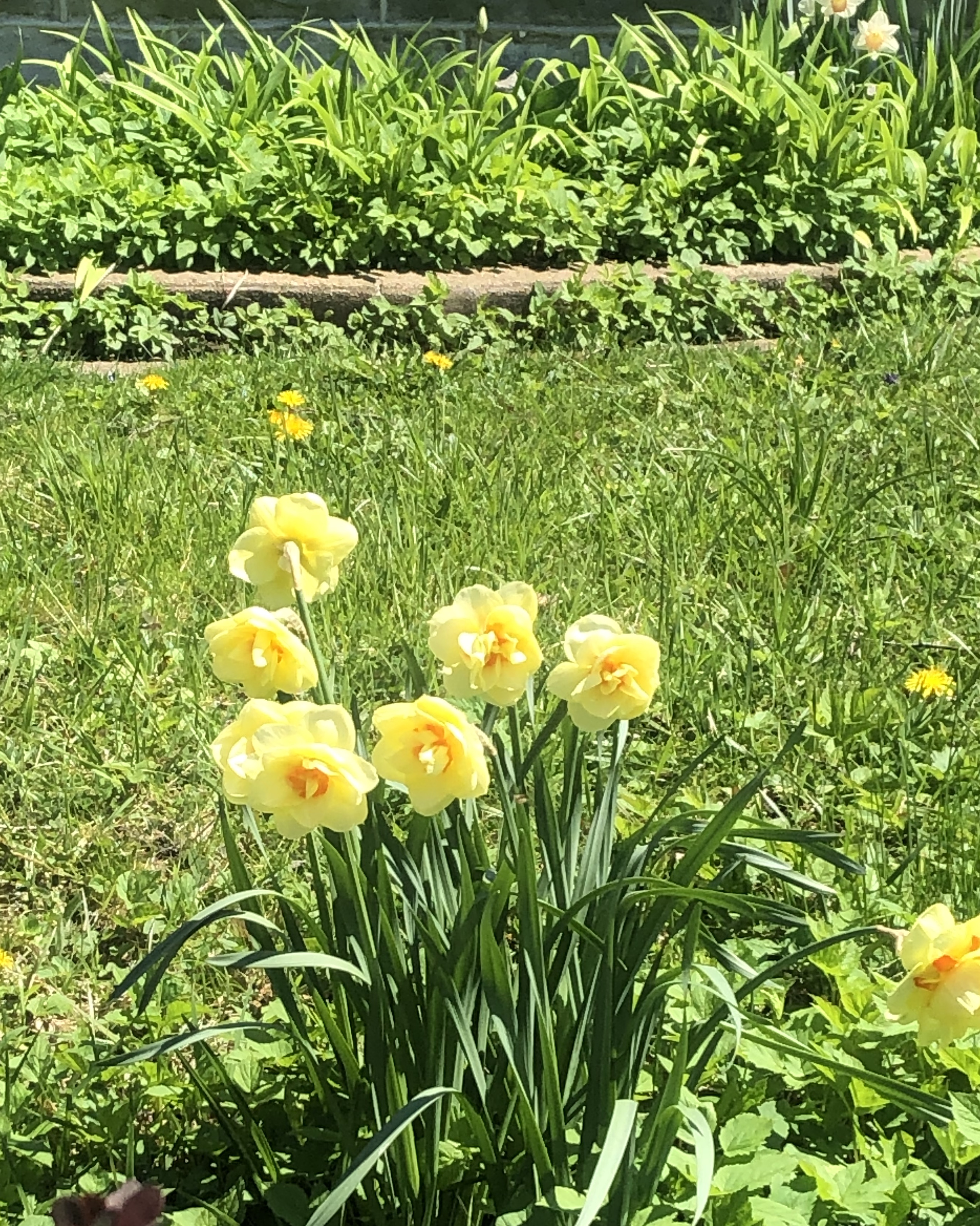
even on daffodil petals.

Barely a block to go and I see

him, having just turned or crossed;

nevertheless, he’s bearing down

on me.  Hands deep in pockets, mask

high, just inches from his hood.

Only eyes to see and be seen:

30 – 40 year old black man eyes.

I recognize a fearful voice, mumbling

in the back of my head:

It’s time to cross, it says, though to cross

the road will take me out

of my way.  I resist it.  I maintain my course.

He’s about my height.  Not quite

as spare.  His mask is black, and

mine is white. As we approach each other

I recognize fear. Fear in his eyes.  Fear of

me. Fear of all the things he thinks I see

when I see a man who looks like him.

Fear of all the things he knows

a woman who looks like me has the power to do.


The things he fears frighten me, too; they repulse me.  I want to smile and say hello.


I summon up a smile, will it into my eyes

and face him, for those seconds it takes me

to pass him.  All I can see is his anxiety,

diminishing.  His eyes grow calm,

his shoulders slack, we share

a nod of gratitude, even

companionship, and then

we both continue on our way.


daffodils

Clem

On this day, December 12, 43 years ago, my great Uncle Clem died.  I’m terrifically grateful to my Uncle Clem.

Clem, who died with the surname Doskey, was my paternal grandmother’s brother.  A sweet man, by all accounts.  He was three years younger than her, born 27 November 1896.   My grandmother always spoke of him adoringly.  I had the impression they were very close as children, and it would appear that closeness continued into their young adulthood.

My grandmother, who I knew as Harriet Hill, married Joe Hill in October of 1917. Some time after that, her beloved brother Clem met Joe’s sister Helen, and in 1922, they married.  Harriet and Joe had one son – my father.  Clem and Helen had a daughter, named Delma.  Delma was about as close to a sister as my father would ever have.

This story is a simple one to tell, for sure.  Or so it would seem.  Actually, this simple tale masks a far more complex set of relationships and lost names.

Clem was baptized Clement Dziedzikowski.  My grandmother had an equally Polish name at birth: Jadwiga Dziedzikowska.  They were two of the seven children of Jan Dziedzikowsi and Pelagia Szweda.  Berea, Ohio Census records show Jan and his family changing their names en masse, around 1900.  At that time, he simplified the last name to Doski.

This information was relatively easy for me to figure out.  Although she never told me any of this while she was alive, my grandmother left me the centennial yearbook for the church the family attended.  Both she and her sister Charlotte appear in a choir picture from the early 1900’s, and the picture is labeled with their real names.  Charlotte, notably, was originally Leokadia.

The bigger puzzle was my grandfather.  I always knew that our surname – Hill – was bogus. My mother had told me so, and she showed me a name – Golembiewski – that she had seen in an obituary once.  “The person who died was your father’s aunt on his father’s side.  So this must be your real name.”  For years, I accepted that as my true name.

Sometime during my 20’s, I wrote to St. Augustine’s Church in Cleveland, where my mother told me my grandparents married.  I asked for their marriage records.  I gave their marriage date, and the names Harriet Doskey and Joe Golembiewski.  The church wrote back to me saying that they had no one by that name getting married on that date, but they did have a Hatti Doski and Joseph Gurzinski.  I set this aside – I was in graduate school and, well, this was not the right name.

It wasn’t until about three decades later that I was introduced to Family Search and Ancestry, and I began poking around looking for my mysterious Polish ancestors.  The name Golembiewski yielded nothing.

Doski, and later Doskey, was more fruitful.  And this is where we get to my gratitude to Uncle Clem, and his wife Helen.  While my grandparents seemed set on erasing their true identity, Clem and Helen were not so inclined.  I found their marriage record. It was for Clement Dziedzikowski.  And Helen’s name – well, for the second time in my life, I encountered the name Gorzynski/Gurzenski.  Helen’s maiden name.

Within that same evening of research, I found Helen’s death certificate, and sure enough – her daughter gave Helen’s maiden name as Gorzynski.

I’d had it all along – my true family name.  But thanks to Clem and Helen, the evidence was secure.  Once I had that name, my quest to rectify our family name was nearly complete.

I would like to say Clem and Helen lived happily ever after, but that doesn’t seem to have been the case.  The were buried in different cemeteries, Helen with the Gorzynskis and Clem with the Doskeys.  They supposedly lived with their daughter when they got older, and my mother reports they didn’t seem all that happy.