I always wanted to be a librarian. Long before I considered getting a Ph.D. so I could teach at the university level, I applied to library school. Then I applied again after I had that Ph.D. and a tenure-track teaching job in a small college in Buffalo. I was thinking this university teaching wasn’t for me.
Both times I applied, I was accepted. The reason I never followed through on library school was because I couldn’t afford it. During the 1980’s and 1990’s, it was easier to get an assistantship to pay for an M.A. in Creative Writing (Syracuse University) and a Ph.D. in Performance Studies (New York University) than it was to get financial aid for library school. An M.L.S. would cost me cash, and I didn’t have it. I had attained my goal of becoming a university professor, and I was broke all the time. That fact in and of itself deserves a blog entry about why the U.S.A. ended up with so many extremely educated coffee baristas. But I digress. This is an entry about how I’ve finally attained my dream job. Librarian. Don’t be deceived, this credential wasn’t earned freely. It only cost $400.00.
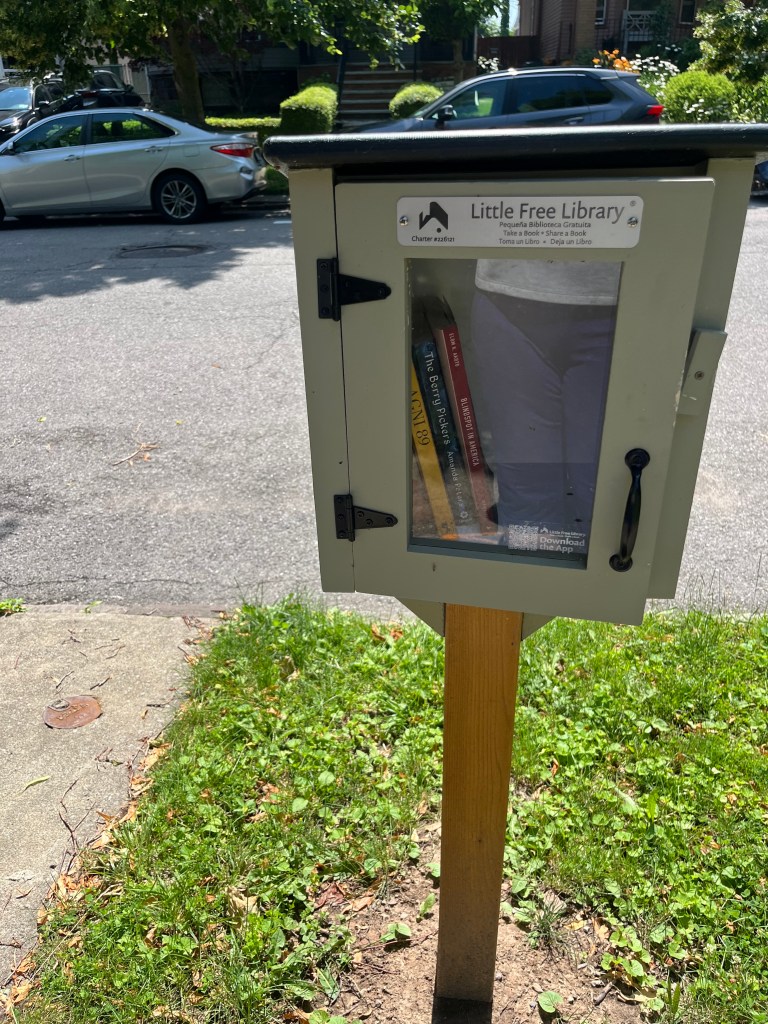
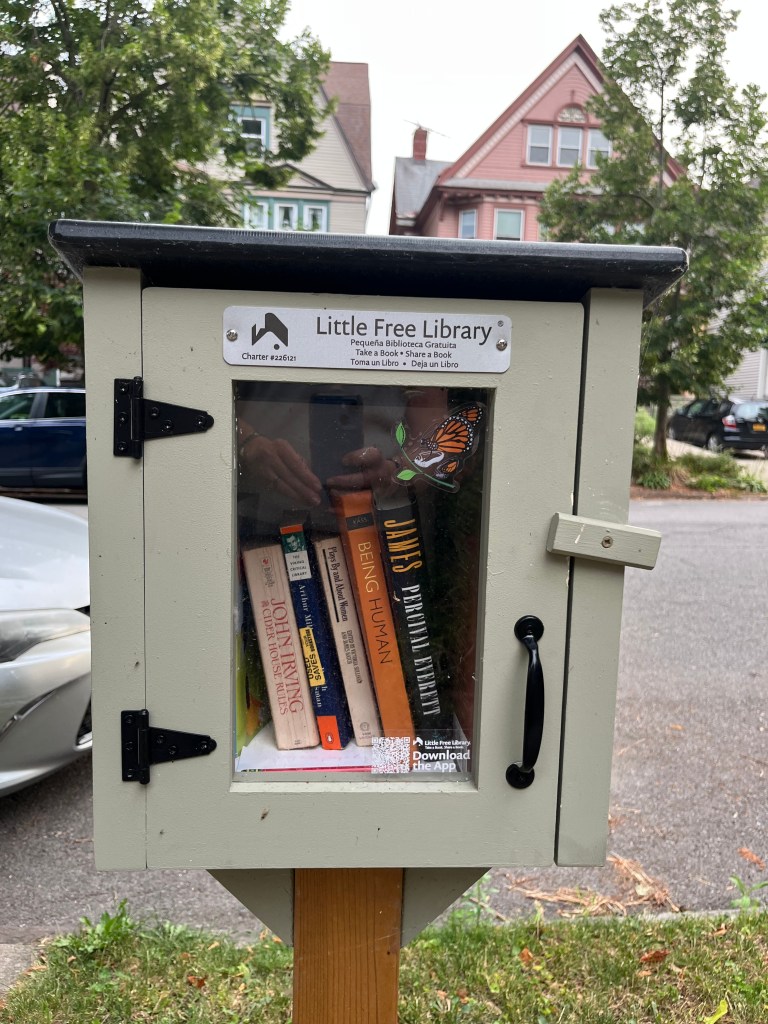
This is my Little Free Library, installed June 13, 2026.
When we installed it our city strip on Buffalo’s West Side, I wasn’t quite sure where to go with it. My husband and I have tons of books, and we think it’s about time to part with many of them. But would the reading material of the previous chapters of our lives appeal to our neighbors? I had a vague sense this little library needed to be curated. But how? What did my audience want to read?
My initial offerings were a stab in the dark. Like many lifetime readers, I don’t know where to begin when it comes to shedding my library. I love my books dearly. Each represents a stage in my life. So, I put out a few volumes of AGNI that I knew I wouldn’t be reading again, and a Pam Johnson-Bennett’s Starting From Scratch: How To Correct Behavioral Problems in Your Adult Cat. I was certain someone would take the cat book. I knew that AGNI was a long shot, but I thought I’d try. Otherwise, I feared I’d have to throw them out.
I sat on my second floor porch and watched, camouflaged by the netting we’d put up to create a cat. Would anyone notice my library? Would anyone stop to browse?
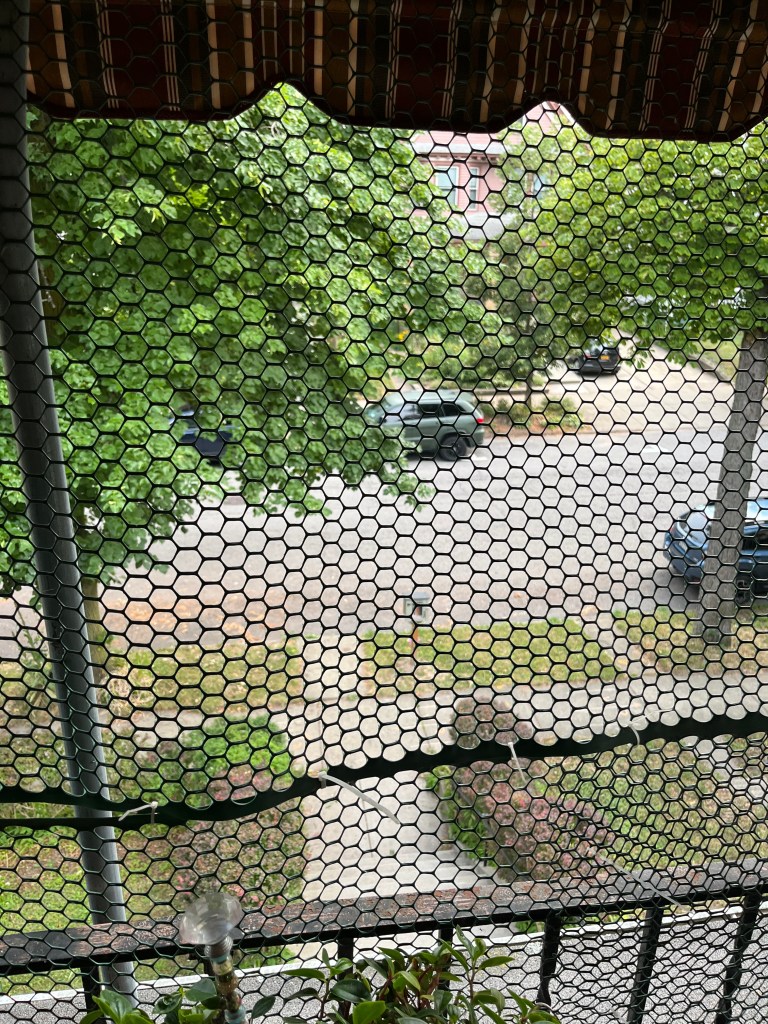
Neighbors out for their evening stroll didn’t notice it at all. Nor did their dogs. Or their children.
Children. I wanted children to look in my library. But what did I have to offer them?
Scanning my children’s books collection, I realized that those that I’ve kept are very dear to me. Doctor Seuss’ Sleep Book and Stormy, Misty’s Foul are stories I once knew by heart. I’m not ready to give them away. Though I never had children, my stepson has two girls, and I have nephews. Who knows? They might want these books. And then I found a book that I’d acquired in a Ten Thousand Villages gift basket I won in a raffle. Mama Panya’s Pancakes: A Village Tale From Kenya. A sweet story, but I wasn’t attached to it. I put it in the Little Free Library, hoping a neighbor child would want it. I also found two coloring books I’d bought a few years ago for the granddaughters. Now young teenagers, they’re not interested in coloring.
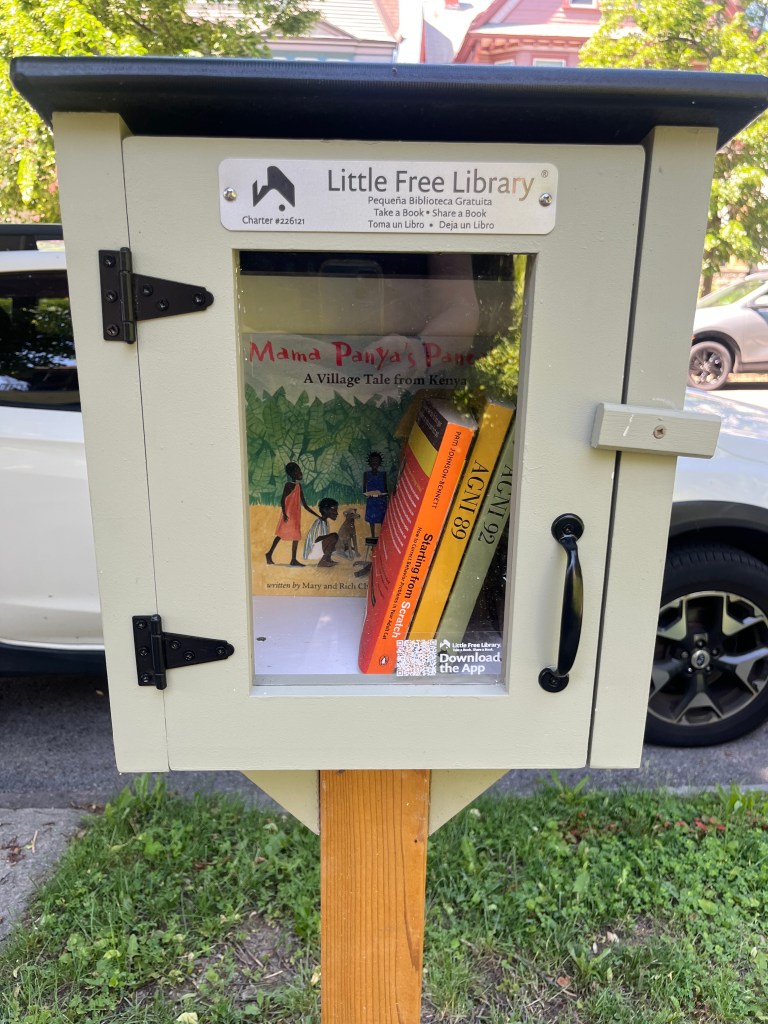
For a couple days, no one even seemed to open the Library door. And then one evening, my husband and I were eating dinner al fresco, out on our second floor porch, when a neighbor and his son walked, very deliberately, from their house two doors away straight to our Little Free Library. They looked at Mama Panya’s Pancakes. They put it back. Then the neighbor said “Look, here’s some coloring books. Do you want them?”
The child shook his head and ran away.
The next morning, the coloring books were gone. And so was one AGNI.
My vision of my immediate community began to take shape. I went to a nearby Family Dollar and bought three more coloring books, as well as a two adult word search books. At the most, they cost $2.00. I figured I could leave one of each out each week.
Within twenty-four hours, they both were gone. As was Mama Panya’s Pancakes. But AGNI remained, as did Starting From Scratch. I found it hard to believe no one wanted the cat book, and, well, I have a lot of old issues of AGNI. If I could find someone interested in contemporary literature, I’d be happy to give more away. If only I could . . .
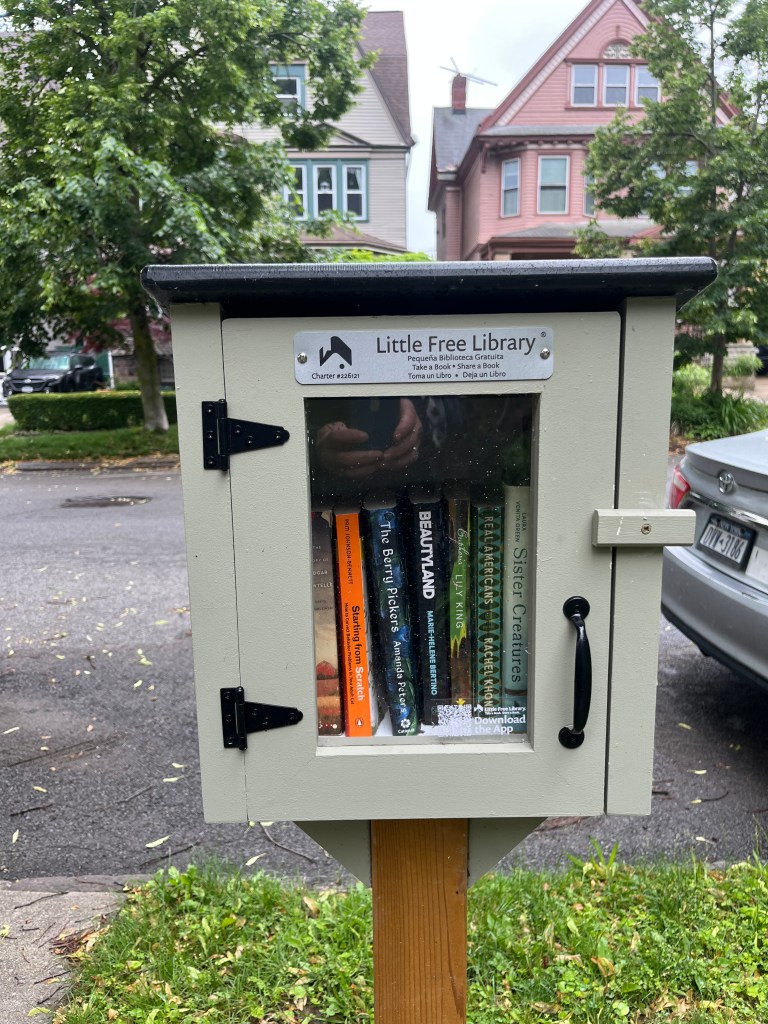
By June 24, I’d begun to scan my books regularly, looking for something I no longer wanted. Like The Story of Edgar Sawtelle, a 2009 Oprah’s pick by David Wroblewski. I’d enjoyed this retelling of Hamlet set in rural Wisconsin when I read it. But I didn’t think I’d read it again. Now armed with the criteria “Loved It But Wouldn’t Read Again,” the picking got easier. Over the past couple years, I’ve been reading voraciously. Some of the titles I’ve read were books I thought might be good “comp titles” for my own novel. I listened to Mary-Helene Bertino’s Beautyland before I read the book, and enjoyed it in both forms. I found much to love in Rachel Khong’s multi-generational family saga in Real Americans. My husband liked it too. But we both were happy to give someone else the pleasure of reading them. So out they went. Other titles, like Laura Venita Green’s Sister Creatures were published by independent presses I thought I might query. I enjoyed Sister Creatures‘ creepiness, and I did indeed query Unnamed Press around the same time I queried Accents Publishing, which will be publishing my novel.
I was spying on my Little Free Library on the day a bookish-looking young woman stopped and snagged Beautyland and Real Americans. I was elated when she slipped them into her backpack. I hoped she’d share Beautyland with a friend after she finished it, as I did, and then have a lively discussion about whether or not the protagonist was really an alien, or simply mad.
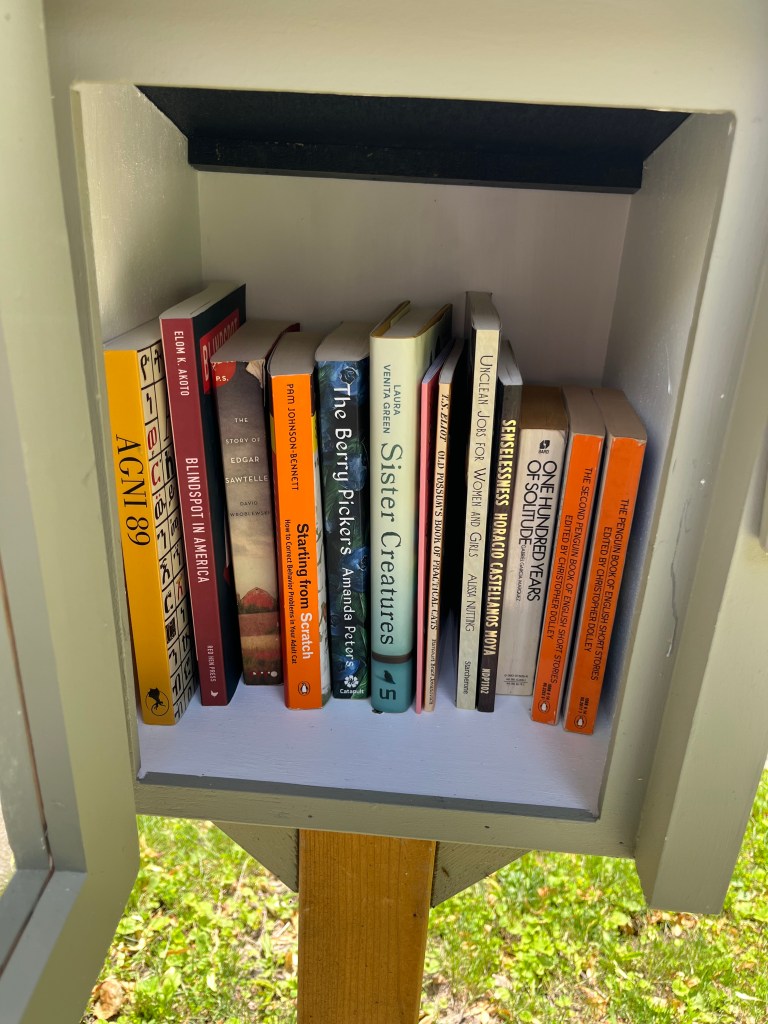
By June 24th, I was adding books that I had doubles of: like T. S. Eliot’s Old Possum’s Book of Jellicle Cats and Gabriel Garcia’s One Hundred Years Of Solitude. And an amazing thing happened: The Berry Pickers by Amanda Peters appeared out of nowhere!
Receiving a book from an anonymous donor raised an ethical question for me: Did that bookish young woman give me The Berry Pickers in exchange for the books she’d taken? Did she think I’d like it? Was I obliged to read it? I took it out of the box and researched it. Google books describes it this way:
“July 1962. A Mi’kmaq family from Nova Scotia arrives in Maine to pick blueberries for the summer. Weeks later, four-year-old Ruthie, the family’s youngest child, vanishes. She is last seen by her six-year-old brother, Joe, sitting on a favorite rock at the edge of a berry field. Joe will remain distraught by his sister’s disappearance for years to come. In Maine, a young girl named Norma grows up as the only child of an affluent family. Her father is emotionally distant, her mother frustratingly overprotective. Norma is often troubled by recurring dreams and visions that seem more like memories than imagination. As she grows older, Norma slowly comes to realize there is something her parents aren’t telling her. Unwilling to abandon her intuition, she will spend decades trying to uncover this family secret. Peters presents a novel about the search for truth, the shadow of trauma, and the persistence of love across time.”–“
IIt was as if the donor realized that I, too, had written a book about family secrets. I added it to my pile of must reads. I even started to read it. Twice. But each time I did, the other books on the pile next to my bed beckoned. The ones I had chosen myself. Ultimately, I decided to let someone else read The Berry Pickers, and if they returned it, I’d try it. (It actually was taken once and returned before disappearing again, that time for good.)
I was delighted when One Hundred Years of Solitude disappeared, within a couple days. I have several copies of it, and I’ve taught the book twice – once while I was teaching in Türkiye, and once after I returned to America. It’s among my ten desert island picks. Garcia-Marquez’s influence on my own writing is profound. When One Hundred Years of Solitude disappeared so quickly, my interest peaked. Who was taking my books? I wanted to meet them.
It was about this time that I decided I was the only person in the neighborhood with a naughty cat. No one wanted Starting From Scratch. It was time to take it out. Maybe put it back later. I also removed Blind Spot in America, one of several Red Hen Press books that I bought before I queried them. I wish I had liked Blind Spot more. I had hoped someone in my neighborhood would be intrigued, but it sat for ten days before it and Starting From Scratch were tossed into a bag for the local U.U. church’s annual used book sale.
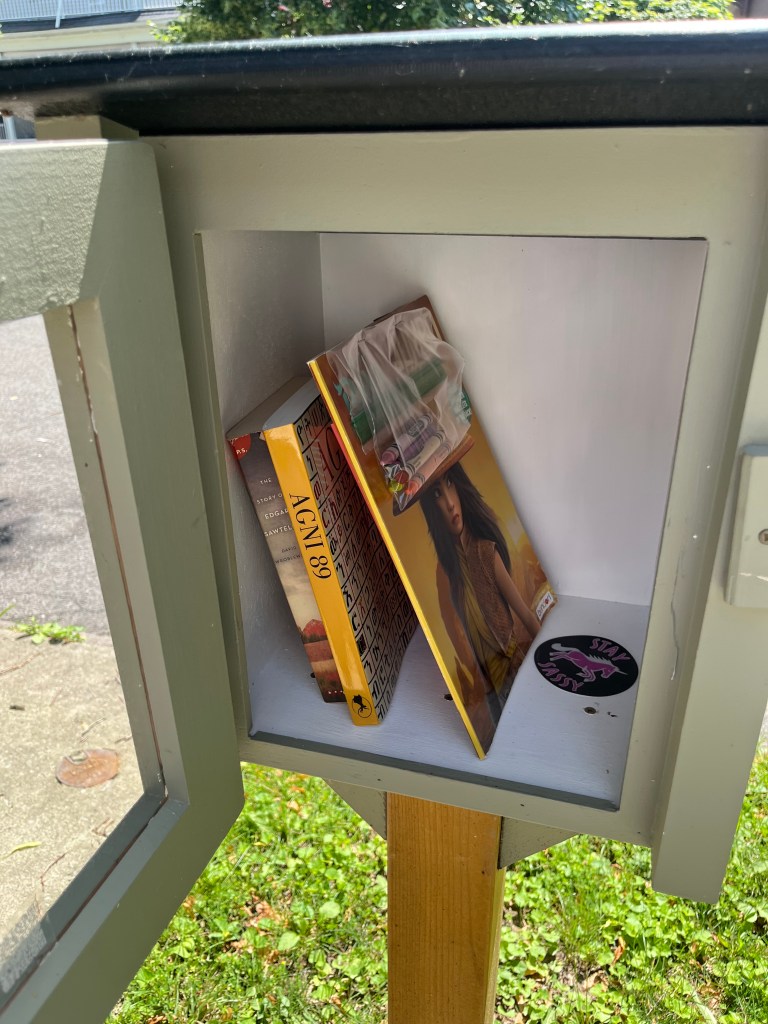
My project to shed anything we wouldn’t use anymore moved into the huge collection of arts and crafts supplies I kept for kids who visited us. We have tons of crayons. More than three 64 color boxes of Crayolas. We could spare a few. I put out a coloring books with a bag of four crayons stapled to it. They were gone within a day, as was the sticker I put next to it. It was at that point I discovered Amazon sold coloring books bulk; I ordered a collection of 25 for $17.00. I’ve been putting them one or two out every week, and I’ve included four crayons with each one.
One day, returning home from running errands, I encountered a man thumbing through my collection. He said hello. He was tall and lanky, with thick glasses and wispy blond hair. He picked up the remaining issue of AGNI. “This is from Boston University, isn’t it?” he asked, and I nodded. “I used to live in Boston,” he said, “and I do love short stories. I’ll see how these are.” We chatted a bit about literature and the neighborhood before he thanked me and walked away.
I don’t know when Edgar Sawtelle disappeared, but it did. As did several other titles. Clearly, I had some neighbors who liked to read. Fantasy was a favorite – I realized that the day several volumes of Neil Gaiman’s Sandman graphic novel appeared. I’d learned about Sandman from one of my former students. I’d read a few of them and liked them. I considered taking them myself, but then they disappeared. A few days later, they returned. Again, I found myself contemplating taking them and sending them to my nephews. I was certain they’d like them.
My husband was trimming the bushes in front of our house the day a young African-American man came hurrying down the sidewalk. He made a beeline to my Little Free Library. “Can I help you?” my husband said. “I came for the Neil Gaiman,” he replied. He gathered them all and hurried away.
Clearly, my Little Free Library was gaining a following, and it looked like people were using it to share books. I saw that happen again when I discovered five of George R. R. Martin’s Game of Thrones books piled inside of it. Four were paperbacks, and one a hardback, and all were huge! They took up all the space in my extremely little Little Free Library. The only other thing I could fit in were coloring books. On July 27, I decided to take four of Martin books out and leave a note explaining what I’d done. My note said: “Dear Readers, Welcome! Thanks for stopping by. . . .
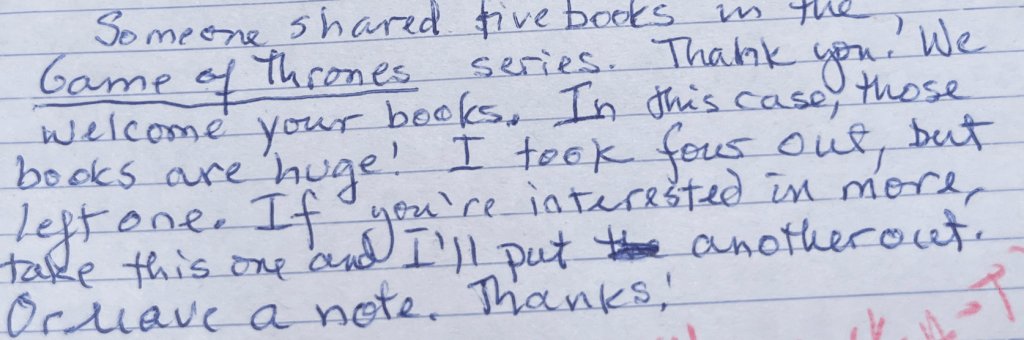
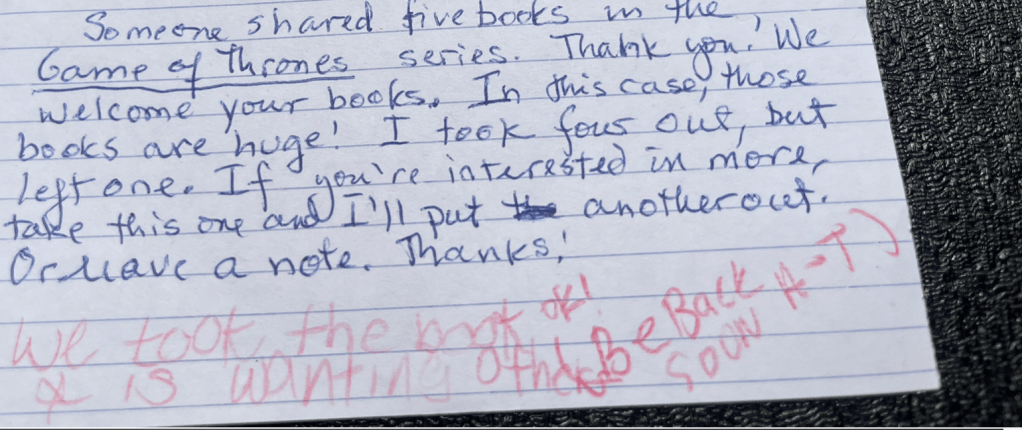
I left a stub of a red pencil beside my note. The next day, I found both the coloring books and Game of Thrones gone, and two different messages added to my note:
Over the next few days, I got rid of all five Game of Thrones books, one at a time, and I began adding more of my own books. I was now beginning to evaluate books I’ve been carrying around for decades. I have quite a collection of fantasy and science fiction that I enjoyed in my early 20’s. I was a terrific fan of Douglas Adams’ Hitchhiker’s Guide to the Galaxy and I bought each sequel as it appeared. I’d love to read them again to figure out why I liked them so much. But I’m also willing to get rid of them. I also have a small collection of non-fiction about popular culture from my undergraduate years as an English major at Cleveland State University in the late 1970’s. One of my favorite instructors taught courses on popular culture and media. The first book I offered up to my current reading public was Greil Marcus’ Mystery Train: Images of America in Rock n’ Roll. That book disappeared overnight, and a new note was added to my card:
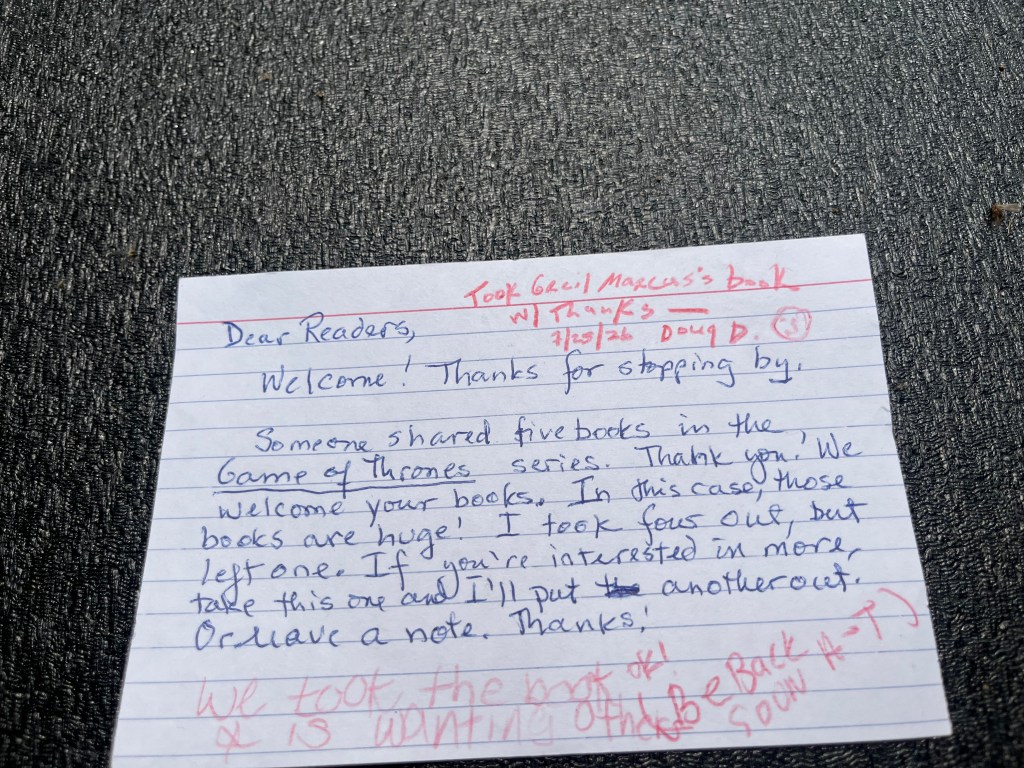
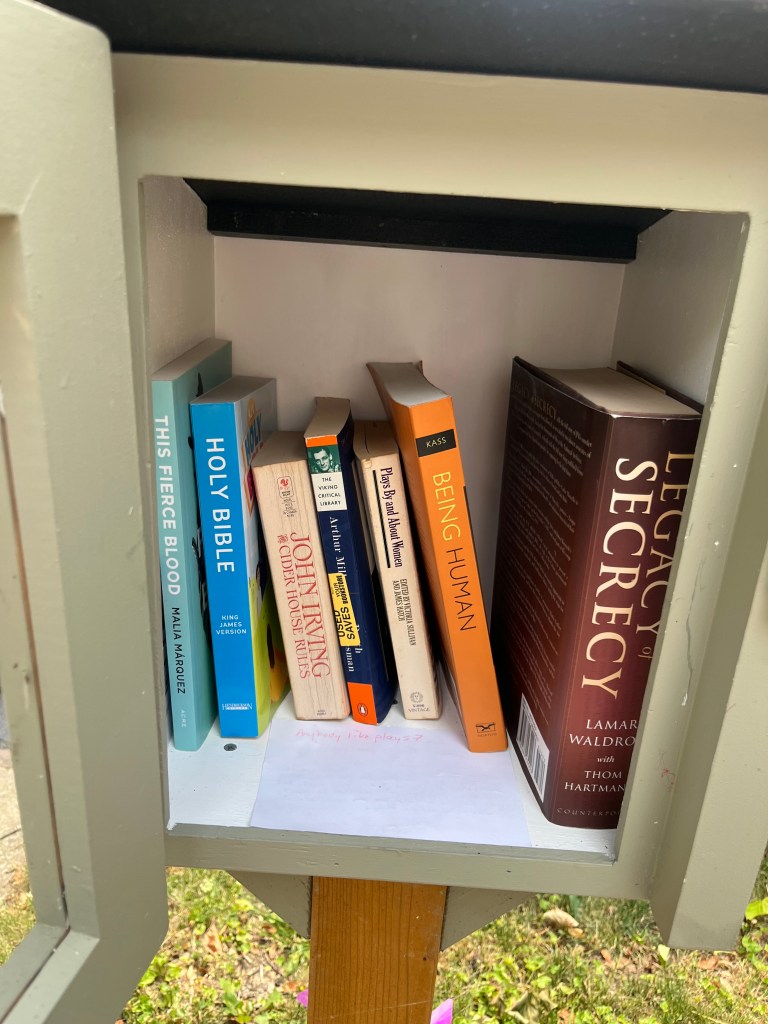
Could it be that my Little Free Library was actually becoming a destination? The Griel Marcus note was dated July 25th. On the 26th, a copy of the Bible appeared, to complement a previous donation by my across-the-street neighbor – Legacy of Secrecy: The Long Shadow of the JFK Assassination and my extra copy of John Irving’s Cider House Rules. The Bible is another desert island pick for me, and I’m not ready to give up my own, so the donated Bible is still waiting for someone who needs it. I also added Being Human, an anthology of classic humanist readings which I’d considered as a possible textbook for a writing course a year or two before I retired. And I began dipping into my vast collection of theatrical play-texts.
About six months ago, I was delighted to find the hard copy edition of Percival Everett’s 2024 best-seller James in someone else’s Little Free Library. I’d been wanting to read it, so I grabbed it. Both my husband and I enjoyed it, but we didn’t need to keep it. Tonight we decided to put it back into circulation. It”s out there tonight, waiting for the next person whose heart will skip a beat when they spy it through the window of my Little Free Library.