Born late in the Baby Boom, I’m among the thousands who retired during COVID. At the end of my academic career, I was the English Program Director at a small liberal arts college. My job grew more difficult as the college shifted its emphasis to business and lowered the bar for acceptance. My last six years were spent designing remedial writing programs and arguing for keeping Intro To Literature courses as a requirement for all undergrads. In retirement, I’m reading for pleasure and writing fiction. An occasional blog entry like this. I swim laps, cook, paint, and research my family tree. Since 2020, traffic has increased in the lap lanes. Most of the new swimmers are my freshly retired contemporaries. Ancestry.com is busier, too. I have more DNA matches. Most of my “hints” lead me to new members of my extended family who finally have time to work on their own family trees. If they’re DNA matches, I know how we’re related: Polish, German, Lithuanian, or Estonian are paternal cousins; Irish, Scottish, English and Western German, are maternal.
No matter where they’re from, my fellow family researchers and I have one thing in common: we are most obsessed with our family tree’s broken branches. Reclaiming them is a bittersweet victory. Yes, we find names and dates of births, marriages and deaths, but we’ll never be able to reclaim the story of our ancestors’ lives.
No family tree is perfect. Each has a few broken branches that mark estrangements, catastrophes, and abandonments. Among my Polish kin, branches lopped off between 1910 and 1930 mark assimilations. At the heart of each assimilation was a translation: a Polish name was replaced by an American equivalent. Identities were translated, too, and originals discarded. Family histories were mythologized and traditions watered down, if they were remembered at all. Stories about family traumas and catastrophes, inherited mental and physical illness, and causes of death were trivialized. Any association with the criminal element was redacted. In Cleveland in 1901, simply being Polish marked an association with Leon Czolgosz, President McKinley’s assassin. The Czolgosz family lived in St. Stanislaus Parish, shopped Polonia’s stores, and banked in Polish banks. My grandfather and his brothers worked in the Newburgh Wire Mills the same time Czolgosz did, and likely drank in Pavel Czolgosz’s pub. For some ambitious young Poles, even the most fleeting association with the assassin was something to write out of their history, even if it meant losing family and friends..
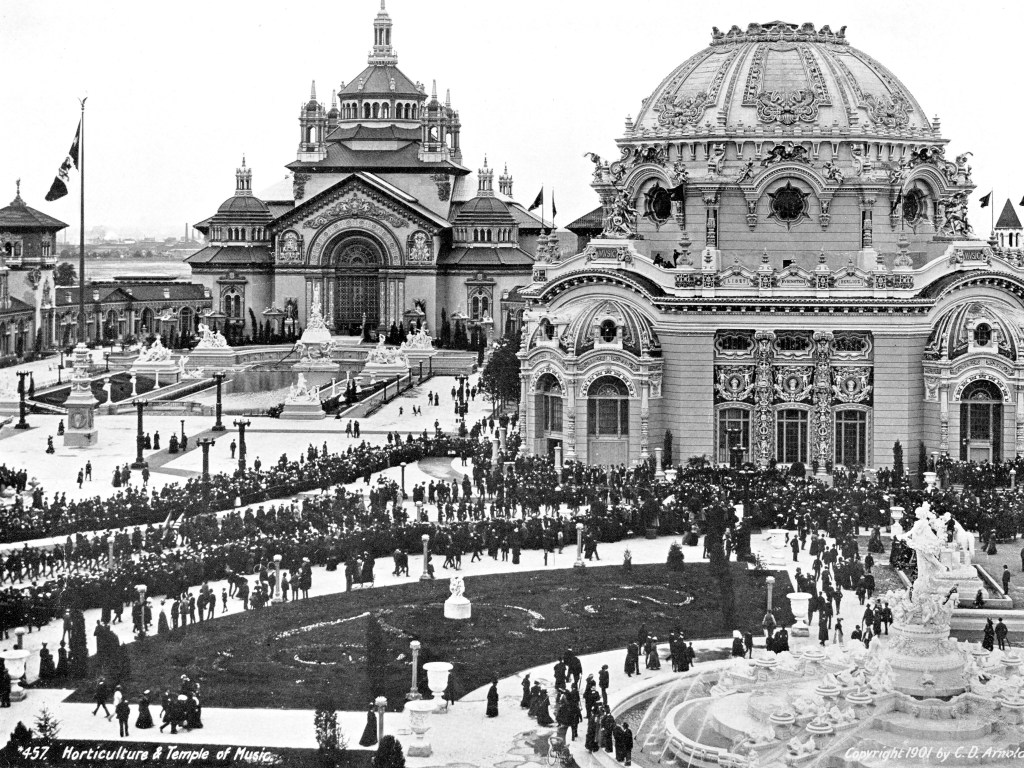
I snagged this photo from a May 20th posting on The Buffalo History Museum’s Facebook page with this description:
“On this day 125 years ago, distinguished guests gathered at the Pan-American Exposition for Dedication Day ceremonies on May 20, 1901. This remarkable view captures the procession entering the Temple of Music, led by Vice-President Theodore Roosevelt, as thousands of spectators lined the grounds to witness the occasion.
“The grand architecture seen here — including the Temple of Music and surrounding exhibition buildings — reflected Buffalo’s emergence onto the international stage at the dawn of the twentieth century.
Buffalo’s Pan American Exposition aimed to rival, if not outshine, Chicago’s World’s Columbian Exhibition of 1893. And it did, with an added dash of infamy: in the middle of the afternoon on September 6, 1901, the Temple of Music was the setting for an assassination. The Cleveland Plain Dealer headline summed it up precisely: BETWEEN LIFE AND DEATH: President McKinley shot twice at the Pan-American Exposition by Leon Czolgosz,Who Went To Buffalo From Cleveland. Czolgosz was caught immediately. McKinley lingered until September 14. During his convalescence, Buffalo’s Polonia reportedly held nightly vigils, praying for his survival. They knew what was at stake. If the president died, pre-existing national scorn towards them would turn to rage.
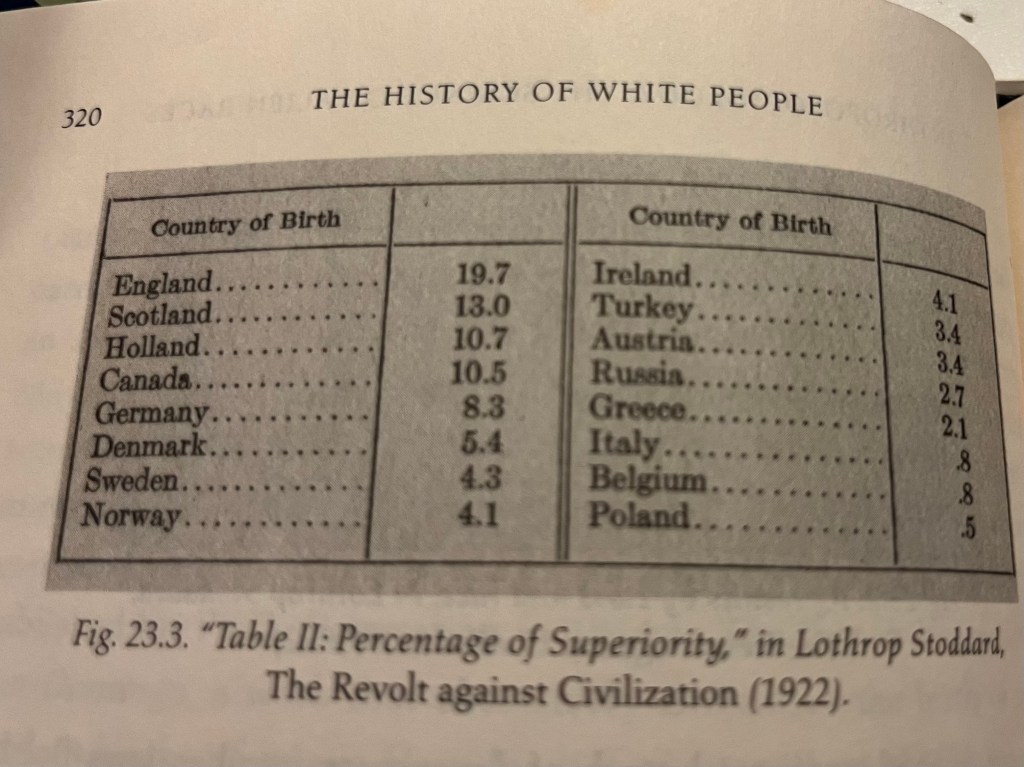
They were right. After McKinley died, anti-Polish sentiment increased. In 1922, the white supremacist demographer Lathrop Stoddard published The Revolt Against Civilization: The Menace of the Underman, in which Poles were among the nationalities identified as Undermen. Nell Irvin Painter calls Stoddard’s book “really an attack on the working class.” “His table showing “Percentage of Superiority” puts the English at the top and the Poles at the bottom.” ( Irvin Painter, Nell. 2010. History of White People, page 320)
How many family tree branches snapped under the heavy weight of collective retribution for Czolgosz’s crime and the growing prejudice against Slavs that followed it? In his 2024 Am-Pol Eagle article, Robert Strybel says, “Today’s Polish-American community according to various estimates numbers between 9 and 12 million. If Americans who are part-Polish are included, the total figure may be as high as 18-20 million. The overwhelming majority of them, perhaps as many as 95 percent, trace their Polish roots to the huge wave of bread-seeking emigrants who flocked to America’s shores between roughly 1870 and 1921 when the U.S. adopted an anti-immigration law.” (Robert Strybel, “For Better Or Worse: . . , Polonia’s Peasant Heritage,” Am-Pol Eagle 20 April 2024) Strybel continues with “Nearly all of the bread seekers were peasants, which has a negative ring to it only in English-speaking countries.”
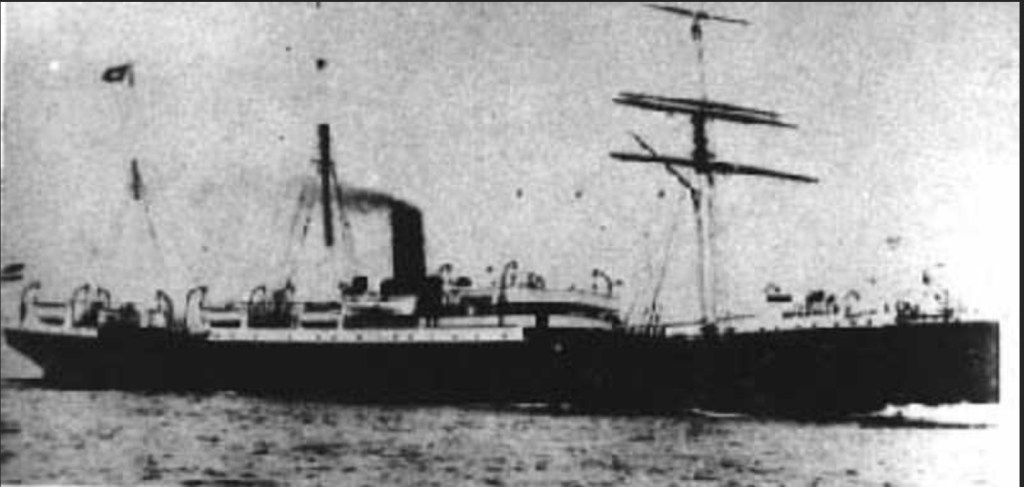
In September 1883, my great-grandmother Franciszka Górzyńska and her eleven-month-old daughter crossed the Atlantic aboard the S. S. Rugla to join her husband, Marian. He had preceded her the year before and found a job as a laborer in Pennsylvania’s coal mines. Did he warn her about the hatred she’d face in the United States? I’ll never know. Perhaps they hoped they could rise above it. Together, they hoped to build a new life and grow their family in America’s land of opportunity. By 1910, the census claimed Marian was literate and able to speak English. Neither applied to his wife. The 1930 census – the last to report Franciszka, now widowed – claimed she spoke only Polish and was still illiterate. She died in 1939, in Cleveland’s Polonia, the only place she felt safe. Notably, her Polish-born daughter never assimilated. She married another Pole and moved to the Polish community in Lorain, Ohio. But four of my great-grandmother’s seven American-born children assimilated. The other three died young of tuberculosis.
I’m two generations removed from my immigrant ancestors. Two generations is more than enough time to erase the story of their immigration. All it took was another migration – to the suburbs – and a name change. Once in their new home, my newly named grandparents accumulated legal documents that featured their new names. They lost any that contradicted it. In this way, they rewrote themselves as white Americans, while erasing their Polish sources completely.
When my grandparents assimilated, they didn’t account for the grandchildren who would demand the truth. They didn’t account for the internet.
Nor did they realize they might change their minds before they died. I believe my grandmother wanted to tell me about her parents and her Polish childhood before she died but couldn’t find a way to do it. Just as a child carries her community’s bullying, my Polish grandmother carried the social bullying of her childhood in her soul. Two years before she died, she admitted to being Polish, though she insisted her father was aristocracy. (Not true: he was a peasant.) One evening, during my weekly visit to grandma, she opened the cupboard door underneath her kitchen sink and showed me a box of cookbooks. She told me to take them after she died. When I finally collected them, I discovered two special gifts. A Polish cookbook and the centennial celebration for St. Adalbert’s Polish Church in Berea, Ohio, which included photographs of grandma’s mother, who was the first baptism in that church, and of grandma and her sister in the church choir. Reading their Polish names, it was as if she spoke to me from the grave, saying: Here you go. This is what you’ve been asking for.
I have since learned much about Poland’s proud history. My grandmother’s collected photographs and books suggest she knew that history, too. She’s probably happy to know I belong to three genealogical societies and two historical societies now. I chose my memberships deliberately, including every city my Polish ancestors lived in.
The Polish Genealogical Society in America (PGSA)
The Polish Genealogical Society in Western New York (PGSNYS)
The. Polish Genealogical Society of Greater Cleveland (PGSGC)
The Nanticoke Historical Society
Each of these organizations publish quarterly newsletters containing information about the experiences my ancestors had in America. My favorite articles are those written by members who grew up in my family’s neighborhood.
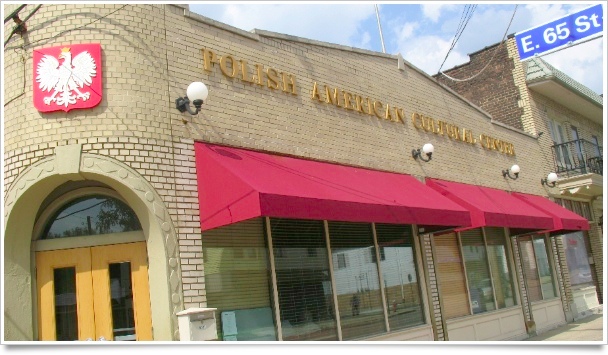
One of the topics Polish Genealogical Societies rarely mention is the flood of young people who left Polonia in the 1910’s and 1920’s. Family historians tracing those broken branches have to make their own way. I would argue we’re born traumatized, carrying traces of our parents’ and grandparents’ imposter syndrome, to varying degrees. The children and grandchildren of those who remained in Polonia and maintained its cultural center and churches, flaunt their first-hand knowledge of their family histories and the Polish language. Many went to Polish school. They grew up in St. Stan’s, either in Buffalo or Cleveland. The beer they stole from their dads as a teen-ager was Okocim or Żywiec. With names like Golembiewski, Tulchowski, Falkowski, Prus, Stankiewicz, their Polish sweatshirts are retro and worn, marking Dyngus Days of yore. But they carry scars too: of growing up Polish when every late-night comic’s sure-fire laugh began with the words “How many Polaks does it take to . . . ?” The child of Polonia’s hard-earned authenticity exacerbates the imposter syndrome suffered by the children of the assimilated. The newness of our Polish paraphernalia is noticeable. Most of us have never celebrated the Polish Christmas Eve, or Wigilia. If we wanted to, we have no clue where to get the required wafer called opłatek. Our surnames are Hill, Green, Jones, O’Malley, Rossi. Some names mark mixed marriages. The short, bland, or odd are translations. My Polish paternal great-grandfather’s surname was Górzyński. In Polish, “góra” means mountain or hill. After 38 years as Jozef Górzyński, my grandfather changed his name to Joe Hill. A friend of mine, who grew up a Zeilinski, reports there are many Greens in her family tree. Why Greens? Zeilin means green.
My family tree’s most interesting name translation occurs among the children of my great-grandfather’s elder brother, Jan. From what I can tell, Jan died a Górzyński, but several of his children opted to translate themselves into something new. Rather than become Gore or Hill, they chose Bergman. Is this truly an assimilation, or is it a matter of finding a more acceptable foreign identity? It’s definitely a translation: “berg” is German for “mountain or hill.” Several of my grandfather’s Bergman cousins moved to Los Angeles and lived unremarkable lives, unlike their brother, who became a well-known shop keeper in Buffalo’s Polonia.
Some name translations were simply truncations. They removed offending “-ski” but remained true to their surname’s root. For instance, my grandfather’s younger brother Eddie changed Górzyński to Gore. Eddie married a Polish woman who never changed her name, and they lived in or near Polonia. His siblings gave him the power of attorney after their mother died; he handled her burial and the sale of the family home. Details about Eddie’s life suggest he could “pass” in white America, he always kept one foot in Polonia. A similar pattern occurred for my friend born Zeilinski; she shortened her name to Zeilin for work purposes but spoke Polish at home with her parents. In these two cases, where the individual kept the root of their surname but omitted the “ski,” they never lost their ability to translation between Polish and English or English and Polish, depending on their situation.
I am from a family that translated the root of their surname and distanced themselves from their immigrant community. Photographs tell me Eddie and my grandfather stayed in touch. I imagine when Eddie came calling, he and my grandfather spoke the Polish version of Spanglish, littered with inside jokes only accessible to the similarly bilingual. That didn’t include my father. He probably learned a few phrases or curses, with no reference to their sources. In this way, the Górzyński family branch began withering. By the time my father had children of his own, his stories and jokes came solely from radio shows and television. He never spoke of his Uncle Eddie or his father’s mother, and rarely spoke his father. The branch had fallen.
When the inner-city Irish girl who became my mother began dating that tall handsome Hill boy from the suburbs, my maternal grandmother called a friend who lived in the same community as my father’s family. That woman reported that the Hills were odd ducks. Especially her – the mother. My grandmother. With her olive-colored skin and deep piercing brown eyes and lisp that I now suspect was an accent, no matter how hard she tried to “pass” in her Anglo community, Grandma Hill stood out. With no authentic Americans to guide her assimilation, she made it up. Using the beloved silent and early talkie movies she adored as sources, she “translated” motherhood and family into what she imagined was the perfect script for a middle-class American family.
Migration forces us into a state of translation – of language, of customs, of self. That translation evolves as long as both source and target language are maintained. Once the family settles into their target language, the source begins diminishing until it dissolves. All that is left is the translation. A translation is only as good as the translator herself, and if it’s not tended, it gets watered down as it passes from one generation to the next. Which is what happened in my family.
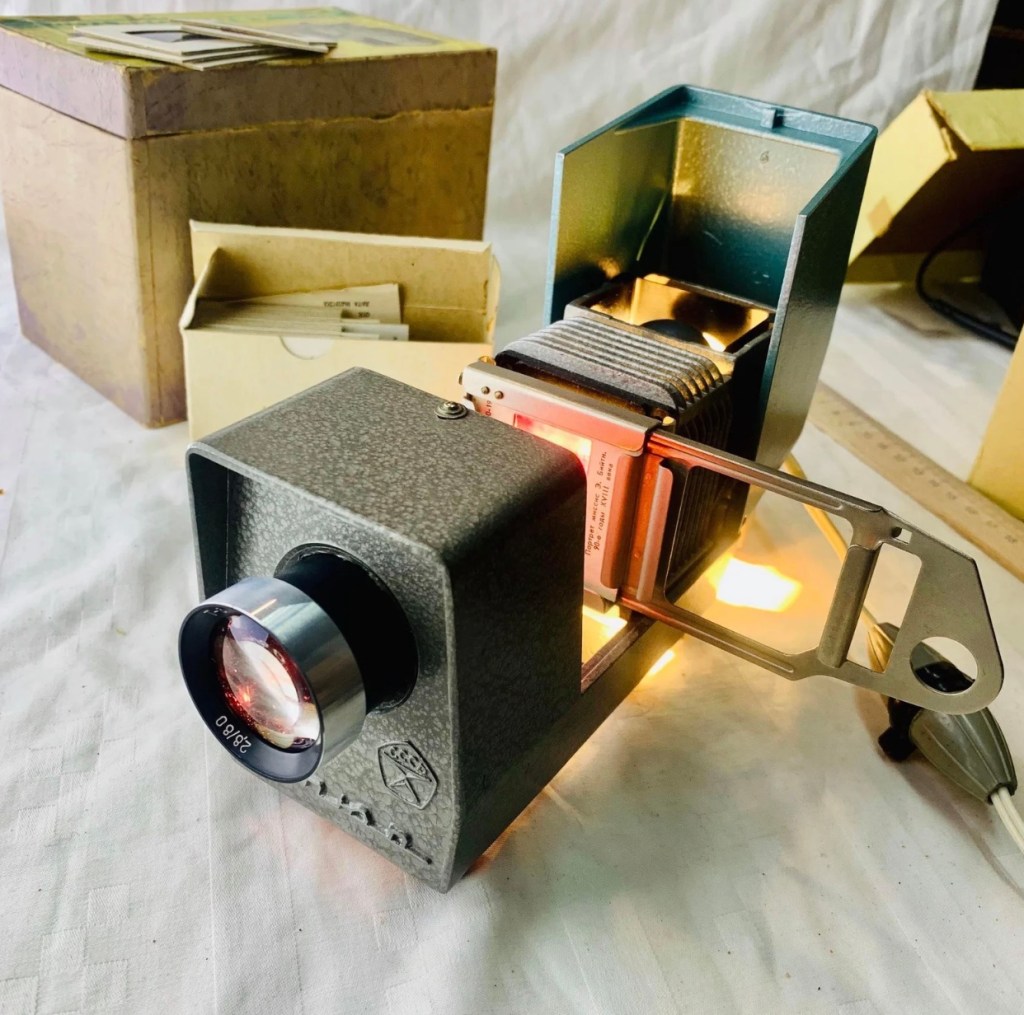
There’s a specific photo that I’d like to end with. I’ve been looking for it, but I can’t find it. Like all the photos documenting my childhood, it’s a slide. And my slide projector is broken. So I’ll have to describe it. This photo was taken Easter Sunday, 1980 or 1981, two or three years after my father died. Dressed in styles influenced by The Brady Bunch and Seventeen magazine, my four siblings and I wear brightly colored mini-skirts and flared-leg trousers. My brother and I both have permed our straight dishwater blond hair into a ridiculous attempt at an Afro. We all hope we’ve created our best facsimile of what we’ve seen on television, but we’re passing clumsily. What’s apparent is that we know we’re imposters, not really meant to inherit the American Dream. We learned that lesson with certainty the day our fifty-one-year-old father, tormented by his inability to pay his monthly bills and saturated with gin, suffered a massive heart attack in our living room.
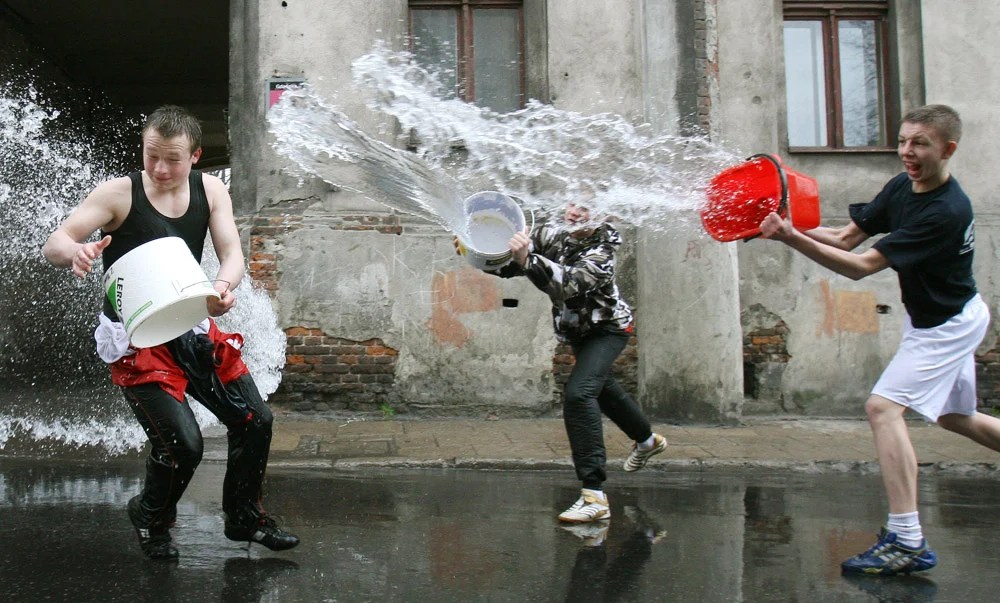
As uncomfortable as my siblings and I are in this photo, the most uncomfortable among us is our Grandma Hill. She stands off to one side. Dressed in a long grey coat that she clutches closed, with her hair in a plastic babushka and a dazed expression in her eyes, she looks like she’s thinking: How did I get here? She’s twenty years older than I am now (Grandma died when she was 90). At sixty-seven, I already know how she was spending her private hours: remembering and re-evaluting her life’s choices. And I wonder if she was wishing that she’d introduced us to the pageantry of a Polish Easter and the playfulness of Dyngus Day. We might have been having more fun that Easter Day, if only we’d known how to do it.